


There's a pattern that appears reliably in AI teams serious about data quality: they invest in internal annotation QA, build out a reviewer team, establish review processes — and then find, six to twelve months later, that operations have become harder to manage, not easier.
Throughput is slower than expected. Delivery timelines slip. Reviewers disagree on edge cases. And every time dataset volume increases, the response is the same: hire more reviewers.
The assumption is reasonable. More qualified reviewers should improve quality. More capacity should accelerate throughput. But annotation operations don't scale the way most teams expect — because labeling throughput and QA coordination complexity scale at very different rates. Adding reviewers increases capacity linearly. Coordination overhead — keeping reviewers aligned, managing escalations, maintaining ontology consistency — grows faster. At a certain point, a team spends more energy managing its QA operation than actually improving data quality.
The real question this article addresses isn't simply "in-house or outsourced?" It's whether the workflow architecture itself is designed to scale — and that applies equally to internal teams and external vendors.
Why internal annotation QA systems initially feel efficient
Before diagnosing where internal QA breaks down, it's worth being honest about why teams start there in the first place. The decision to handle annotation quality internally isn't naive — it reflects real operational advantages that exist at smaller scales.
In-house annotation workflows work well at smaller scales
When datasets are manageable and teams are small, internal annotation QA has genuine strengths. Communication loops are short. Domain experts are directly accessible. Ontology adjustments can be made quickly without a vendor coordination layer. Feedback cycles between annotators and reviewers happen in the same room or the same Slack channel. Problems surface fast and get fixed fast.
For early-stage AI teams iterating quickly on model architecture, that speed and proximity is genuinely valuable. The overhead of managing an external annotation partner — onboarding, alignment, communication cadence, QA governance — can outweigh the benefits when datasets are still relatively small and requirements are changing week to week.
None of this is a reason to avoid internal QA. It's a reason to understand the conditions under which it works well.
The hidden assumption most teams make about scaling
The issue isn't that internal QA starts well. It's that most teams carry one assumption into scaling that quietly breaks their operations: that QA is fundamentally a headcount problem.
Under this assumption, scaling annotation quality means scaling reviewer count. The workflow stays the same; the team gets larger. But annotation QA isn't purely a labor problem — it's a coordination and systems problem. As reviewer count grows, so does the complexity of keeping those reviewers calibrated to the same standards, resolving disagreements consistently, maintaining ontology governance, and preventing the gradual drift in interpretation that accumulates across a large distributed team.
More reviewers, applied to an immature workflow architecture, don't solve the scaling problem. They make the coordination problem bigger.
The operational problems that appear as annotation QA teams expand
The transition from manageable internal QA to operationally fragile internal QA tends to be gradual and then suddenly obvious. These are the specific problems that surface as QA teams expand.
Reviewer coordination becomes exponentially harder
In a small reviewer group — three to five people working closely together — alignment is relatively easy to maintain. Disagreements surface quickly, get resolved in conversation, and the resolution is immediately shared. Everyone is working from the same mental model of the ontology.
As the team grows, that alignment becomes harder to sustain. Reviewers in different time zones, working across different batches, start developing subtly different interpretations of edge cases. A label that one reviewer accepts as correct, another flags for rework. Escalations that should be rare become routine. Management spends increasing time recalibrating reviewers rather than improving the quality of the data itself.
This isn't a failure of individual reviewers. It's a structural property of large distributed teams without systematic calibration mechanisms. The coordination overhead is a feature of the team size, not the team quality.
QA overhead quietly starts consuming gains
The second compounding problem is subtler but equally damaging. As more reviewers are added to handle growing dataset volume, the review process itself accumulates more layers. Escalation paths get longer. Disagreements require more management time to resolve. QA queues — which should be getting shorter as capacity increases — stay roughly the same length because the volume of work requiring attention grows alongside reviewer count.
At a certain inflection point, QA becomes slower than labeling itself. The annotation pipeline has a bottleneck, but it's not on the labeling side — it's on the review side. And because the response to slow QA has been to add more reviewers, the team keeps adding fuel to the wrong fire.
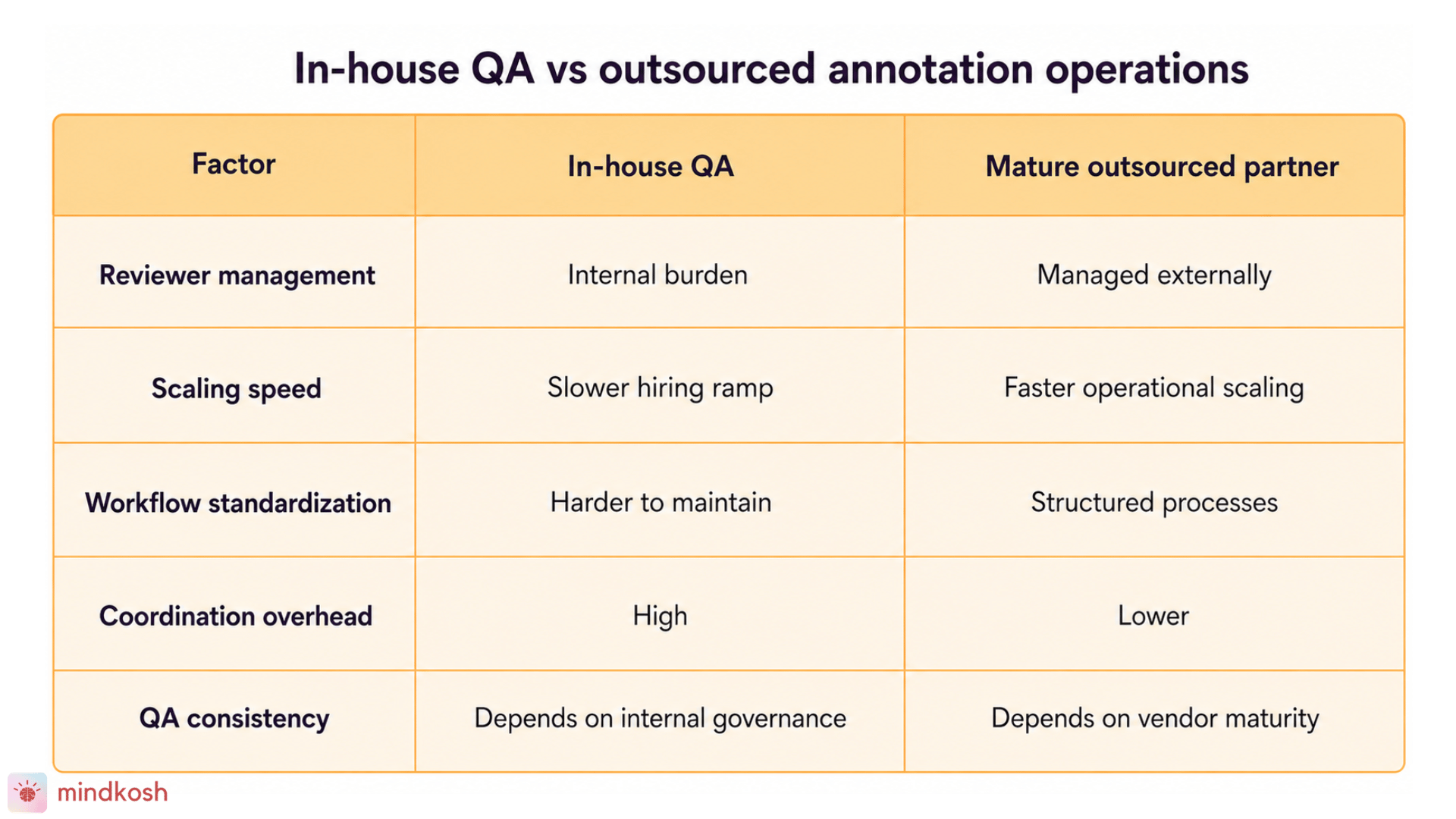
Industry data consistently shows that annotation rework — labels that need to be corrected and re-reviewed — can add 20–50% to base annotation costs when QA systems are poorly structured. When those rework cycles compound across large reviewer teams, the operational cost compounds with them.
Delivery timelines become harder to predict
The downstream consequence of coordination complexity and QA overhead accumulation is delivery unpredictability. When QA cycles are inconsistent — when some batches move quickly and others stall in escalation loops, when reviewer availability determines throughput more than workflow design does — timelines become impossible to forecast with confidence.
For ML teams, that unpredictability has real costs. Model development timelines slip when training data isn't ready. Stakeholder confidence erodes when annotation delivery estimates are consistently unreliable. And operations leaders find themselves managing annotation as a source of organizational friction rather than a reliable input to the development pipeline.
This is typically the point where teams begin seriously evaluating external data labeling services. The internal operation has become harder to manage, not easier, despite continued investment in reviewer capacity.
Why some outsourced data labeling services fail too
This is the section that most vendor-produced content skips — and skipping it is exactly why that content loses credibility with experienced operations leaders. Outsourcing annotation QA doesn't automatically solve the problems that internal scaling creates. Many external providers fail in the same ways, and for the same reasons.
Cheap labor alone does not solve annotation scalability
The commodity end of the data labeling market is large, and it's tempting when internal QA costs are growing. The pitch is straightforward: offshore reviewers at a fraction of the internal cost, high throughput, fast turnaround.
The operational reality, frequently, is different. Commodity annotation vendors optimise for reviewer volume rather than workflow maturity. QA governance is weak or absent. Reviewer training is inconsistent. Ontology alignment is poor. Escalation systems are reactive rather than structured. And when quality problems surface — as they reliably do — the vendor's response is to add more reviewers to the review process, which reproduces the same coordination problems the team was trying to escape.
The three things operations leaders most fear about outsourcing — losing quality control, unreliable delivery, and operational opacity — are all legitimate concerns when the vendor's model is fundamentally a labor supply business rather than a workflow maturity business.
The difference between labor vendors and operational partners
The distinction that matters in evaluating external annotation services isn't cost per label or reviewer count. It's whether the vendor brings workflow architecture alongside reviewer capacity.
Mature annotation partners don't just provide people to review labels. They provide calibration systems that keep reviewers aligned at scale. They provide structured escalation logic that handles edge cases without requiring management intervention on every exception. They provide QA governance frameworks that maintain consistency across batches. And they provide operational visibility — the ability for clients to see what's happening in the pipeline without having to manage it directly.
The difference in outcomes is significant. A labor vendor scales your reviewer count. A mature annotation partner scales your annotation operation — which is a meaningfully different thing.
Mindkosh is designed around the second model: scalable workflow orchestration, systematic reviewer alignment, and operational consistency that holds up as dataset volume and complexity grow — without requiring clients to manage the coordination burden themselves.
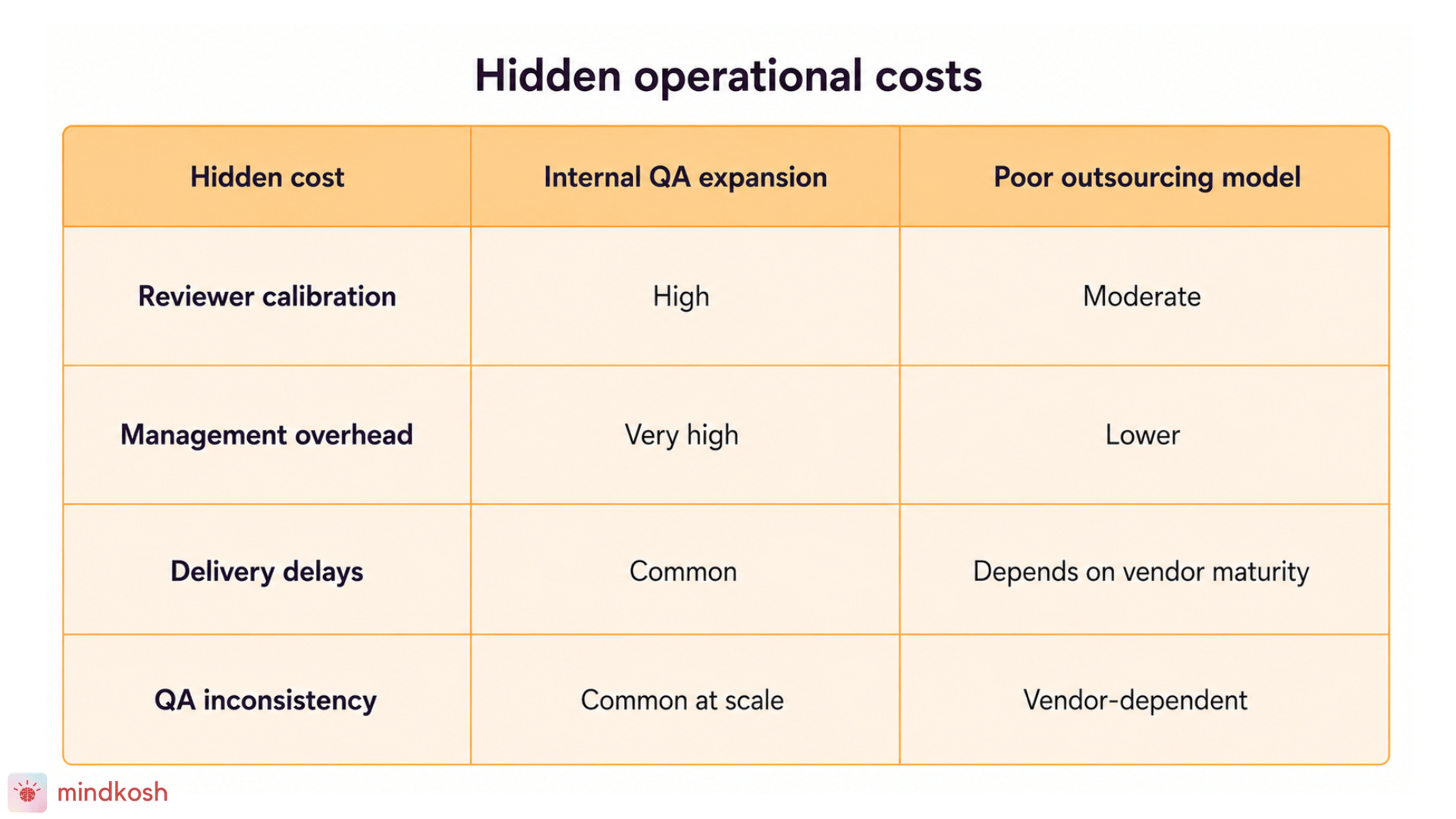
In-house annotation QA vs outsourced data labeling services — what actually scales better?
With the failure modes of both models understood, the honest evaluation can happen. Neither in-house QA nor outsourced annotation services is categorically better. The scalability advantage depends on specific operational conditions.
The real scalability advantage is coordination efficiency
The framing of "in-house vs outsourced" tends to focus on cost and control. Those are real considerations. But the factor that most determines whether an annotation operation scales efficiently is coordination efficiency — how much management overhead is required to keep reviewers calibrated, escalations handled, and delivery consistent.
Internal teams with strong workflow architecture and systematic calibration can scale coordination efficiently. External vendors with mature QA systems can do the same. Internal teams without those systems, and external vendors without them, both struggle in predictably similar ways.
Operational maturity scales better than reviewer headcount. That's the principle — and it applies regardless of whether the reviewers are internal or external.
When in-house annotation workflows still make sense
There are genuine scenarios where keeping annotation QA internal is the right operational decision:
Highly sensitive datasets where data governance requirements make external access difficult or impossible. Extremely niche domain expertise where reviewers require specialized knowledge that external vendors realistically can't provide or build quickly. Small, fast-moving teams in early-stage iteration where the speed of internal feedback loops outweighs the coordination benefits of external workflow maturity. Organizations with the resources and operational discipline to build proper internal calibration systems, ontology governance, and QA architecture from the start.
None of these are reasons to avoid evaluating external options. They're conditions where the tradeoff genuinely favors internal operations.
When outsourced annotation operations become operationally advantageous
The conditions that favor mature outsourced annotation partners tend to cluster around scale, complexity, and management capacity:
When dataset volume is growing faster than internal hiring can accommodate. When QA overhead is consuming throughput gains despite ongoing reviewer expansion. When internal management strain is pulling team capacity away from model development. When delivery inconsistency is becoming a recurring problem. When the coordination burden of a growing reviewer team is creating more operational problems than it's solving.
In these conditions, a mature annotation partner doesn't just offload the labeling work. It offloads the coordination complexity — the calibration overhead, the escalation management, the ontology governance — that was consuming internal capacity. The result is often not just lower cost per label but lower total operational overhead.
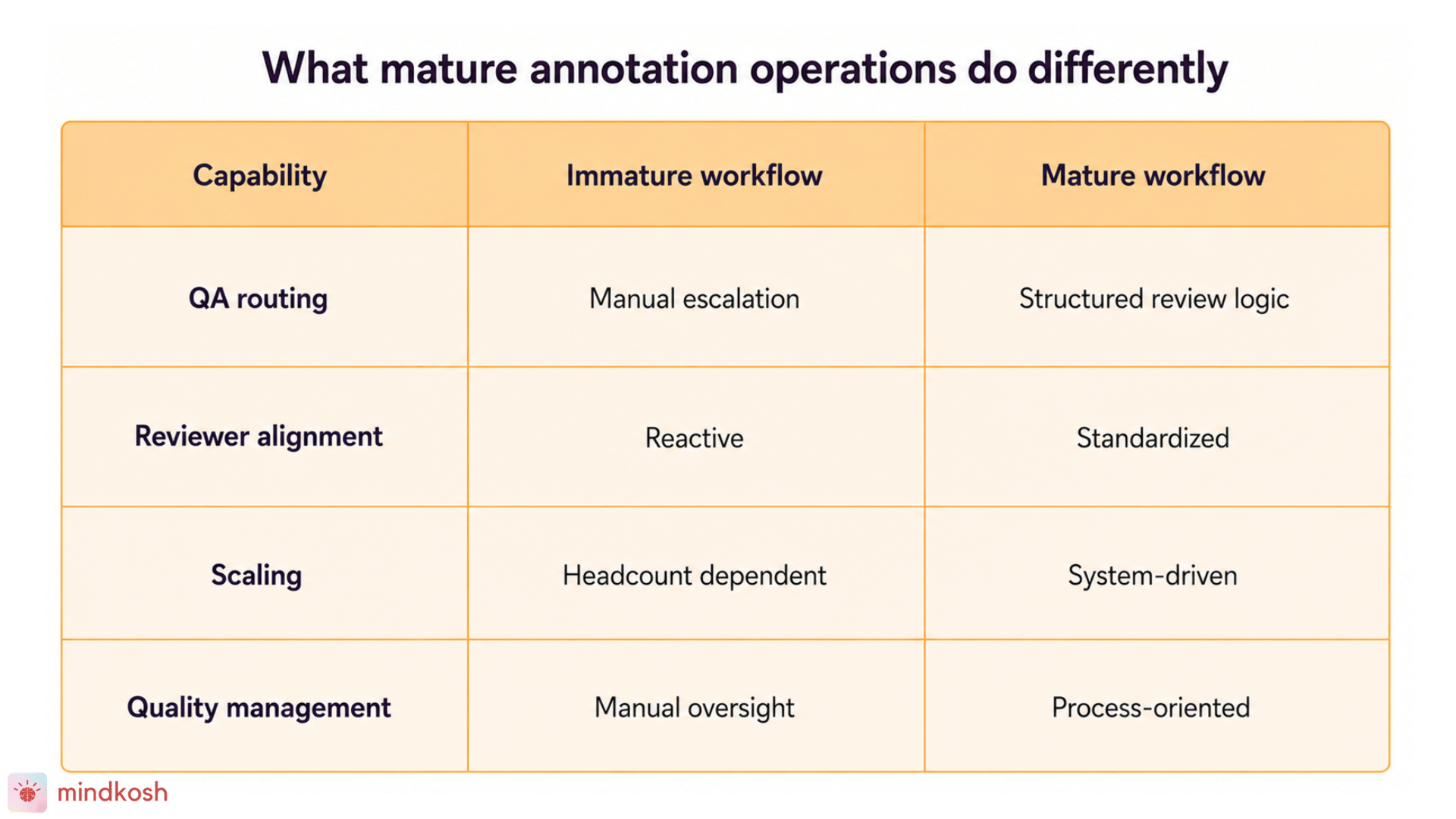
What mature annotation operations do differently
Whether the operation is internal or external, the annotation workflows that scale efficiently share a set of structural characteristics. These aren't aspirational best practices — they're the operational mechanisms that prevent coordination complexity from outpacing throughput.
Structured QA routing instead of reactive review escalation
In an immature workflow, escalation is reactive. A reviewer encounters an uncertain label, flags it, and waits for a manager or senior reviewer to resolve it. That path works at small scale. At large scale, it creates queues, delays, and dependency on specific individuals whose availability determines throughput.
In a mature workflow, escalation is structured. Confidence thresholds determine which labels go to which review path automatically. Ambiguous cases follow documented escalation logic rather than informal judgment calls. Edge cases that have been resolved before are routed to documented decisions rather than re-escalated. The system handles the routing; humans handle the judgment.
Reviewer calibration becomes systematic
Reviewer disagreement in mature annotation operations isn't treated as an individual performance problem — it's treated as a calibration signal. When two reviewers reach different conclusions on the same label, the response isn't to correct one reviewer. It's to examine whether the ontology definition is clear enough, whether the calibration process is working, and whether the resolution should update the guidelines.
This means disagreement tracking is a designed feature of the workflow, not an afterthought. Calibration sessions are scheduled, not reactive. Ontology updates follow a governance process. The system continuously corrects itself rather than accumulating drift.
Workflow systems matter more than reviewer volume
The central insight of operationally mature annotation is that quality at scale is a systems problem. A well-governed workflow with clear ontology definitions, structured escalation logic, and systematic calibration will consistently outperform a larger, less structured team — not because the reviewers are better, but because the system doesn't allow quality to drift and doesn't require constant management intervention to stay on track.
The implication for operations leaders evaluating their own annotation workflows — or evaluating external annotation partners — is direct: the question to ask isn't "how many reviewers do they have?" It's "how does their system prevent coordination complexity from compounding as volume grows?"
How to evaluate whether your annotation workflow is scaling efficiently
Whether you're assessing your internal QA operation or evaluating an external annotation service, these questions surface the operational health of the workflow faster than any vendor pitch or internal assumption.
Questions operations leaders should ask internally
- Is QA workload growing faster than annotation throughput, or is it stabilizing as volume increases?
- Are reviewer disagreements increasing, decreasing, or holding steady across batches?
- Are delivery timelines becoming less predictable as the team grows?
- Is management overhead rising proportionally with reviewer team size?
- Are relabeling cycles becoming more common rather than less?
- Does scaling dataset volume require a proportional increase in reviewer hiring?
- When edge cases are resolved, does that resolution prevent the same cases from recurring?
If several of these questions surface known problems, the workflow likely has structural inefficiencies that additional headcount won't resolve.
Questions to ask annotation service providers
- How is reviewer calibration handled at scale — and how is drift detected and corrected?
- How are edge cases escalated, documented, and prevented from recurring?
- How is QA consistency measured and reported across batches?
- How are workflows standardized, and how do they adapt when client requirements change?
- How does the vendor reduce coordination overhead rather than simply absorbing it internally?
- How are delivery timelines stabilized when dataset volume or complexity increases?
- Can the vendor demonstrate operational consistency on production-scale data — not just pilot examples?
These questions distinguish mature annotation partners from commodity labor vendors quickly. Vendors with strong workflow systems answer them specifically. Vendors without them deflect to reviewer count and cost per label.
Mindkosh's QA process
At Mindkosh, mature QA processes are supported through random quality sampling and structured audit checks that continuously evaluate annotation consistency across reviewer groups. Instead of relying only on final-output review, quality validation is embedded throughout the workflow lifecycle.
Workflow systems matter more than reviewer volume
One of the clearest indicators of operational maturity is recognizing that annotation quality at scale is fundamentally a systems problem.
A workflow with:
- structured QA routing
- strong ontology governance
- calibration mechanisms
- audit visibility
- escalation logic
- multi-layer validation
will consistently outperform a larger but loosely managed annotation team.
Not because the reviewers themselves are inherently better, but because the system prevents quality drift, reduces coordination overhead, and minimizes dependency on constant managerial intervention.
This changes how operations leaders should evaluate annotation workflows — whether internal or outsourced. The key question is rarely “How many reviewers are available?”
The more important question is:
How does the workflow prevent inconsistency, escalation bottlenecks, and quality drift as scale increases?
That is usually where mature annotation operations separate themselves from workflows that begin to break under growth.

Conclusion
The in-house vs outsourced framing is a useful starting point, but it tends to send operations leaders looking for the wrong answer. The real scaling challenge isn't which model to choose — it's whether the workflow architecture, in either model, is designed to handle coordination complexity as dataset volume grows.
Internal QA teams that invest in calibration systems, structured escalation logic, and ontology governance can scale efficiently. External annotation partners with those same capabilities can do the same — often faster, and with lower management overhead for the client team. Internal teams without those systems, and external vendors without them, both produce the same operational outcomes: growing QA bottlenecks, inconsistent delivery, and annotation overhead that consumes capacity rather than creating it.
If your annotation operations are becoming harder to manage as QA expands — if coordination overhead is growing, delivery is becoming unpredictable, and reviewer disagreements are increasing rather than decreasing — the issue is likely workflow architecture, not the in-house vs outsourced decision itself.
Mindkosh is built for teams that have reached that inflection point. As a quality-first AI annotation platform and managed service, Mindkosh combines structured QA workflows, systematic reviewer calibration, and scalable operational architecture — so annotation operations become more efficient as dataset volume grows, not less. For teams working with complex, multi-modal data across images, video, LiDAR, and sensor fusion use cases, Mindkosh provides the workflow maturity that makes annotation a reliable input to ML development rather than a recurring source of operational friction.
If QA overhead is expanding, delivery timelines are slipping, and reviewer coordination is consuming management capacity — the issue is likely workflow architecture rather than reviewer count and we might be able to help with that.
FAQs
Should annotation QA be handled in-house?
It depends on operational scale and maturity. In-house QA works well when datasets are manageable, communication loops are short, and domain expertise is easily accessible. But as reviewer teams and dataset volumes grow, coordination complexity often outpaces throughput gains — especially without strong calibration systems, escalation logic, and ontology governance.
When should companies outsource data labeling services?
Outsourcing becomes valuable when dataset growth outpaces hiring, QA overhead slows throughput, or management strain starts pulling focus away from model development. The best outsourcing decisions are operational maturity decisions — choosing a partner with structured workflows that reduce coordination complexity and improve delivery consistency.
What are the risks of outsourced annotation operations?
The main risks are inconsistent quality control, unreliable delivery processes, and limited operational visibility. These issues usually stem from commodity labor vendors rather than mature annotation partners with structured QA systems, calibration processes, and transparent workflows.
How do you evaluate AI data annotation services?
Evaluate vendors based on workflow maturity, not just cost or reviewer count. Key indicators include reviewer calibration processes, escalation handling for edge cases, QA consistency tracking, ontology change management, and proven quality at production scale.
What makes an annotation workflow operationally mature?
Mature annotation workflows rely on structured QA routing, systematic reviewer calibration, active ontology governance, and strong feedback loops between reviewers, QA teams, and model development. The goal is to focus human judgment where it adds the most value.
How can annotation teams reduce coordination overhead?
Teams reduce coordination overhead by investing early in calibration infrastructure, documenting escalation logic, implementing confidence-based review routing, and maintaining clear ontology governance processes. When internal coordination becomes difficult to scale, mature annotation partners can absorb much of that operational complexity.
Is your annotation operation becoming harder to manage as it grows?
If QA overhead is expanding, delivery timelines are slipping, and reviewer coordination is consuming management capacity — the issue is likely workflow architecture rather than reviewer count.
Mindkosh works with ML teams and operations leaders on exactly this: building annotation workflows that scale efficiently through structured QA systems, systematic reviewer calibration, and operational processes that hold up as dataset volume and complexity grow.
We work with complex, multi-modal data — images, video, LiDAR, point clouds, and sensor fusion — and we run free pilots on real production data, not toy examples. So you can evaluate operational consistency before committing at scale.