


Most annotation vendors can tell you how they’ll scale your datasets. Far fewer can tell you how they’ll scale your costs.
That gap is where annotation budgets break down. Not in a single expensive invoice, but gradually, through a series of operational realities that were never surfaced during vendor evaluation: QA rounds that weren’t quoted, revisions that weren’t defined, internal management time that nobody budgeted for, edge cases that required escalation, scaling complexity that nobody modeled.
The standard procurement conversation — compare capabilities, compare pricing, pick the most credible option — is designed to evaluate what a vendor can do. It’s rarely designed to evaluate how predictably they’ll do it. And at scale, predictability is the variable that actually determines whether your annotation program stays on budget.
Most outsourcing conversations focus on capabilities, pricing, and speed. Smart buyers focus on predictability — because predictable operations are what create predictable budgets.
This article gives you eight questions that shift the evaluation from what vendors offer to how operationally mature they are so you can assess annotation partnership fit over the long term. Each question is designed to surface a specific category of cost risk that standard RFP processes routinely miss. Use them before you sign, and you’ll have significantly more control over what your annotation program actually costs.
Vendor quotes rarely tell you the full cost of annotation outsourcing
A quote reflects a vendor’s cost estimate under the conditions they’re imagining at the time they write it. Once a project begins and those conditions shift — which they almost always do — the quote stops being a useful forecast. What it never was, from the start, is a total cost estimate.
Comparing vendor pricing alone creates false confidence
Custom pricing dominates annotation outsourcing. Vendors quote based on assumptions about annotation type, dataset complexity, expected accuracy, and delivery pace. Those assumptions get made once, at the beginning of a sales conversation, under conditions that rarely hold for the life of a project.
What happens in practice: project scope evolves. Taxonomy definitions get refined. New object classes appear. Accuracy requirements tighten as model performance gets measured. The vendor’s quoted rate often stays fixed while everything else changes. Buyers who treated that quote as a budget ceiling discover, months later, that it was only ever a starting estimate.
Comparing quotes across three vendors gives you a sense of market pricing. It gives you very little information about which vendor will be the least expensive to actually operate with over twelve months.
The operational variables that quietly drive annotation costs
The factors that most consistently create budget surprises aren’t in any quote. They live in the operational layer of how annotation work gets done:
- QA effort — how many review rounds does the vendor’s standard workflow include, and what triggers additional rounds?
- Reviewer expertise — specialized annotation requires calibrated reviewers, and calibration has a cost that rarely appears in per-label pricing.
- Revision cycles — when annotation falls below quality thresholds, who owns rework and is it included in the quoted rate?
- Project management overhead — how much internal coordination does the vendor’s operating model require from your team?
- Edge-case complexity — ambiguous instances, label disagreements, and novel object types create escalation costs that no upfront quote accounts for.
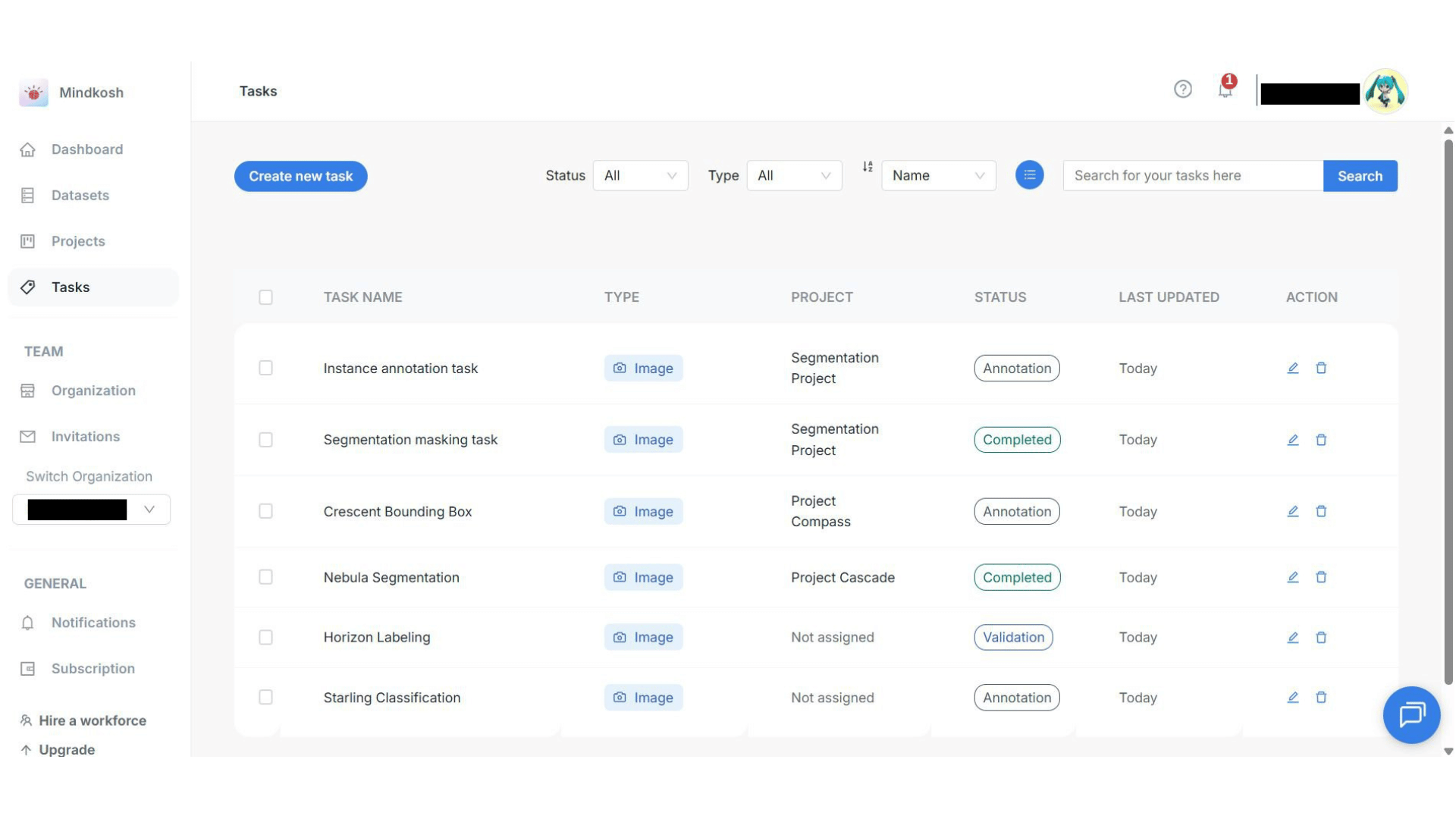
These aren’t hidden fees in a deceptive sense. They’re operational realities that have been experienced. These aren’t hidden fees in a deceptive sense. They’re operational realities that experienced annotation teams plan for and less experienced ones treat as surprises after they occur. At Mindkosh, all annotations are done through the platform, which allows for more predictable costs as scale increases.
The 8 questions buyers use to protect future annotation budgets
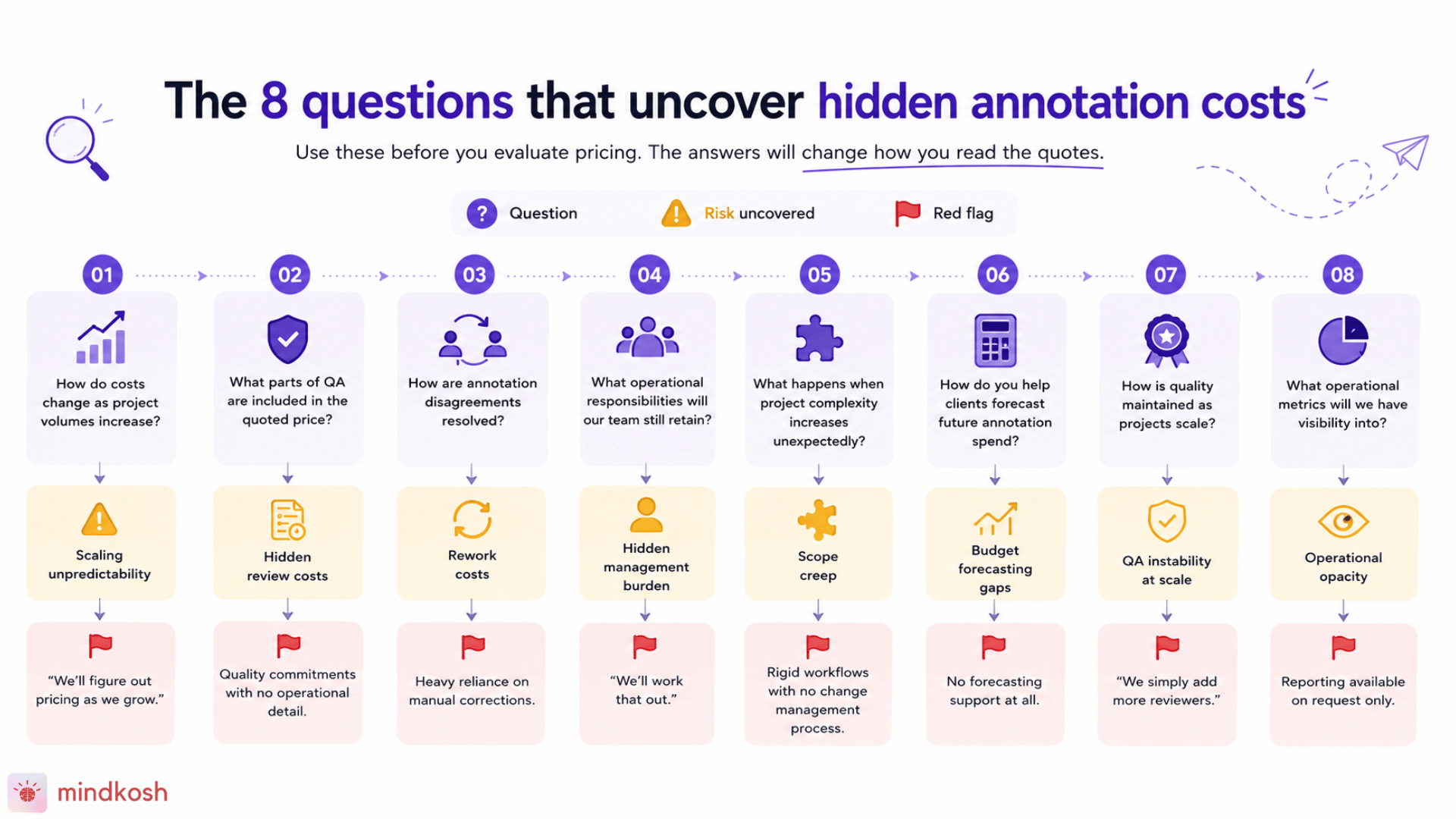
The questions below aren’t interview prompts. They’re diagnostic tools. Each one is designed to expose a specific operational risk area that standard vendor conversations skip. A vendor who answers them clearly and specifically is demonstrating operational maturity. A vendor who deflects, generalizes, or defers is revealing something important about how their model actually works.
Use these before you evaluate pricing. The answers will change how you read the quotes.
1 How do costs change as project volumes increase?
Risk uncovered: Scaling unpredictability.
Most buyers understand their starting costs. Almost none understand their scaling costs. These are fundamentally different numbers, and the gap between them is where annotation budgets most commonly fracture.
A vendor quoting a per-label rate for a 50,000-image dataset is working from assumptions about team size, workflow complexity, QA load, and tooling that may not hold at 500,000 images. When those assumptions shift, so do costs — and if nobody discussed that dynamic during evaluation, the buyer absorbs the surprise.
What to look for: explicit pricing tier structures, clear explanations of how workflow complexity changes with volume, and direct acknowledgment of where scaling creates new coordination overhead. Vendors with predictable scaling have modeled it. They can tell you how it works.
Red flag: “We’ll figure out pricing as we grow.” This means scaling costs haven’t been modeled, and you’ll discover them through invoices.
2 What parts of QA are included in the quoted price?
Risk uncovered: Hidden review costs.
Quality assurance is consistently one of the most underestimated cost drivers in annotation outsourcing. Vendors structure QA differently: some include multiple review rounds as a standard part of their workflow; others treat additional rounds as billable scope. The quoted rate rarely makes this distinction clear.
The specific questions that matter: How many review rounds are included in the base price? Who performs QA — the same annotator pool or a separate reviewer tier? What happens operationally when annotation accuracy falls below your agreed threshold? Is rework billed separately or absorbed?
Vague quality guarantees — “we deliver high-accuracy annotations” without operational specifics — are a signal that QA costs haven’t been clearly defined. Ask how quality is measured and maintained, not just promised.
Red flag: Quality commitments with no operational detail. An accuracy guarantee with no defined measurement process or rework policy is not a quality guarantee.
3 How are annotation disagreements resolved?
Risk uncovered: Rework costs.
Every annotation project encounters disagreements: different annotators apply different labels to the same instance, class boundaries turn out to be ambiguous at scale, or reviewer interpretations drift over time. How a vendor resolves those disagreements determines how much invisible rework accumulates across a dataset.
Mature annotation operations have defined systems for this: consensus protocols, reviewer calibration schedules, escalation hierarchies, or ML-assisted adjudication for ambiguous cases. Less mature operations handle disagreements manually and reactively — which creates inconsistency and costs that compound as volume grows.
Ask specifically: What is your process when two annotators label the same instance differently? Who adjudicates ambiguous cases? How do you prevent label inconsistency from drifting across large annotator teams over time?
Red flag: Heavy reliance on manual corrections with no systematic calibration process. This works at small volumes and breaks at scale.
4 What operational responsibilities will our internal team still retain?
Risk uncovered: Hidden management burden.
Outsourcing annotation doesn’t eliminate operational ownership. It redistributes it. Teams that sign outsourcing contracts expecting to hand off the work entirely routinely discover that they’re spending significant internal time on vendor communication, QA review, approval workflows, and coordination overhead that nobody budgeted for.
The question isn’t whether your team will retain responsibilities — they will. The question is whether those responsibilities are clearly defined before the contract is signed, or discovered incrementally after the project begins.
What to ask: What does a typical client relationship look like week-to-week? What ongoing involvement do you expect from our side? Who owns QA approvals — your team or ours? What does the communication model look like as volume scales?
Red flag: Operational responsibilities left undefined during evaluation. Anything described as “We’ll work that out” becomes internal overhead after signing.
5 What happens when project complexity increases unexpectedly?
Risk uncovered: Scope creep.
Annotation complexity doesn’t grow at the same rate as dataset size. A taxonomy that seems well-defined at pilot scale reliably surfaces edge cases, novel object types, and ambiguous class boundaries as annotation volume increases. Vendors with rigid operating models handle this poorly — and when they do, the cost falls on the buyer.
What you’re evaluating here is flexibility. Can the vendor incorporate taxonomy refinements mid-project without disrupting throughput? Do they have defined escalation pathways for novel annotation types? How does increased complexity affect pricing, and how is that communicated to clients in advance rather than after?
Vendors who’ve built annotation programs at scale have encountered every version of this problem. Their answers will be specific and operational. Vendors who haven’t will give you reassuring generalities.
Red flag: Rigid workflows with no change management process. Complexity that the vendor can’t adapt to becomes complexity that your budget absorbs.
6 How do you help clients forecast future annotation spend?
Risk uncovered: Budget forecasting uncertainty.
This is the question that most clearly separates operationally mature annotation partners from transactional service providers. Most vendors can tell you what today’s project will cost. The ones worth working with at scale can help you model what your annotation program will cost in six months, across different volume and complexity scenarios.
Predictability is often a stronger procurement signal than pricing itself. A vendor that costs slightly more per label but helps your team forecast accurately is likely to create less total budget variance than a cheaper vendor whose costs are difficult to predict. Over twelve months, the forecasting gap becomes a real number.
Look for: cost estimation tools, scenario planning frameworks, transparency about how volume and complexity interact with pricing, and a willingness to discuss cost sensitivities openly rather than deferring them.
Red flag: No forecasting support at all. If the vendor can’t help you model future costs, you’ll model them yourself — with less information than the vendor has.
7 How is quality maintained as projects scale?
Risk uncovered: QA instability at scale.
Scale exposes workflow weaknesses. A QA process that delivers consistent accuracy at 10,000 annotations can produce significant drift at 100,000 — not because quality standards changed, but because the system holding quality in place wasn’t designed for higher throughput. This is one of the most common and least discussed risks in annotation outsourcing.
Ask specifically: How does your QA structure change as annotation volume increases? Do you use the same review team throughout a project, or does team composition shift as headcount scales? How do you track inter-annotator agreement over time? What governance triggers a calibration or workflow adjustment?
Vendors who've successfully scaled annotation programs treat QA as a system — Mindkosh has a minimum of two levels of quality checks on every batch, SLAs built into contracts, and a free re-labeling commitment for anything that falls short of agreed standards. These vendors answer this question in operational terms. Vendors who haven't scaled successfully tend to answer it in terms of intention.
Red flag: “We simply add more reviewers.” Scaling headcount is a logistics solution, not a quality solution. At scale, QA needs to be a governance system, not a staffing ratio.
8 What operational metrics will we have visibility into?
Risk uncovered: Operational opacity.
Visibility creates predictability. When your team has real-time access to throughput rates, QA pass rates, turnaround performance, and escalation data, you can identify problems before they become expensive. When you can’t see those metrics, you find out about problems when they show up on an invoice or in model performance.
Ask what operational reporting your team will have access to throughout the project. Ask whether it’s delivered proactively or available on request. Ask how often key metrics update and whether you’ll have self-serve access to dashboards or need to request data from the vendor.
Vendors who build robust client-facing reporting do it because they’re confident in their performance and understand that visibility builds trust. Vendors who offer limited reporting often have operational reasons for the opacity.
Red flag: Reporting available on request only, with no proactive operational visibility. This is a structural risk, not just an inconvenience.
What predictable annotation operations actually look like
Knowing which questions to ask is one side of vendor evaluation. Knowing what good answers look like is the other. Predictable annotation operations have a recognizable profile, and once you know what to look for, immature and mature partners become easy to distinguish.
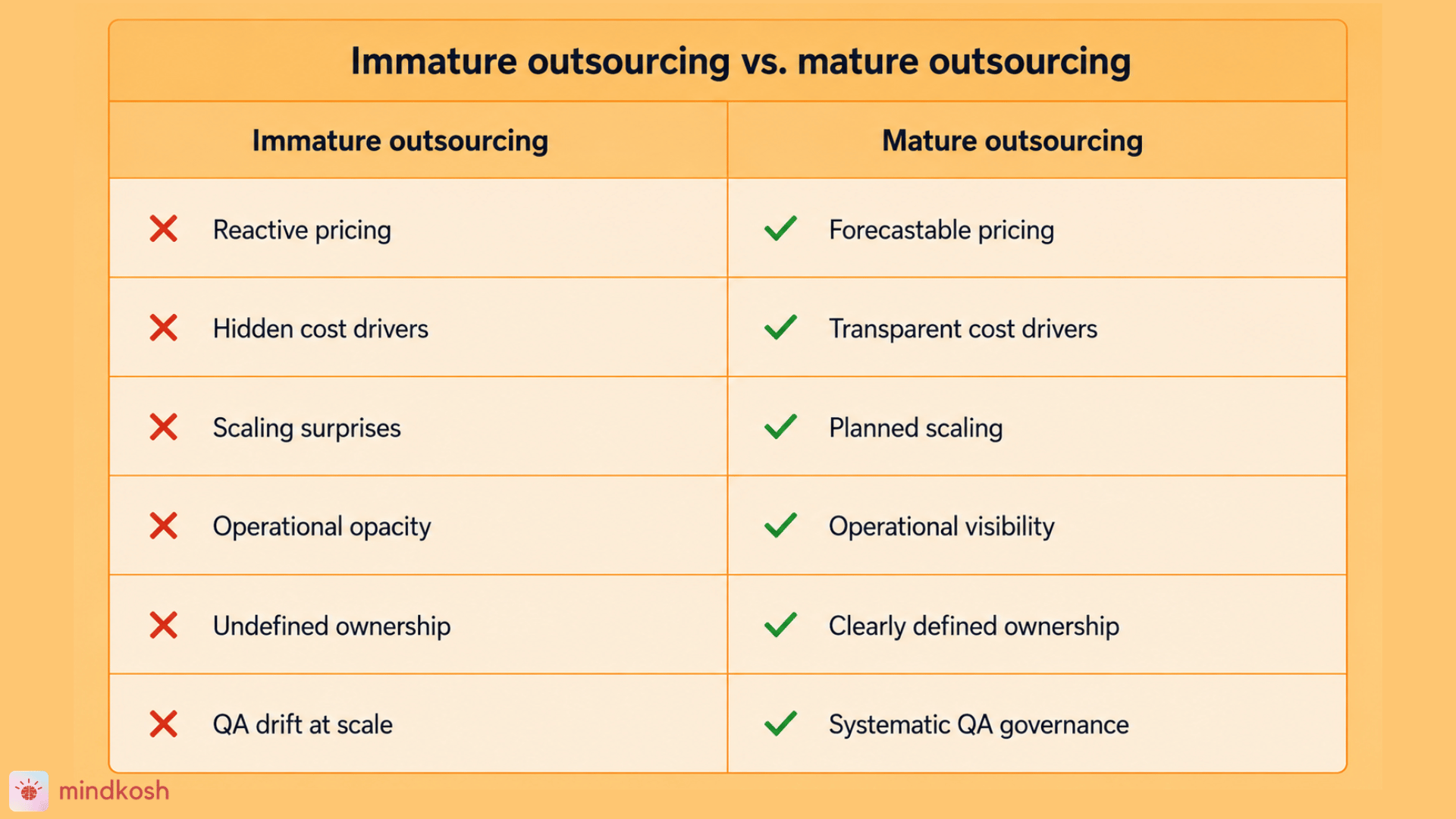
Mature annotation partners reduce uncertainty
The value of a mature outsourcing partner isn’t primarily labor capacity. It’s operational intelligence applied on your behalf. Mature partners bring structured approaches to cost forecasting, QA governance, ownership definition, and complexity management — which means your internal team spends less time managing unknowns and more time making decisions.
They help buyers forecast costs, delivery timelines, and scaling requirements before projects begin. That’s the distinction that matters at scale. The best annotation vendors don’t simply help teams scale annotation. They help teams scale annotation predictably.
A reliable signal of maturity: the vendor discusses operational tradeoffs openly. They acknowledge that outsourcing involves complexity, and they explain specifically how their model manages it. That honesty is itself a credibility indicator.
Predictability becomes a competitive advantage at scale
At small annotation volumes, unpredictability is a friction cost. At scale, it’s a real operational problem — one that delays model development, strains procurement relationships, and erodes the internal credibility of whoever owns the annotation program.
Stable annotation budgets create compounding benefits: smoother procurement cycles, easier internal planning, and the organizational confidence to expand annotation scope when the model needs more data. Teams that build annotation programs on predictable operations consistently do more with equivalent budgets, because they stop spending headcount and management time on variance they didn’t plan for.
How to evaluate data annotation outsourcing services beyond price
Vendor evaluation typically starts with pricing because pricing is the easiest dimension to compare. It’s a reasonable starting point, not a sufficient ending one. The teams that consistently select the right annotation partners evaluate on a different primary dimension: predictability.
Shift from cost comparison to predictability evaluation
The right question during vendor selection isn’t which vendor is cheapest. It’s which vendor gives your team the most confidence in what future costs will look like. Those questions frequently produce different answers — and the second one is consistently more useful for operational planning.
A vendor with lower per-label rates and high operational opacity can easily cost more over twelve months than a vendor with slightly higher rates and strong QA governance, transparent reporting, and clear ownership definitions. Total operational cost is the right evaluation unit. Quoted rate is an input into that calculation, not a substitute for it.
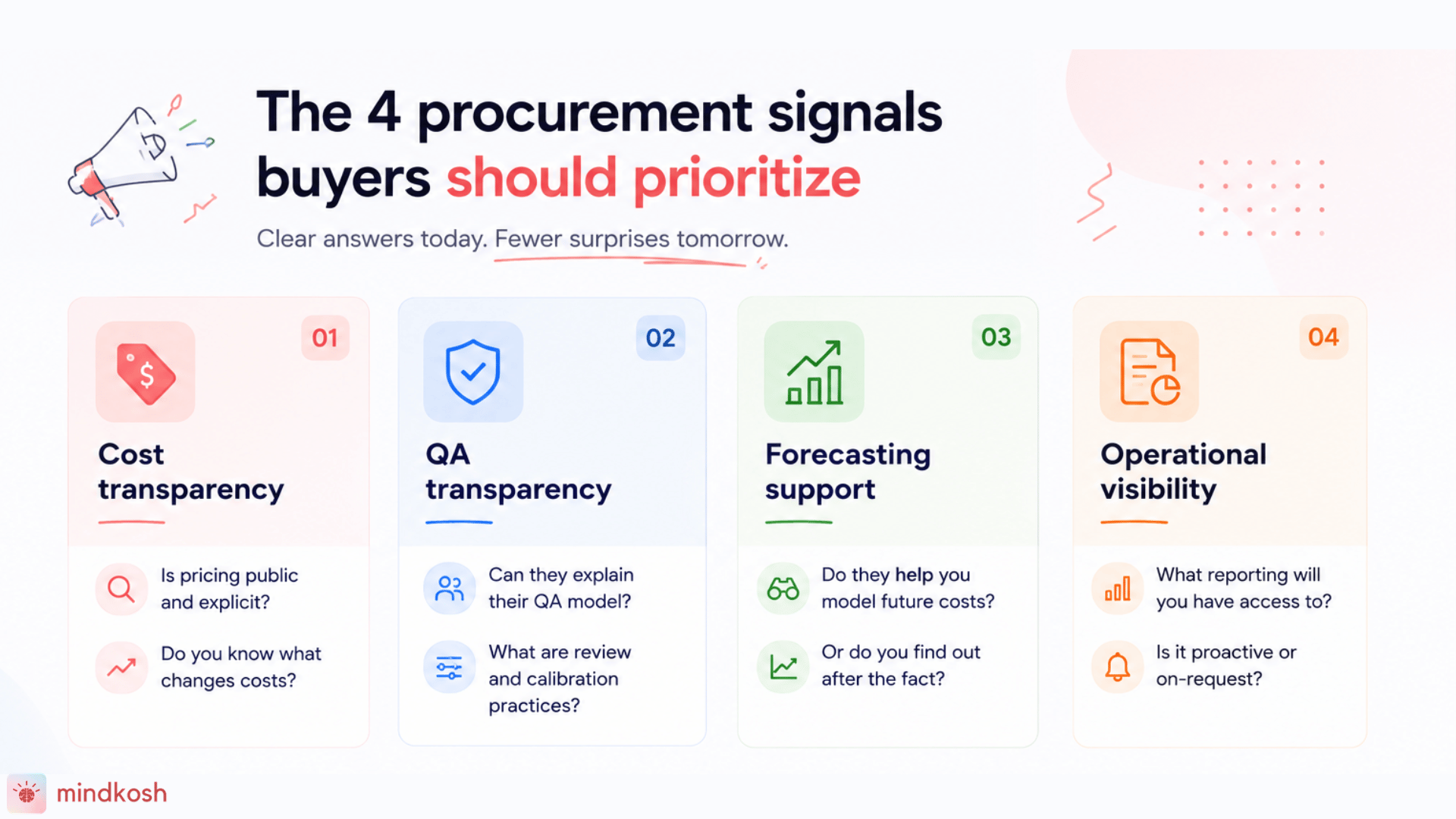
The four procurement signals buyers should prioritize
- Cost transparency: Is pricing public and explicit, or does every conversation begin with a custom quote? Can the vendor explain — in specific terms — what makes costs change over time?
- QA transparency: Can the vendor describe their QA model operationally — review rounds, calibration protocols, ownership boundaries — rather than through accuracy promises?
- Forecasting support: Does the vendor actively help you model future costs, or do you discover them after they occur?
- Operational visibility: What reporting will your team have access to throughout the project, and is it proactively delivered or available only on request?
Vendors who score well across all four are operationally mature. They’ve built systems designed to be predictable, and they can demonstrate that with specifics rather than assurances.
Mindkosh is built around the operational values this framework describes. Pricing is publicly listed across image and LiDAR annotation types. There are no long-term commitments or annual minimum requirements. Workflow structures are designed for operational clarity, and cost drivers are transparent by design rather than disclosed on request. For procurement leaders evaluating annotation partners on predictability rather than price alone, that transparency is the starting point for a productive conversation.
Conclusion
The vendors worth working with at scale aren’t necessarily the ones with the lowest quoted rates. They’re the ones who help your team understand what costs will look like before projects begin — and build operating models designed to keep costs in line as projects grow.
The eight questions in this article are designed to surface that distinction before a contract is signed. They’re not a guarantee of a perfect project. What they are is a structured way to evaluate operational maturity rather than just operational claims.
Ask about scaling costs before you compare starting costs. Ask about QA ownership before you evaluate quality promises. Ask about forecasting support before you accept a quote as a budget. Ask about operational visibility before you rely on reporting you haven’t seen.
The best annotation vendors don’t explain costs after projects scale. They help buyers forecast costs before projects scale. That’s the difference between outsourcing annotation and outsourcing it confidently.
Evaluate annotation partners on predictability, not just pricing
Mindkosh offers transparent pricing, flexible project structures, and the operational visibility teams need to keep annotation budgets on track — at any scale. Start for free or explore Mindkosh pricing. No long-term commitments required.
Frequently asked questions
What is data annotation outsourcing?
Data annotation outsourcing is the practice of engaging a third-party vendor or managed workforce to label, classify, tag, or segment data — images, video, text, audio, or LiDAR point clouds — used to train or evaluate AI and machine learning models. Outsourcing allows teams to scale annotation operations without building internal labeling infrastructure from scratch.
What are data annotation outsourcing services?
Data annotation outsourcing services typically include workforce management, quality assurance, project management, tooling, and delivery infrastructure for annotation projects. Scope varies significantly across vendors: some provide end-to-end managed services while others offer tooling platforms with optional workforce access. Clarifying that scope boundary is a critical part of vendor evaluation.
Why do annotation budgets become unpredictable after outsourcing?
Annotation budgets most commonly become unpredictable because buyers evaluate vendors on quoted pricing rather than total operational cost. Hidden cost drivers — QA effort, revision cycles, internal management burden, and scaling complexity — rarely appear in initial quotes. Surfacing those variables before signing is the primary function of a structured vendor evaluation.
What is the difference between per-label pricing and total annotation cost?
Per-label pricing reflects the cost of a single annotation unit under assumed conditions. Total annotation cost includes QA overhead, rework, project management, reviewer calibration, tooling, and internal coordination time. Vendors with low per-label rates can generate higher total costs if their operating model requires significant buyer-side involvement or produces lower first-pass quality rates.
How do you evaluate data annotation outsourcing services beyond price?
Effective vendor evaluation assesses four dimensions beyond price: cost transparency (is pricing explicit and explainable?), QA transparency (is the quality model defined operationally?), forecasting support (can the vendor help you model future costs?), and operational visibility (what reporting will you have access to?). The eight questions in this article provide a structured framework for that evaluation.
What red flags should I watch for when evaluating annotation vendors?
Key red flags include: vague quality guarantees with no operational detail, undefined revision or rework policies, inability to explain how costs change as volume scales, limited operational reporting, no forecasting support, and undefined ownership boundaries between your team and the vendor. Any vendor who defers or generalizes when asked about these topics warrants additional scrutiny.