


Two annotation vendors can quote similar services, similar timelines, and similar per-task rates — and still produce dramatically different total costs by the time a project closes. The difference rarely comes from the number on the pricing page. It comes from everything that the page doesn't show.
If you are in the market for an annotation vendor, you probably aren't primarily asking "what can these vendors do?" You probably already know. By the time you're comparing finalists, the real question is:
"What will this project actually cost once it scales — and can I forecast that number with enough confidence to get stakeholder approval?"
That question is rarely answered by a capabilities list. It's answered by how transparently a vendor communicates cost drivers: how QA is billed, whether revisions are included, how pricing shifts at volume, and whether there are any tools that help you model spend before you commit.
The challenge isn't finding annotation vendors. It's understanding how transparently they communicate the factors that drive total project cost.
This article takes 8 of the most widely evaluated annotation companies and assesses them through a pricing transparency lens. The goal isn't to rank them by capability — most are genuinely capable. The goal is to help you read their pricing posture as a procurement signal, and ask better questions before you sign.
The complexity of vendor comparisons
The typical annotation vendor roundup compares services offered, industries served, AI capabilities, and tooling features. These are legitimate evaluation criteria, and for teams in early-stage discovery, they're genuinely useful.
But for teams in late-stage evaluation — comparing two or three finalists and needing to justify a procurement decision — capability comparisons often leave the most important questions unanswered:
- How will costs behave as the project scales?
- What overhead is not included in the quoted rate?
- How much budget buffer is realistic to hold?
Vendor comparison becomes difficult when pricing structures differ
One core reason annotation buying is harder than it looks is that vendor pricing structures are not standardized. Some charge per task, some per hour, some per project. Some include QA in the base rate; others bill it separately.
Some require annual commitments; others offer monthly flexibility. Some provide public pricing pages; others require a sales call before sharing even a rough range. This makes an apples-to-apples comparison on cost alone nearly impossible.
What you can compare, however, is how much each vendor helps you understand total project cost before you commit — and that visibility gap is wider than most buyers expect. Pricing itself isn't the problem. Cost visibility is.
Pricing transparency as a strong indicator of vendor maturity
The problem isn't hidden fees — it's limited visibility into total project costs
Custom pricing in annotation is not inherently suspicious. Projects vary significantly in complexity, volume, modality, and quality requirements. A vendor that prices everything identically regardless of scope is probably cutting corners somewhere.
The issue isn't whether pricing is custom. It's whether a vendor provides enough visibility into the factors that drive cost — before a contract is signed.
When buyers can't model total spend with reasonable confidence, projects get approved on the basis of the quoted rate, and actual costs arrive later as unwelcome surprises.
Cost drivers often matter more than the quoted rate
The per-task or per-hour rate a vendor quotes is often one of the smaller variables in total project cost.
The larger drivers are typically:
- QA effort — how many review cycles are built into the workflow, and whether they're included in the base rate or billed separately
- Revision and rework — whether quality failures trigger additional charges or are absorbed by the vendor
- Project management overhead — whether dedicated PMs, onboarding, and workflow configuration are included or add-ons
- Scaling premiums — whether rates remain consistent at higher volumes or compress as complexity increases
Vendors who communicate these drivers clearly before contracting create a fundamentally different procurement experience than those who don't.
Transparent pricing creates procurement confidence
When cost drivers are visible upfront, procurement teams can do three things they otherwise can't:
- Build a credible budget forecast
- Compare vendors on total cost rather than quoted rate
- Bring stakeholders into the approval process with defensible numbers
This is why pricing transparency is worth evaluating directly — not as a moral judgment on vendor behavior, but as a practical indicator of how easy it will be to manage and forecast costs throughout the engagement.
A pricing transparency framework for evaluating annotation services
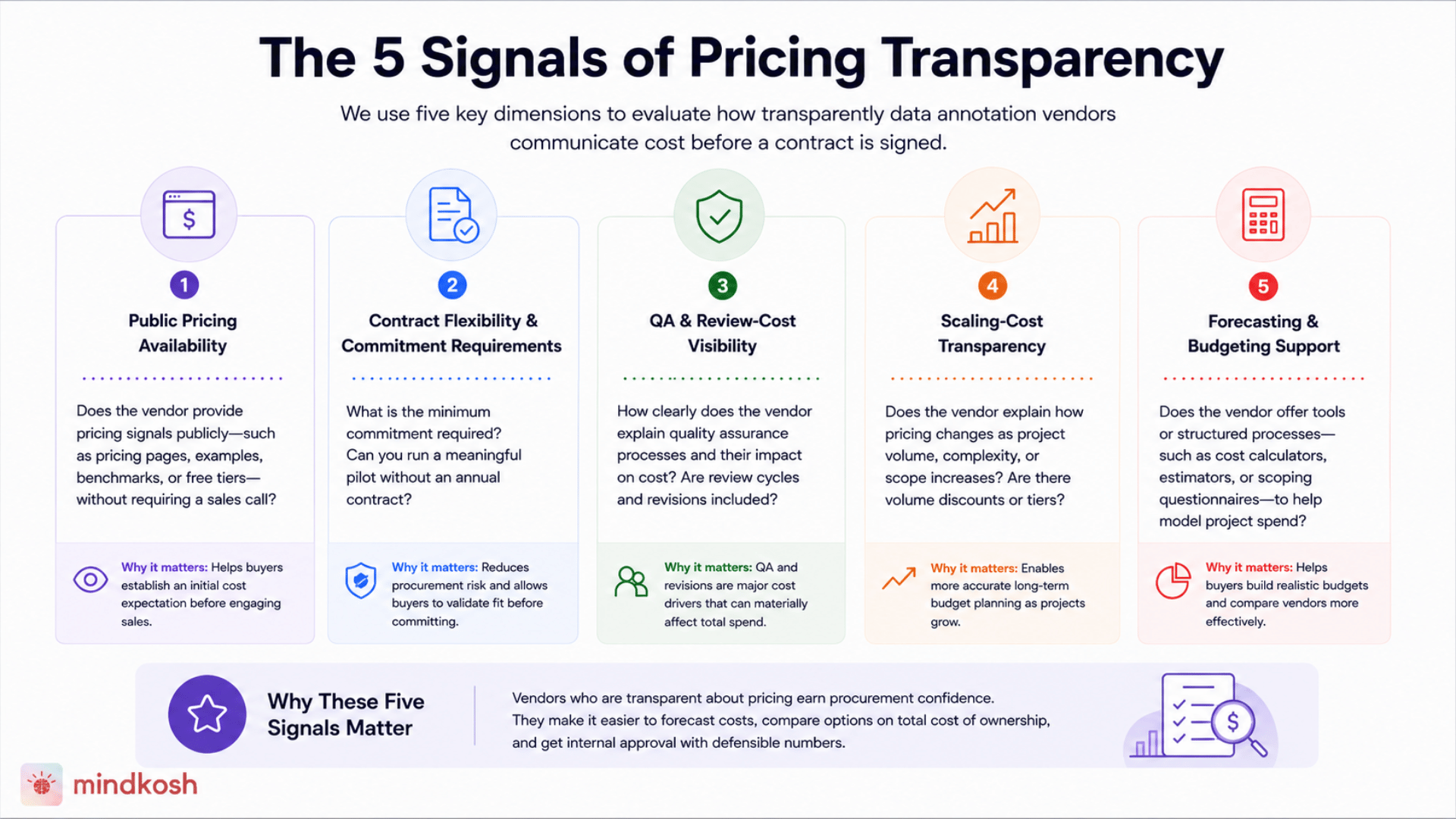
Rather than comparing vendors solely on features or headline rates, procurement teams should evaluate how much pricing information is available before a contract is signed.
The goal isn't to determine whether a vendor offers the lowest price. It's to assess how easily a buyer can forecast costs, compare alternatives, and build an internal business case before entering a sales process.
The following five dimensions provide a practical framework for evaluating pricing transparency across annotation providers.
1. Public Pricing Availability
Can buyers access meaningful pricing information without contacting sales?
This does not necessarily require a public rate card. Many enterprise annotation projects are too complex for fixed pricing.
However, vendors can still provide valuable pricing signals through:
- Public pricing pages
- Free or self-service tiers
- Marketplace listings
- Task-level pricing examples
- Pricing benchmarks or ranges
The more information available upfront, the easier it becomes for buyers to estimate costs and compare vendors before engaging procurement or legal teams.
2. Contract Flexibility and Commitment Requirements
How much commitment is required before a buyer can evaluate the service?
Some vendors offer:
- Free tiers
- Monthly subscriptions
- Pilot projects
- Usage-based pricing
Others require custom contracts and significant sales engagement before work can begin.
Flexible entry points reduce procurement risk by allowing teams to validate quality, workflows, and operational fit before committing to larger engagements.
3. QA and Review-Cost Visibility
How clearly does the vendor explain quality assurance processes and their impact on cost?
Quality control is one of the largest drivers of annotation economics, yet it is often absent from public pricing discussions.
Important questions include:
- Is QA included in the base rate?
- Are review cycles billed separately?
- Are revisions included?
- Does the vendor explain its quality-control process publicly?
Vendors that provide visibility into QA practices allow buyers to estimate total project costs more accurately.
4. Scaling-Cost Transparency
Can buyers understand how costs change as projects grow?
Annotation requirements rarely remain static. Projects often expand in volume, complexity, modalities, or quality requirements.
Pricing transparency improves when vendors explain:
- Volume discounts
- Enterprise tiers
- Pricing adjustments for complex tasks
- Cost drivers that affect large-scale deployments
Without this information, buyers may underestimate long-term project costs even if initial pricing appears attractive.
5. Forecasting and Budgeting Support
Does the vendor actively help buyers model expected spend before purchase?
Examples include:
- Annotation cost calculators
- Project cost estimators
- Pricing configurators
- Scoping questionnaires
- Example project budgets
These tools help procurement teams move beyond rough estimates and build more reliable cost forecasts for stakeholder approval.
A vendor does not need to publish every pricing detail publicly to score well in this category. The key question is whether buyers are given practical tools to estimate costs before signing a contract.
Top data annotation companies evaluated through a pricing transparency lens
The following evaluations assess each vendor's publicly available pricing posture — not their capabilities or delivery quality, which varies by use case and require direct evaluation.
The goal is to characterize how much cost visibility each vendor provides before a contract is signed.
CloudFactory
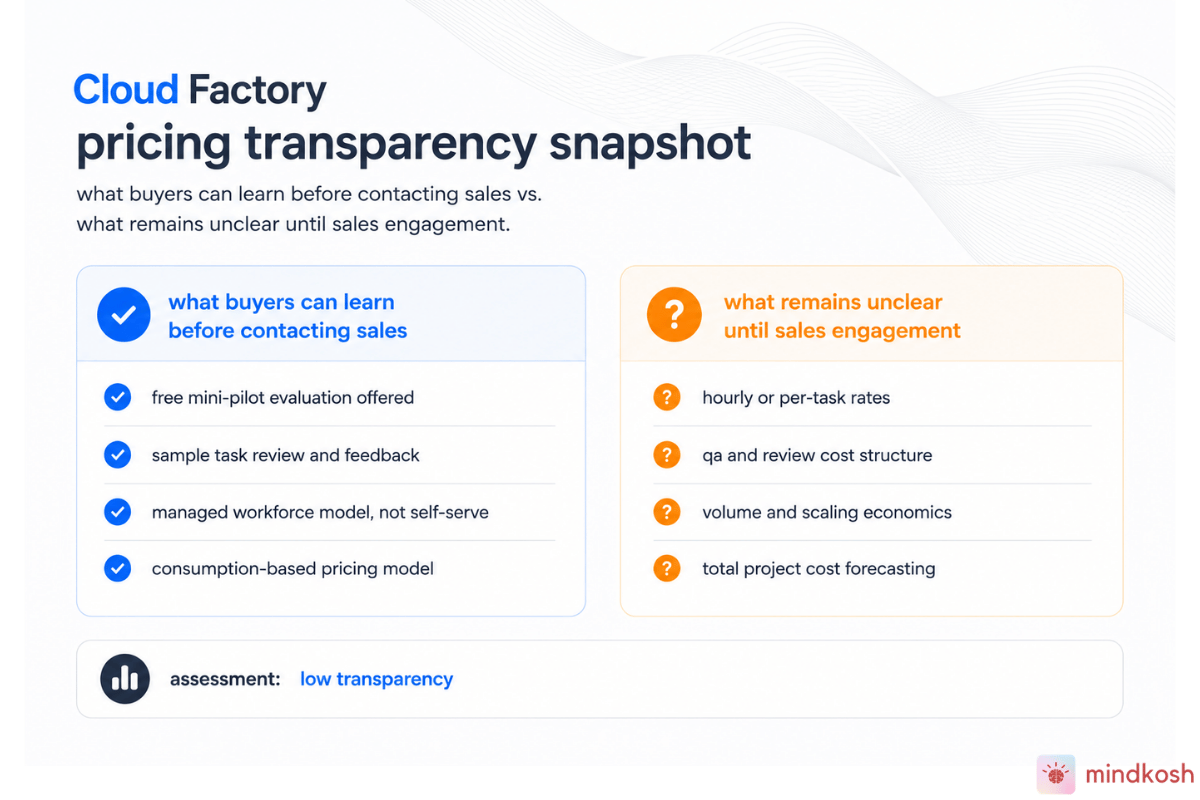
CloudFactory is a managed workforce annotation partner, combining trained annotation teams with proprietary workflow tooling for computer vision and NLP projects. The company does not publish a pricing page with rate cards, tiers, or a cost calculator on its own site.
Instead, CloudFactory offers a free mini-pilot: before any commitment, the company reviews task instructions, completes a small representative sample, and provides feedback on annotation approach. This gives buyers a way to evaluate quality and fit, but not a way to estimate cost, since pricing is consumption-based and only finalized through direct sales engagement.
Transparency assessment: Low
CloudFactory offers a genuinely useful pre-commitment evaluation path through its free pilot, but buyers get no visibility into pricing structure, hourly rates, or cost drivers until they engage sales directly.
Deepen
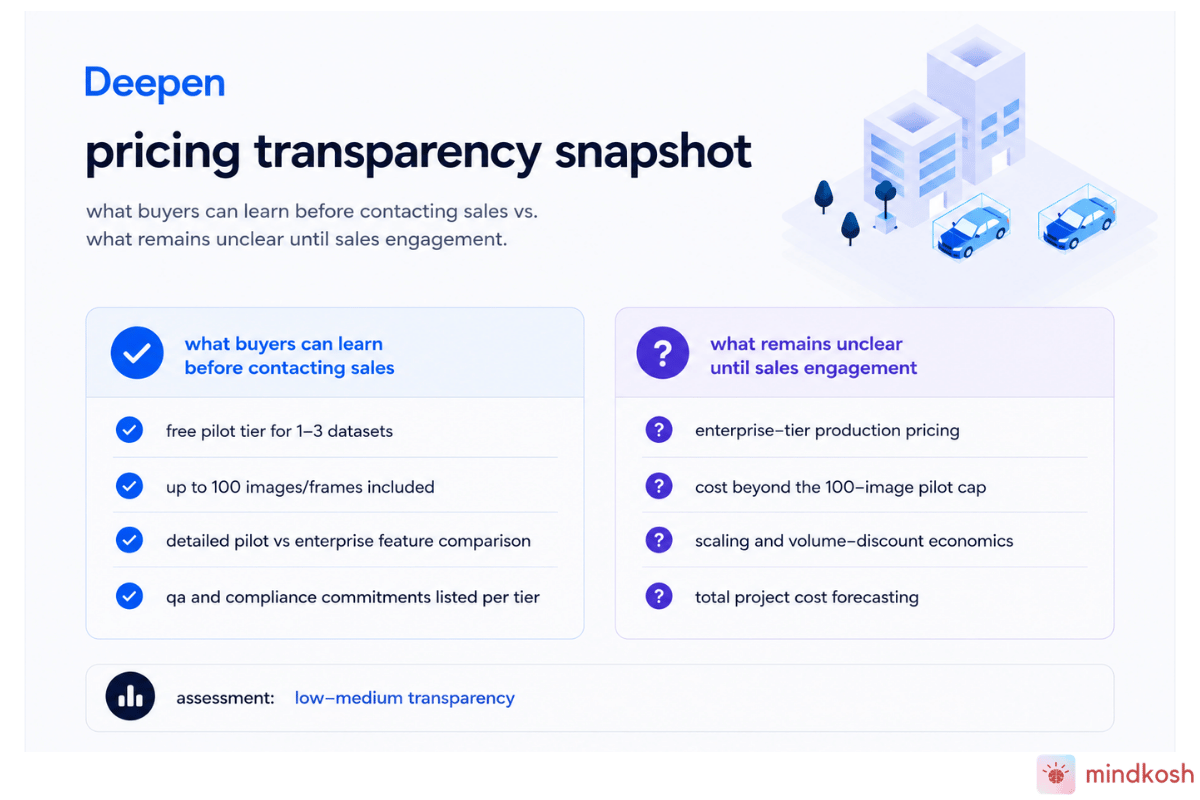
Deepen provides high-touch, multi-sensor fusion annotation services for autonomous vehicles, robotics, and drone applications, with a workforce of specialized annotators handling LiDAR, camera, and multi-sensor calibration work. The company offers a free Pilot tier covering 1-3 datasets and up to 100 images or frames, with basic AI-assisted annotation and QA included, giving buyers a genuine way to evaluate the service before committing.
Beyond the pilot, however, pricing shifts to a custom Enterprise tier with no published rates. The feature comparison is detailed. Buyers can see exactly what changes between tiers, including QA accuracy commitments, dedicated project management, and compliance certifications, but the actual cost of an Enterprise engagement still requires a sales conversation. Deepen also lists a usage-metered pricing option on AWS Marketplace, though this appears tied to platform/tool consumption time rather than managed annotation service delivery.
Transparency assessment: Low–Medium
Deepen's free pilot tier and detailed feature comparison give buyers more to evaluate upfront than most managed service providers in this list, but production-scale pricing remains fully custom and undisclosed.
Scale AI
Scale AI offers one of the clearest product segmentation models among enterprise annotation providers. The company distinguishes between self-serve offerings designed for experimental or research projects and enterprise solutions built for large-scale AI initiatives.
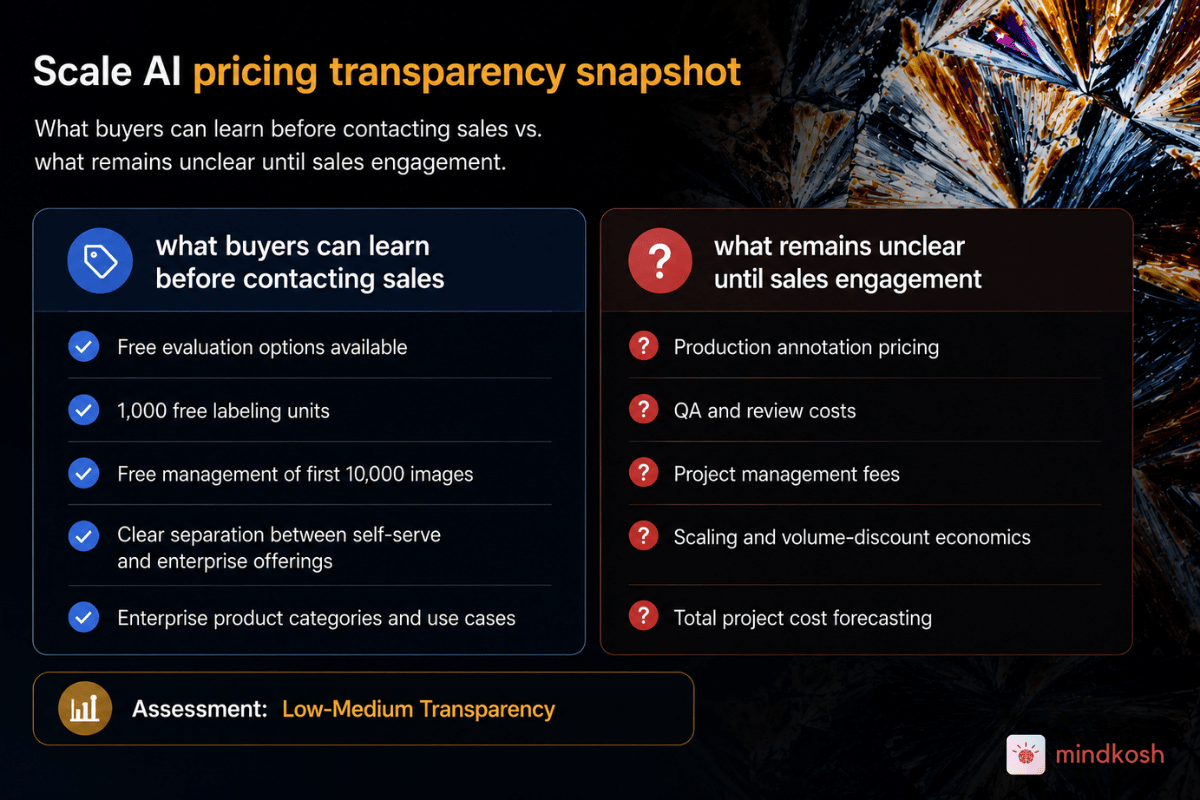
For smaller teams, Scale provides free entry points, including 1,000 labeling units at no cost and free management of the first 10,000 images. These options allow buyers to evaluate the platform without immediately entering a sales process.
However, pricing transparency decreases significantly for production-scale deployments. Enterprise products such as Scale Data Engine and Scale GenAI Platform require direct engagement with the sales team, and public information about annotation rates, QA costs, project management fees, or scaling economics is not available.
Transparency assessment: Low–medium
Scale provides meaningful visibility into evaluation options and free-tier access, but buyers still need to engage sales before they can estimate the total cost of a production annotation program.
Sama
Sama positions itself as a managed data annotation partner focused on quality, governance, and long-term enterprise relationships. Unlike many platform-centric vendors, Sama emphasizes customized workflows, dedicated teams, and outcome-driven engagements tailored to customer requirements.
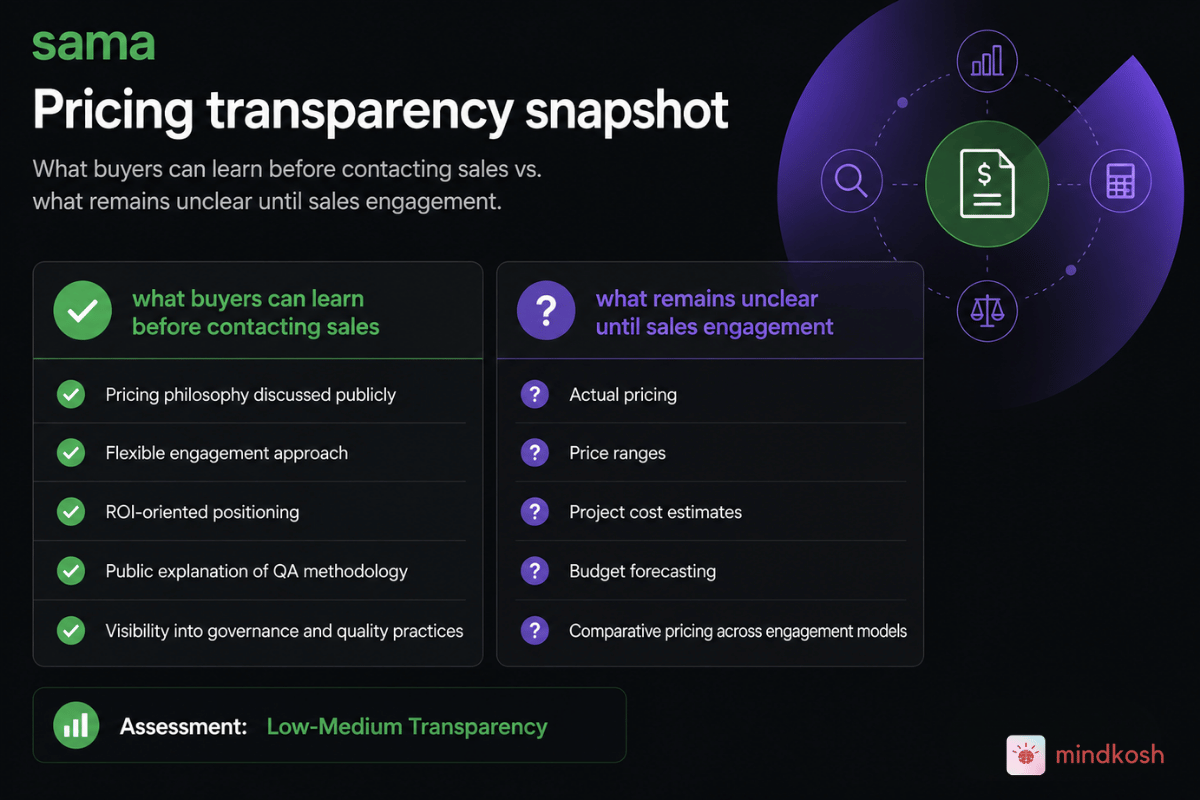
While Sama discusses pricing philosophy publicly, stating that its pricing is flexible and optimized around ROI rather than rigid volume commitments, the company does not publish pricing tiers, price ranges, calculators, or estimated project costs. Prospective buyers must contact the sales team to understand likely investment levels.
Sama also provides more visibility into its quality approach than many competitors, publicly discussing multi-layer QA processes, human oversight, and governance practices as part of its broader positioning around responsible AI development.
Transparency assessment: Low–Medium
Sama provides limited visibility into its pricing approach by publicly discussing how engagements are structured and positioning itself against competitors with opaque pricing models. However, buyers cannot access actual pricing information, estimate costs, or compare plans without engaging directly with sales.
Hive
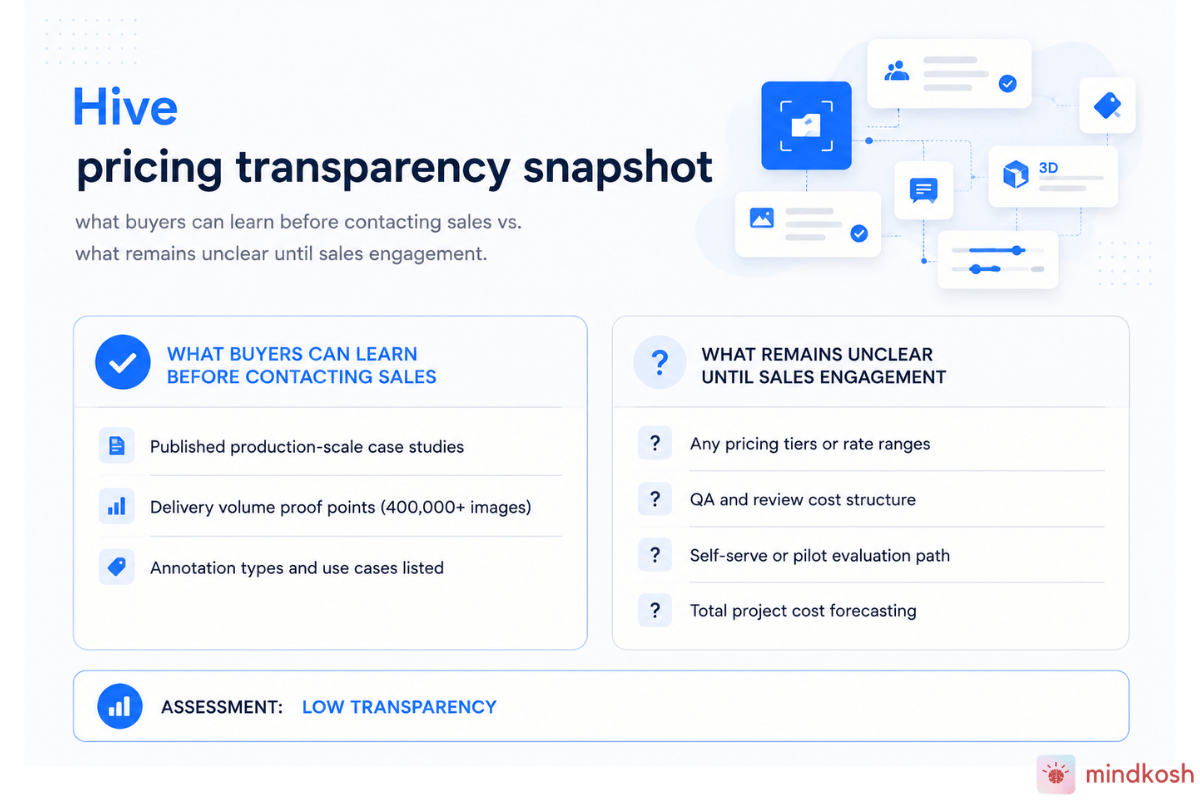
Hive operates one of the larger distributed annotation workforces in the industry, offering managed data labeling services for computer vision projects including bounding boxes, polygons, segmentation, and object tracking. The company positions its Enterprise Data Annotation offering around large-scale production work, citing projects such as labeling 400,000+ images with 10M+ bounding boxes for an autonomous vehicle client and sourcing 650,000+ documents across 12+ languages for an OCR project.
Despite that scale, Hive's annotation service page offers no tiers, no cost estimator, and no self-serve entry point. The only option presented is to contact sales directly.
Transparency assessment: Low
Hive demonstrates clear production-scale delivery capability through its case studies, but provides no public pricing structure of any kind for its data annotation service. Buyers get proof of scale, not proof of cost.
Mindy Support
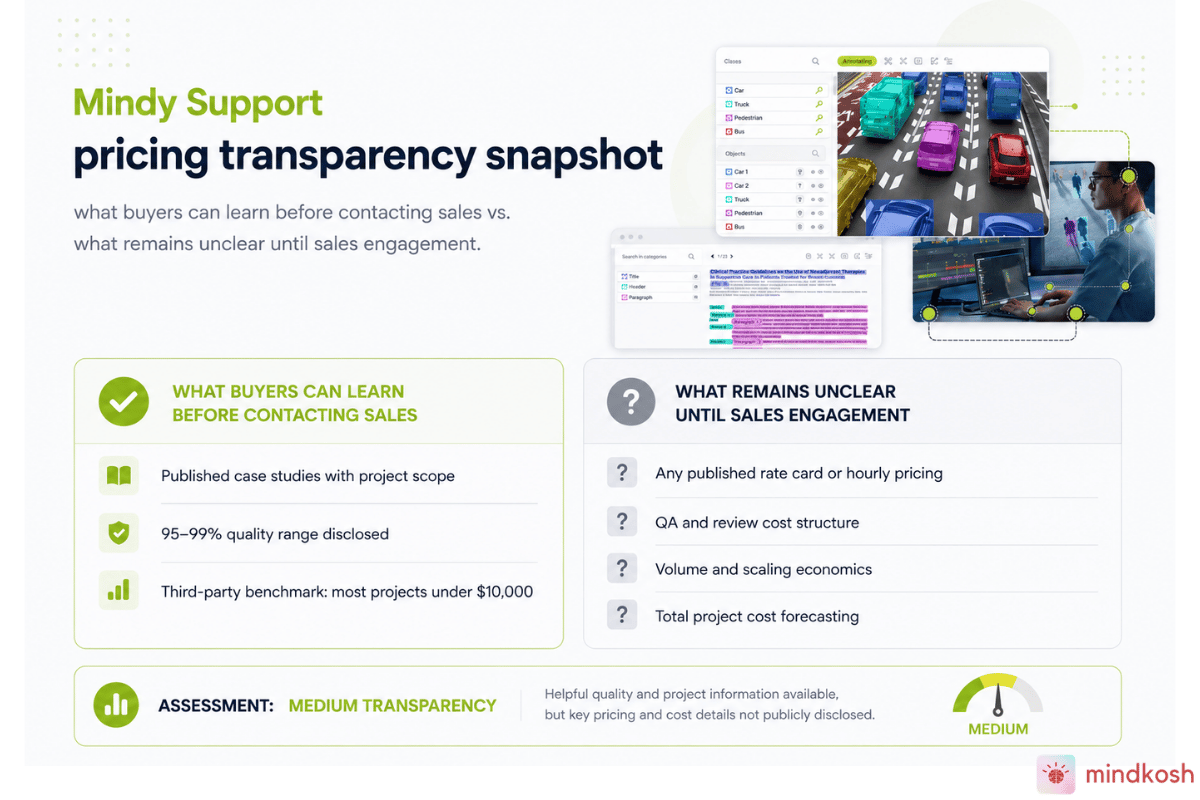
Mindy Support is a managed data annotation and BPO provider offering outsourced annotation teams across image, video, text, audio, and 3D/LiDAR data types, with a global workforce spanning 40+ languages and offices in multiple countries. The company publishes case studies showing production-scale work, including large-scale PII redaction for a legal technology platform and LLM evaluation and reasoning benchmark generation for a global technology company, and states a 95-99% quality range depending on client requirements.
Mindy Support itself publishes no pricing tiers, rate card, or cost estimator, directing every inquiry to "get a quote." However, independent benchmark data from Clutch, based on 23 verified client reviews, indicates that most projects fall under $10,000, giving prospective buyers a rough anchor point that isn't available for several other vendors on this list.
Transparency assessment: Medium
Mindy Support discloses no pricing of its own, but third-party benchmark data offers buyers a usable reference point that pure "contact sales" vendors don't provide.
iMerit
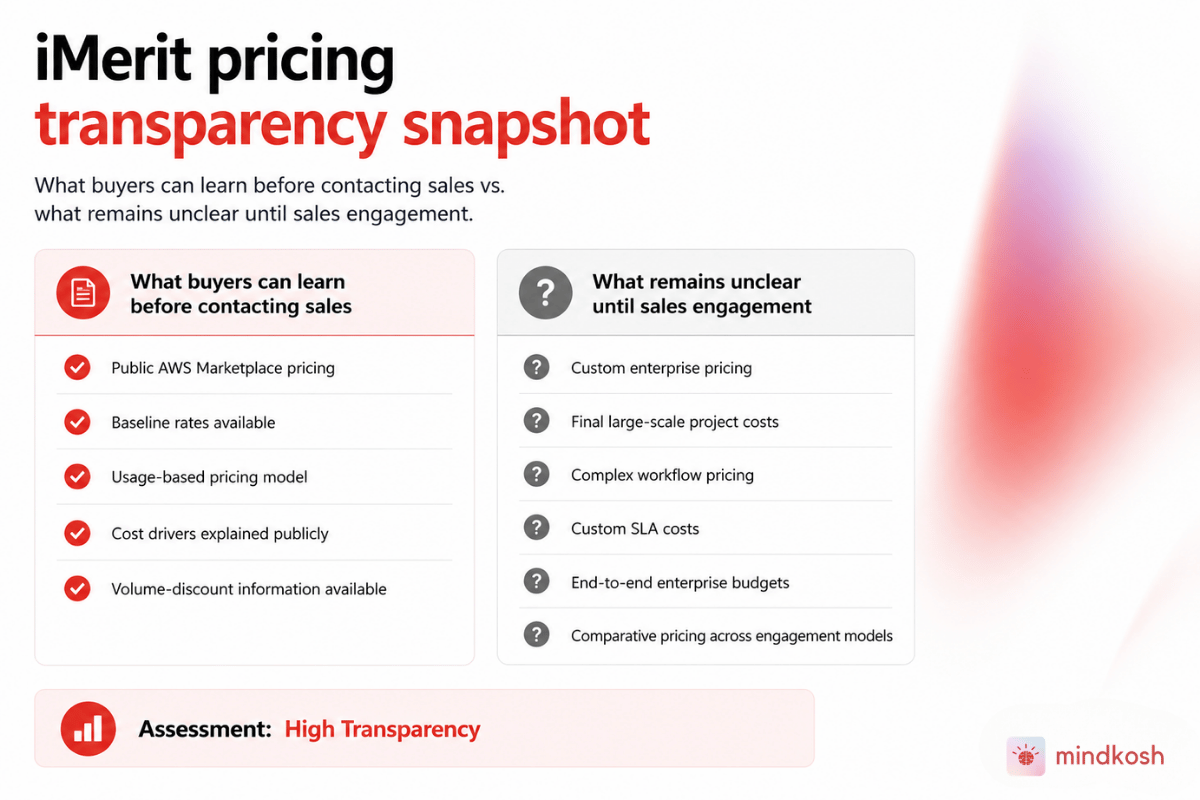
iMerit combines managed data labeling services with specialized teams for AI training data projects across industries such as healthcare, autonomous systems, and enterprise AI. Unlike many annotation vendors that require prospective customers to contact sales before discussing pricing, iMerit provides publicly accessible pricing information through its AWS Marketplace listing.
The company discloses a usage-based pricing model and publishes baseline rates, allowing buyers to establish budget expectations before engaging with sales. Additional publicly available information indicates that costs may vary based on factors such as dataset volume, platform access, language requirements, data formats, and project scale, with discounts available for larger workloads.
Transparency assessment: High
iMerit provides more pricing visibility than most annotation vendors by publicly disclosing pricing and explaining several factors that influence project costs. While custom enterprise engagements may still require tailored quotes, buyers can access meaningful pricing information and estimate costs without first scheduling a sales call.
Note: Pricing information reflects what is publicly accessible at the time of writing. Buyers should verify directly with each vendor before making procurement decisions
Mindkosh
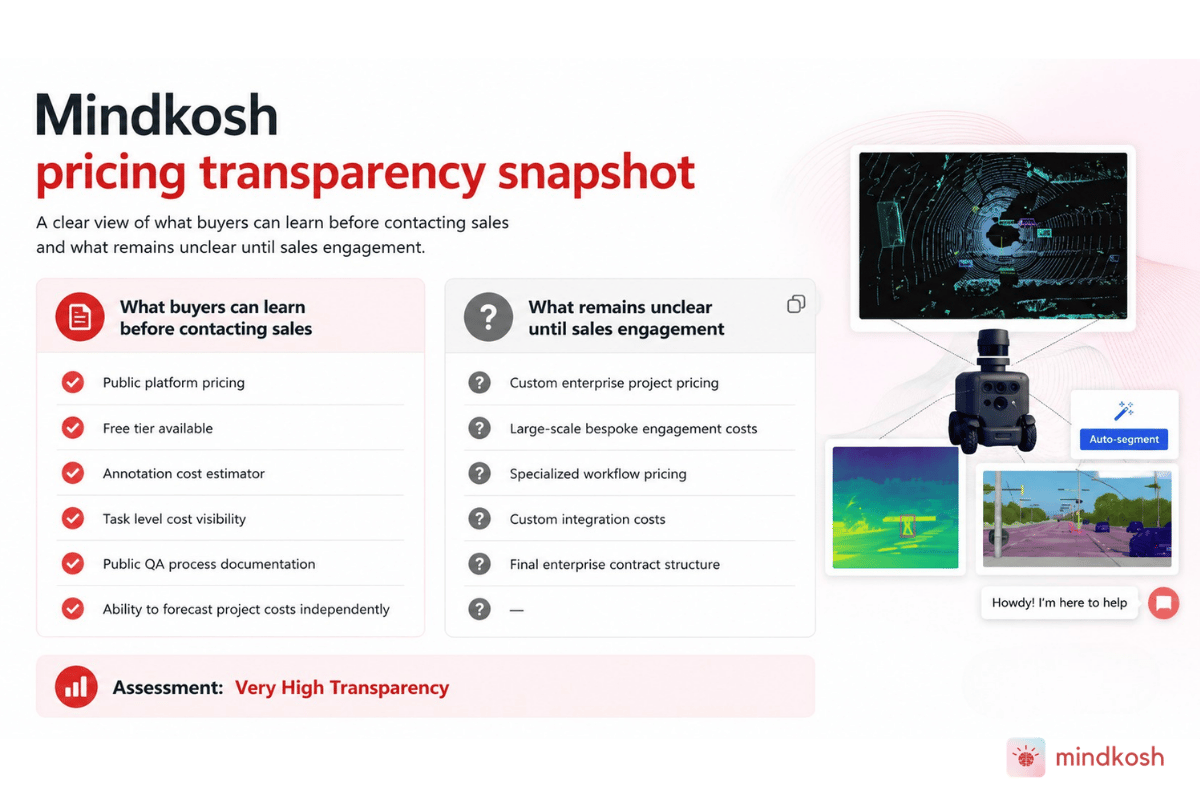
Mindkosh provides one of the more transparent pricing experiences among data annotation providers. The company publishes platform pricing, offers a free tier, provides a public annotation cost estimator, and offers a free tool to estimate image annotation pricing, allowing buyers to model project costs across multiple annotation types before contacting sales.
In addition to pricing visibility, Mindkosh publicly documents key elements of its quality-control process, giving buyers greater insight into how annotation quality is managed before a procurement conversation begins.
Enterprise customers can still request custom quotes for larger or more complex projects, but baseline pricing information and cost-estimation tools are available without requiring a demo or sales engagement.
Transparency assessment: Very High
Mindkosh combines public pricing, annotation-level cost estimates, cost forecasting tools, and visible QA practices, allowing buyers to evaluate both cost expectations and operational approach before entering a sales process.
The data annotation market remains largely opaque from a pricing perspective. Most vendors, including Scale AI, Sama, and several enterprise annotation providers, rely primarily on custom quotations, offering little public information about expected project costs. Others, such as Hive and iMerit, provide partial pricing visibility through cloud marketplace listings, platform subscriptions, or publicly available pricing references, though buyers often still need sales engagement to understand end-to-end costs.
Only a small number of providers supplement their pricing pages with calculators, task-level estimates, or self-service cost modeling tools. As a result, buyers evaluating annotation partners should assess how much information is available before entering a sales process, including access to calculators, workload estimators, pricing examples, and clear explanations of what drives costs.
Conclusion: Visibility is the real procurement advantage
The cheapest quoted rate is rarely the lowest total cost. Across annotation projects of any meaningful scale, actual spend is often determined by factors that never appear in headline pricing: QA overhead, revision cycles, project management effort, and how costs change as programs grow. Vendors that communicate these drivers clearly allow procurement teams to forecast budgets, compare providers more effectively, and reduce the risk of cost overruns after contracts are signed.
This is where pricing transparency becomes a meaningful operational signal rather than simply a procurement convenience. Vendors that provide public pricing references, flexible entry points, and structured forecasting support make it easier for buyers to evaluate options with confidence. Mindkosh follows this philosophy by providing publicly available pricing, a free tier, and cost-estimation tools designed to help teams understand likely project costs before entering a sales process.
Ultimately, the goal is not to find the cheapest annotation vendor. It is to find the vendor that gives you the clearest understanding of what your annotation program will actually cost. The providers that make cost drivers visible early are often the easiest to budget for, justify internally, and scale successfully over time.