


Most AI teams discover the real problem with their annotation parners about two to three months after onboarding. Not during the sales process. Not during the pilot. After scale begins. By that point, the initial pricing advantage has been absorbed by rework cycles, escalating QA overhead, and the coordination effort required to compensate for workflow gaps the vendor never disclosed. The project is behind. The team is managing an annotation partner instead of relying on one.
This is the operational reality that most data annotation company comparisons fail to surface. Vendor evaluations tend to focus on the dimensions that are easiest to compare: per-annotation pricing, workforce numbers, and accuracy claims. These metrics are visible. They are also, in most cases, poor predictors of how an annotation partner will actually perform under production pressure.
The challenge for AI operations leaders, ML infrastructure teams, and procurement stakeholders is not finding annotation vendors. There are many of them. The challenge is identifying which providers possess the operational systems to scale reliably, maintain quality consistently, and communicate transparently when problems arise.
Here we reframe vendor evaluation away from surface-level comparisons and toward the operational signals that actually matter. It then applies that framework to 9 leading annotation companies so teams can make a more informed selection decision.
The goal is straightforward: fewer surprises after onboarding. Fewer workflow breakdowns six months into a program. Fewer hidden costs that were never part of the original procurement calculus.
Pricing and “accuracy claims” are poor ways to compare annotation companies
Cheap annotation costs often create expensive operational problems later
Low per-annotation pricing is not inherently a problem. It becomes a problem when that pricing reflects the absence of the systems required to maintain quality at scale.
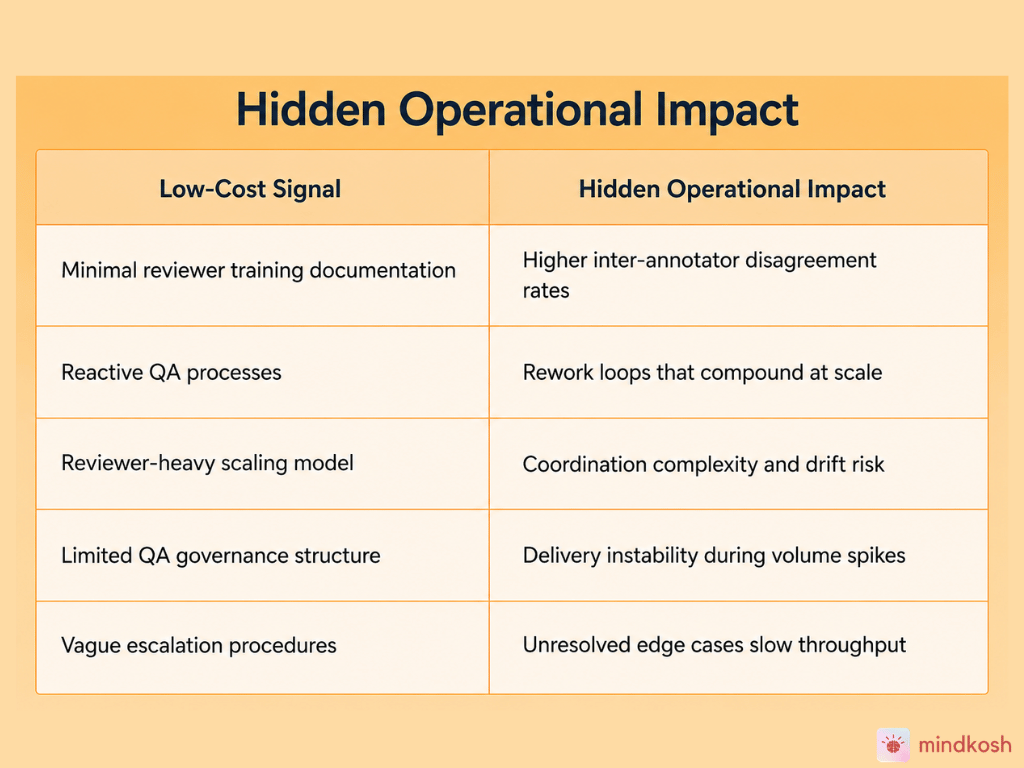
Annotation vendors who compete primarily on price tend to underinvest in the workflow infrastructure that prevents quality from degrading over time: structured reviewer training, calibration systems, QA governance, and escalation logic. These investments are operationally costly to build and maintain. They are also invisible during a standard vendor evaluation.
The downstream consequences of selecting a low-cost vendor without operational maturity typically include higher disagreement rates between reviewers, reactive rather than preventive QA, rework loops that expand as volume increases, and delivery instability during scaling spikes. These costs rarely appear on the original invoice. They accumulate in the operational budget instead.
Does “99% accuracy” explain how annotation quality is actually maintained?
Accuracy figures appear in almost every annotation vendor’s marketing materials. They rarely explain anything useful about how that accuracy is achieved or sustained.
A vendor claiming 99% accuracy without disclosing the underlying QA methodology raises more questions than it answers. How is accuracy measured? Across which task types? At what volume? How are reviewer disagreements detected and resolved? How is annotation drift monitored across long-running projects?
Without answers to these questions, an accuracy claim is a marketing metric, not an operational guarantee. The more operationally mature annotation partners explain their QA architecture in specific terms: inter-annotator agreement thresholds, reviewer calibration cadences, edge-case escalation logic, and ontology governance processes. Vendors who cannot answer these questions in detail are often the ones whose quality degrades once scale begins.
Operational systems matter more than marketing metrics. This distinction is the foundation of a more defensible vendor evaluation.
The 5 operational signals that separate mature annotation partners from commodity vendors
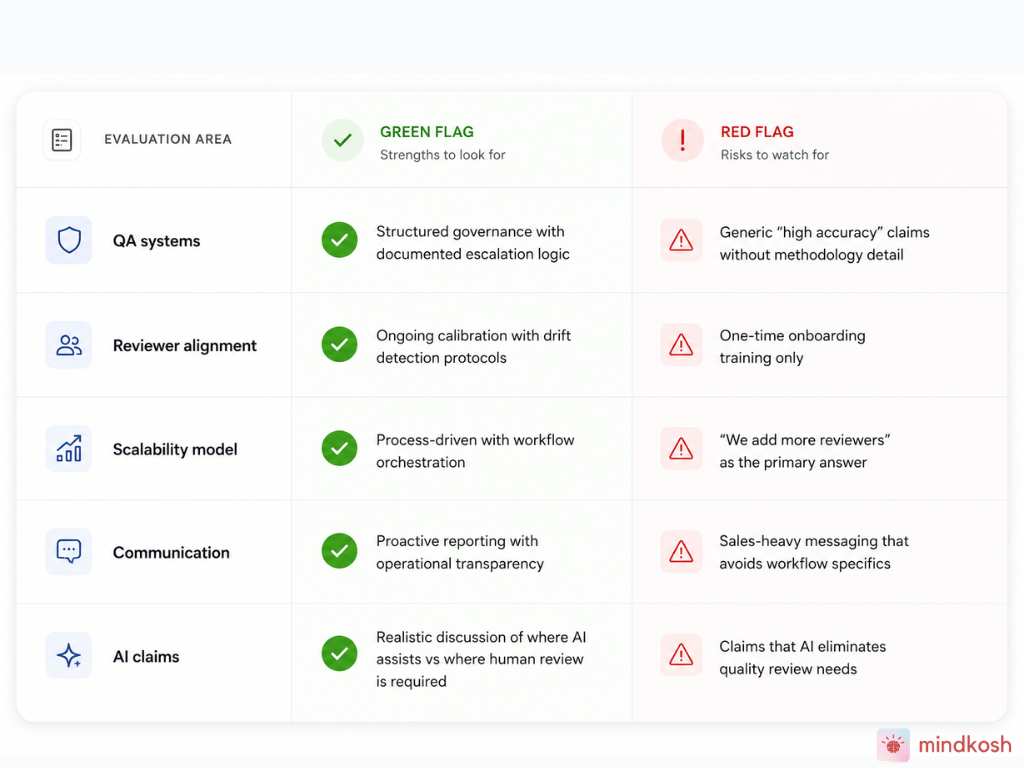
Evaluating annotation vendors through an operational lens requires moving beyond pricing tables and accuracy claims toward the workflow signals that predict performance under production pressure. These five areas form the core of a more reliable evaluation framework.
1. Structured QA governance instead of reactive review cycles
Mature annotation operations do not treat quality assurance as an afterthought. They build structured QA governance into the workflow itself: defined escalation logic for edge cases, routing systems that direct difficult items to appropriately skilled reviewers, and disagreement resolution protocols that prevent inconsistencies from propagating through a dataset.
Reactive QA — reviewing samples after annotation is complete and correcting errors after the fact — is a systemic risk at scale. It creates rework loops, delays delivery, and generates inconsistency across annotation batches. Structured QA governance prevents problems before they compound.
When evaluating vendors, ask for specific details about their QA architecture. Vague references to “quality review processes” are not the same as a documented escalation framework.
2. Reviewer calibration systems that maintain consistency at scale
Annotation quality is not static. Even skilled reviewers diverge over time as task complexity increases, edge cases multiply, and guidelines evolve. Without ongoing calibration, annotation drift becomes an invisible problem that erodes dataset consistency gradually and expensively.
Operationally mature vendors maintain systematic reviewer calibration programs: regular alignment sessions, ontology governance protocols, drift detection mechanisms, and standardization processes that keep reviewer interpretations consistent across teams and over time.
This is especially critical for annotation programs that run across multiple months or involve large reviewer pools. The question to ask a vendor is not whether they train reviewers initially. It is how they maintain calibration continuously
3. Workflow visibility and operational transparency
Annotation programs generate operational complexity that needs to be visible to the teams managing them. Mature annotation partners provide structured reporting that gives clients genuine insight into workflow status, QA metrics, delivery progress, and escalation activity.
Operational transparency is not just a feature. It is a signal of the vendor’s confidence in their own processes. Vendors who resist providing workflow visibility often have processes they would rather clients not examine too closely.
Communication structure matters as well. How are delivery risks communicated? Who owns escalation when a problem surfaces? How quickly are issues flagged versus buried? These questions reveal more about a vendor’s operational culture than any marketing document.
4. Scalability systems that reduce coordination complexity
Many annotation vendors describe scalability in terms of workforce size: “We can add more reviewers as your volume grows.” This is a coordination model, not a scalability architecture.
Adding reviewers without process infrastructure creates coordination overhead, increases the risk of reviewer drift, and generates delivery unpredictability. Mature annotation workflows scale through systems: workflow orchestration, structured task routing, automated quality checks at volume, and process governance that maintains consistency regardless of team size.
The evaluation question is not how large a vendor’s reviewer pool is. It is how their QA and workflow systems behave as volume increases. Process-driven scaling is fundamentally more reliable than reviewer-count scaling.
5. Realistic operational communication instead of exaggerated AI claims
The annotation tooling market contains a significant volume of AI-capability marketing that does not hold up to operational scrutiny. Vendors who describe AI-assisted annotation as eliminating quality review requirements, or who promise scalability without acknowledging the workflow complexity that scale introduces, are signaling something about how they approach operational honesty generally.
Mature annotation partners discuss tradeoffs directly. They explain where AI assistance genuinely accelerates throughput and where human review remains essential for quality. They describe scalability in specific operational terms rather than abstract capability claims.
This operational honesty is a practical advantage for teams that need to plan annotation programs accurately. A vendor who overpromises during procurement and underdelivers during execution creates planning problems that compound over time.
Applying the framework — how leading data annotation companies compare
The evaluation criteria above are useful in theory. The harder challenge is applying them consistently when comparing actual annotation vendors.
Most vendor comparison articles focus heavily on surface-level differences — pricing models, feature lists, workforce size, or generic accuracy claims. Those comparisons can be useful at a high level, but they often fail to reveal how annotation operations behave once programs begin scaling and operational complexity increases.
The more meaningful differences between annotation partners usually emerge deeper in the workflow itself:
- How quality disagreements are handled
- How reviewer consistency is maintained
- How edge cases are escalated
- How workflows adapt under volume pressure
- How transparent vendors are when operational problems appear
The following section attempts to apply the operational evaluation framework above to nine widely used annotation companies and platforms. The goal is not to produce a definitive ranking, because different teams have different operational requirements. Instead, the objective is to provide a more consistent lens for evaluating where each platform is strongest, where operational tradeoffs exist, and which types of teams each solution is best suited for.
Each company is evaluated using the same narrative structure:
- What the platform is operationally strongest at
- Which teams is it best suited for
- Workflow limitations or tradeoffs buyers should understand before committing.
Mindkosh
Mindkosh positions itself differently from many annotation platforms by treating quality assurance as a workflow architecture problem rather than a post-review process. Instead of relying heavily on manual review escalation after annotations are completed, validation is embedded directly into the annotation workflow through systems like multi-annotator validation, honeypot testing, reviewer scoring, and targeted review routing.
Operationally, the platform is strongest in LiDAR and vision workflows, where annotation consistency, reviewer coordination, and edge-case management become difficult to maintain at scale. Its workflow design emphasizes scalability through structured QA systems rather than simply expanding reviewer headcount.
Best for: Teams scaling LiDAR and vision annotation workflows that need stronger QA governance without enterprise procurement friction.
Watch out for: Best suited for teams prioritizing operational workflow maturity and QA-heavy programs rather than extremely lightweight one-off annotation tasks.
CloudFactory
CloudFactory is built around a dedicated, non-crowdsourced managed workforce, which is where its operational strength lies. The company uses human review and provides teams with a consistent point of accountability. This structure is particularly suited to regulated industries like healthcare and financial services, where consistency and auditability matter as much as raw throughput.
Best for: Teams running large, ongoing production volumes that need a stable, accountable managed workforce and built-in HITL (Human in the loop) reviewer QA, especially in compliance-sensitive industries.
Watch out for: Onboarding runs through a sales-led pilot process rather than instant self-serve access, and some reviews note limited workflow customization for teams with highly specific pipeline requirements.
iMerit
iMerit is currently being acquired by EXL, a move the company frames as extending its foundation-model training, evaluation, and reinforcement-learning capabilities into EXL's enterprise AI platform. Independent of that transition, iMerit's core offering centers on a global network of over 25,000 domain experts across 60+ countries, including "iMerit Scholars," a curated group of subject-matter specialists used for foundation model evaluation, RLHF, alignment, and chain-of-thought reasoning validation, positioned as a deliberate alternative to crowd-sourced annotation.
For annotation itself, iMerit's Ango Hub platform covers image, video, LiDAR, text, and audio data, with automation and built-in QA.
Best for: Teams needing deep domain expertise, foundation-model evaluation, or specialized modalities like LiDAR, DICOM, and long-form video, particularly where subject-matter accuracy matters more than fast self-serve onboarding.
Watch out for: The company is currently in the process of being acquired by EXL, which is worth confirming directly given how it may affect service continuity or roadmap. No pricing information is available without direct sales contact.
Uber AI Solutions
Uber AI Solutions combines its own technology with a specialized global workforce, built on over 9 years managing large-scale data labeling. It covers 30+ annotation types, including image, video, text, 3D point cloud, and LiDAR annotation, with multilingual support across 100+ languages. The company also offers product testing and localization services, and acquired Segments.ai in October 2025 to strengthen its LiDAR and multi-sensor capabilities.
Best for: Teams needing broad modality coverage and multilingual annotation at global scale, especially those working with LiDAR or multi-sensor data.
Watch out for: A newer entrant to third-party annotation services, with less independent operational detail available and no published pricing.
Sama
Sama delivers human-verified data annotation, validation, and model evaluation, combining automation with expert human review for computer vision, NLP, and multimodal AI. The company reports a 99% first-batch acceptance rate and an average client relationship of 8 years, working with teams like Walmart, Getty Images, Continental, and Volumental. Every project starts with an annotation strategy and labeling guide, followed by ongoing calibration as data evolves, which Sama says reduces rework and improves reliability over time.
Best for: Teams that want a long-term, hands-on data partner with a track record of production-scale accuracy, particularly for computer vision and multimodal projects.
Watch out for: As a fully managed service, pricing and scope are determined through a conversation with the Sama team rather than published upfront, so budgeting requires an initial call before you get numbers.
Scale AI
One of the most operationally mature annotation providers in the market, particularly for large-scale enterprise AI programs. Scale AI is strongest when organizations need massive workforce coordination, complex data pipelines, and established enterprise delivery infrastructure. Its depth of tooling and industry credibility are significant advantages for large autonomous systems programs.
Best for: Large enterprise AI teams running high-volume annotation operations with dedicated procurement and infrastructure resources.
Watch out for: Enterprise-heavy onboarding, limited self-serve accessibility, and high operational overhead for smaller or fast-moving teams.
Deepen
Deepen offers solid foundational LiDAR tooling with support for core 3D annotation workflows. The platform works well for structured annotation programs with relatively straightforward review requirements. Its biggest strength is simplicity rather than operational flexibility.
Best for: Teams needing reliable core LiDAR annotation without highly customized workflow requirements.
Watch out for: Limited workflow configurability, lack of interpolation support, and weaker issue-management systems for large-scale operations.
Hive
Hive's operational strength is production-scale delivery experience. Its case studies describe labeling volumes in the hundreds of thousands of images with tens of millions of resulting bounding boxes and classification attributes, and its broader business (AI models, content moderation) gives it deep infrastructure for handling large data volumes reliably. For computer vision annotation specifically, Hive covers bounding boxes, polygons, segmentation, and object tracking through a distributed managed workforce.
Best for: Teams with large-volume, well-defined computer vision annotation needs who prioritize proven delivery scale over workflow customization.
Watch out for: Public detail on Hive's QA methodology, reviewer calibration process, and escalation handling for data annotation specifically is limited compared to competitors who publish this openly, making it harder to evaluate operational maturity before a sales conversation.
Mindy Support
Mindy Support's operational strength is global reach and workforce flexibility, with offices and recruiting capability spanning 250k+ contributors across 100+ countries and a workforce that can scale from small teams to over a thousand annotators.
Best for: Teams needing multilingual annotation coverage or rapid workforce scaling across image, video, text, audio, or 3D/LiDAR data types.
Watch out for: Public detail on QA governance, reviewer calibration cadence, and escalation logic is limited; most operational specifics surface only after a sales conversation begins.
Questions enterprise teams should ask before signing an annotation vendor
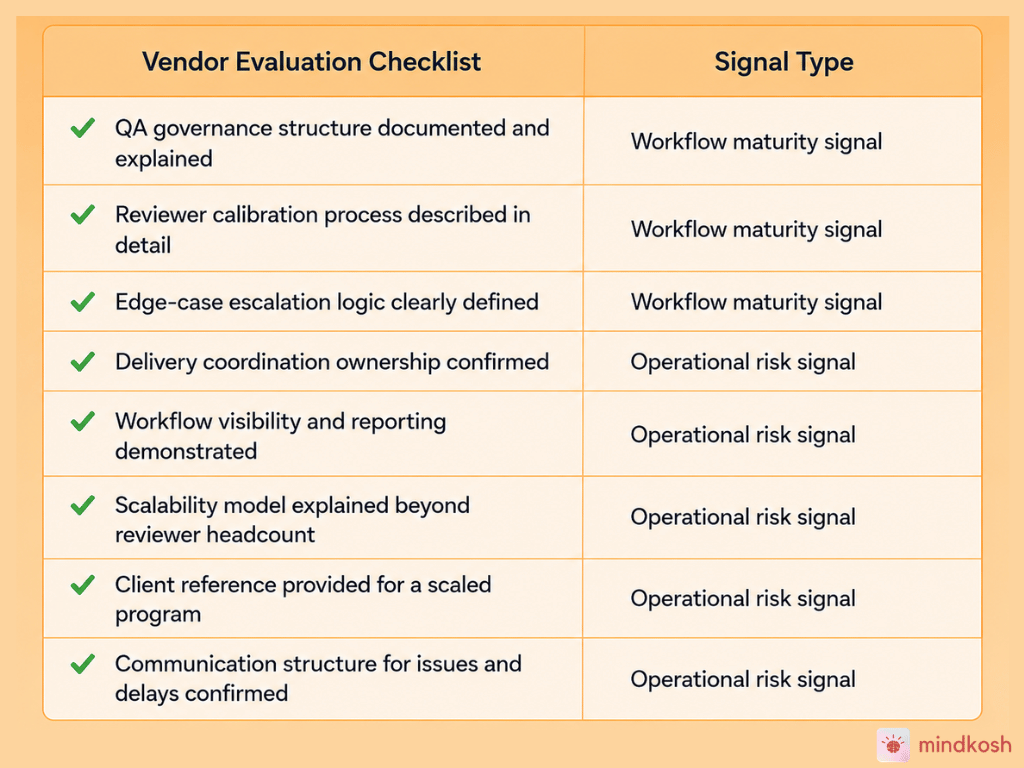
The evaluation framework above is most useful when operationalized into specific vendor conversations. The following questions are designed to surface workflow maturity and operational risk early in the procurement process, before a contract is signed and before onboarding begins.
Questions that reveal workflow maturity
- How are reviewer disagreements detected and resolved within your QA workflow?
- What processes do you use to monitor and prevent annotation drift across long-running projects?
- Walk us through what happens operationally during a significant volume spike. How does your workflow adapt?
- How are reviewers calibrated on an ongoing basis, not just during initial onboarding?
- How are edge cases identified and escalated? Who makes the final call on ambiguous annotation decisions?
- Can you provide an example of how your QA governance handled a quality issue in a previous program?
Questions that expose operational risk early
- What visibility will we have into your QA workflows and daily delivery metrics?
- Who specifically is responsible for delivery coordination on our account?
- How are delivery delays or quality issues communicated to the client team, and how quickly?
- How do you maintain annotation consistency if the program scales to two or three times its initial volume?
- What does handoff look like if we need to transition annotation data to a new tool or provider?
- Can we speak with a current client whose program scaled significantly during the engagement?
Teams that ask these questions systematically will identify operational gaps that standard RFP processes rarely surface. Vendors with mature operational systems answer these questions specifically. Vendors without them tend to respond with generalities.
If you want to go beyond these questions and score vendors systematically across criteria, Mindkosh'svendor evaluation tool lets you rate providers across key operational dimensions and generates a total score — making it easier to compare multiple vendors side by side with a consistent framework rather than relying on gut feel after a series of sales calls.
Why operational maturity matters more than short-term annotation pricing
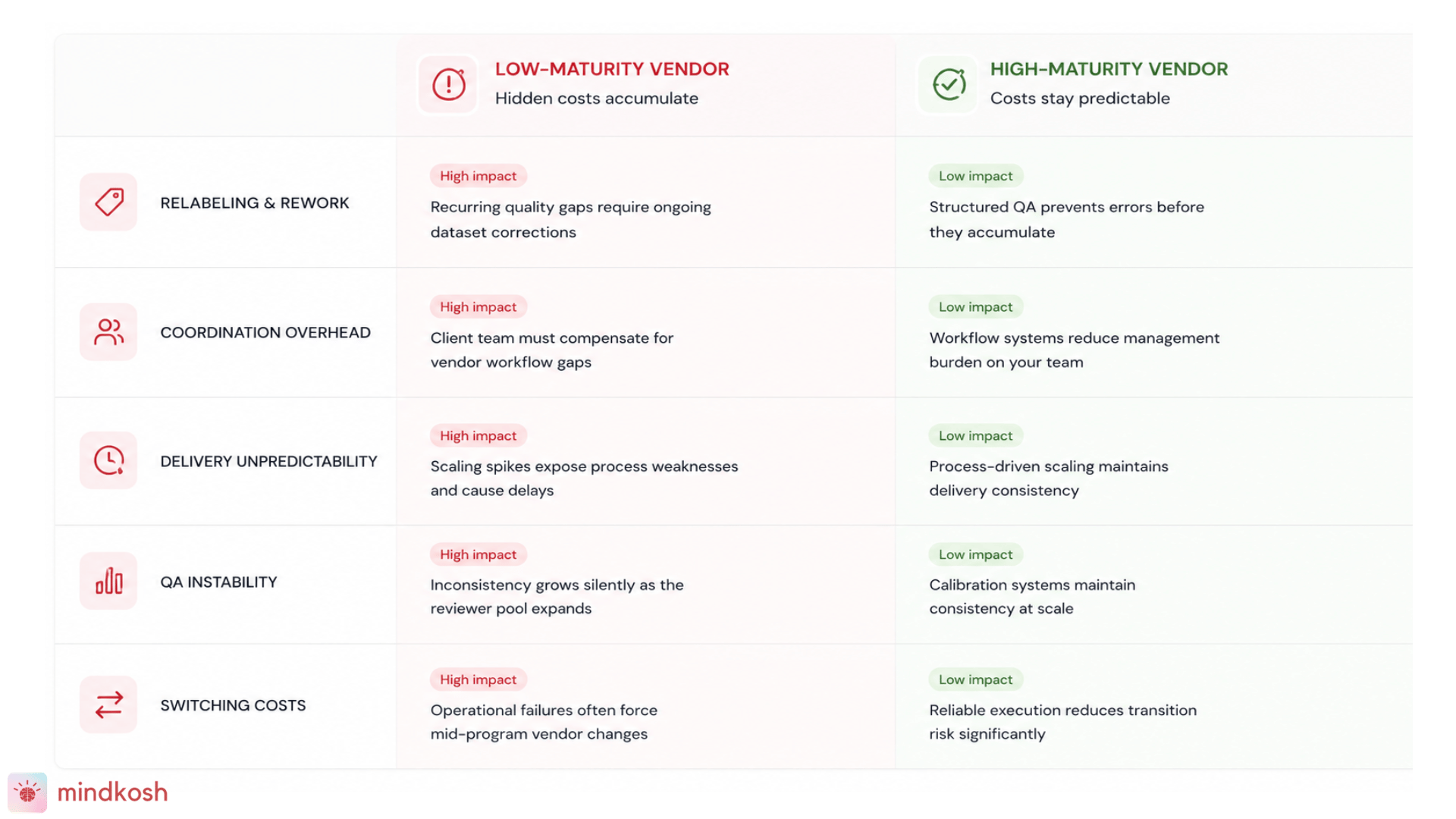
Annotation pricing is a visible variable. Operational maturity is an invisible one — until it becomes a problem. The total cost of an annotation program includes more than the per-annotation rate. It includes the QA overhead required to catch errors that the vendor’s systems miss. It includes the coordination effort needed to compensate for workflow gaps. It includes the rework costs when annotation inconsistency requires a dataset to be partially or fully relabeled. It includes the management time spent managing a vendor relationship that was supposed to reduce operational burden.
These costs are difficult to quantify in advance. They are much easier to quantify after they have already been absorbed. Teams that evaluate annotation vendors through an operational maturity lens are making a different kind of procurement decision. They are optimizing for predictable delivery, sustainable quality, and reduced coordination overhead over the life of the program — not for the lowest number on the initial pricing sheet.
The platforms that perform most reliably at scale tend to share a similar operational philosophy. They prioritize structured QA governance, workflow visibility, reviewer calibration, and scalable process design over surface-level throughput claims or aggressive pricing competition.
Mindkosh's positioning aligns closely with this model. Rather than framing annotation quality as a purely reviewer-level problem, the platform emphasizes workflow-level quality systems designed to maintain consistency as annotation complexity and program scale increase. Pricing transparency is part of that philosophy — Mindkosh's cost estimator gives you a clear picture of what your annotation program is likely to cost before you commit to anything.
Conclusion
The annotation vendor decision rarely fails at the point of selection. It fails months later, when the gap between what was promised during procurement and what was delivered under production pressure becomes impossible to ignore.
Selecting annotation vendors primarily on pricing, workforce size, or generic accuracy claims is a procurement approach optimized for the wrong outcome. It surfaces the dimensions that are easiest to compare rather than the dimensions that most reliably predict annotation program success.
The annotation partners that perform consistently over time — regardless of where they sit in the market — tend to share the same operational characteristics: structured QA governance, systematic reviewer calibration, meaningful workflow visibility, scalability systems built on process rather than headcount, and operational honesty about tradeoffs and constraints.
These are not marketing characteristics. They are operational ones. They are also the characteristics that are hardest to fake in a direct vendor conversation, which is precisely why asking for specifics matters so much in the evaluation process.
Ready to evaluate your annotation vendor options with a more operational framework?
Teams evaluating annotation providers often struggle to compare workflow maturity consistently using standard RFP processes. A structured evaluation approach — one focused on QA governance, reviewer calibration, and operational scalability rather than pricing alone — makes vendor selection significantly easier and reduces the risk of operational surprises after onboarding.
For teams evaluating annotation providers, the most useful vendor conversations are usually the ones focused less on feature lists and more on operational systems:
- how QA disagreements are resolved
- how reviewer consistency is maintained
- how workflows scale under pressure
- and how operational visibility is handled once programs move beyond pilot stages
Mindkosh’s workflow architecture is designed around many of these operational concerns, particularly for LiDAR and vision teams managing complex annotation programs at scale.
Explore Mindkosh’s annotation workflow approach or speak with the team about your program requirements.