


Autonomous vehicles rely on sensors to perceive and understand the world around them. While traditional sensors, such as cameras, provide a rich view of the surroundings, LiDAR has become a fundamental sensor due to its unique advantages. Let us first look at how LiDARs work and then explore why they play such a critical role in autonomous driving.
LiDAR is a remote sensing method that uses light in the form of a pulsed laser to measure distances. In a typical LiDAR device, a laser beam is used to send a pulse of light, which then bounces back after hitting surrounding objects. The Lidar system calculates the distance of an object based on the time it takes for the laser pulse to travel to the object and back.
General characteristics of LiDAR
Why these characteristics are critical for autonomous navigation (safety, reaction time, perception redundancy):
- High resolution: LiDAR sensors are high resolution, which allows them to capture fine-grained spatial details of the environment.
- Real-time data: LiDAR sensors can generate data in real time, making them ideal for applications that require immediate feedback, such as autonomous driving.
- Long range: LiDAR sensors can detect objects at significant distances, making them effective for mapping large areas, enabling early perception and planning.
- Field of view: LiDAR sensors have a wide field of view, allowing them to capture a large area in a single scan.
How is LiDAR used in autonomous driving
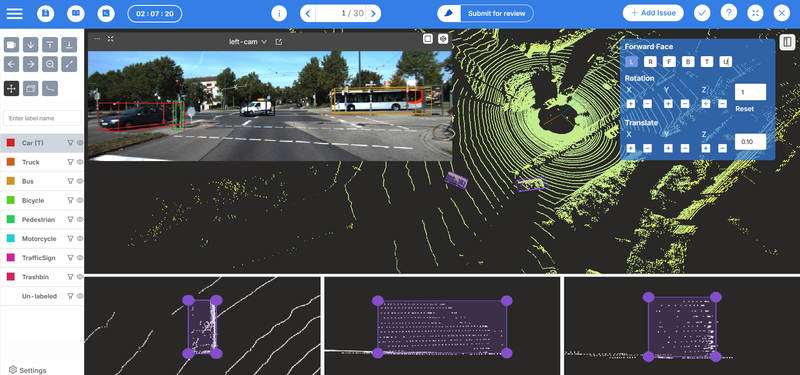
Lidar is a key component of the Sensor stacks most often used in Autonomous driving use-cases. Below we discuss how Lidars are used within this context. Note that other sensors like Sonar and Radars are also used in conjunction with Lidars to provide a redundant sensing system to the vehicle. You can learn more about the differences between Lidars, Sonars and Radar here.
Mapping & localization
LiDAR enables autonomous vehicles to generate dense point cloud maps of their surroundings. This provides the vehicle with detailed LiDAR, enabling autonomous vehicles to generate dense point cloud maps of their surroundings. Path planning is the process of determining how a vehicle will reach point B from point A. Localization, on the other hand, is the process of understanding where in the world the vehicle is currently located. Both of these are critical components of any autonomous driving system. You can learn more about Lidar mapping here.
Obstacle detection and avoidance
LiDAR sensors can detect and identify objects in the vehicle's path, regardless of lighting conditions. This makes it a reliable tool for autonomous vehicles operating at any time of the day or night. The sensors can also determine the distance and speed of the detected objects, enabling the vehicle to make timely decisions to avoid collisions.
Blind-spot coverage
LiDAR complements radar by providing detailed, high-resolution data about objects in the vehicle's blind spots. This additional depth and precision are crucial for avoiding collisions and ensuring the safe operation of the vehicle.
LiDAR data Annotation
High-resolution, real-time LiDAR data is only valuable if it can be accurately interpreted and labeled at scale. This requires high quality labeled datasets - but labeling multi sensor data such as Lidar + Cameras is not easy. Specialized Annotation platforms like Mindkosh are designed to work directly with dense point clouds, enabling teams to efficiently annotate 3D data for Sensor fusion use cases while preserving spatial accuracy and temporal consistency. By supporting fast iteration, accurate object labeling, and multi-sensor workflows, Mindkosh helps autonomous vehicle teams turn raw LiDAR data into reliable training and validation datasets—supporting safer perception and decision-making. You can sign up for Mindkosh here and try it for free.
Understanding different ADAS levels
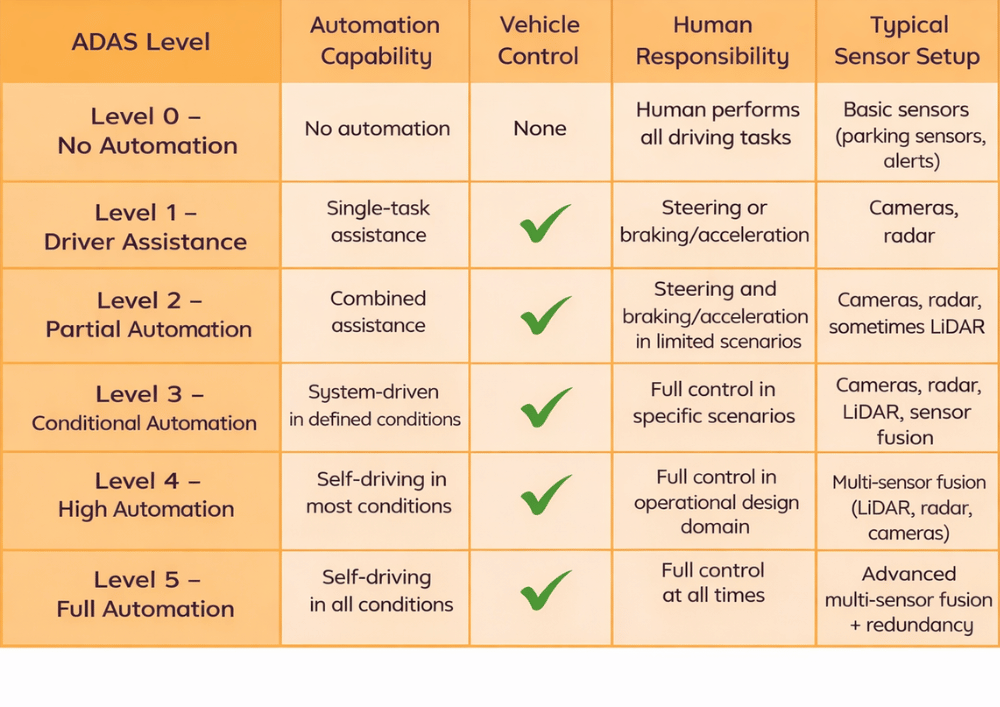
Advanced Driver Assistance Systems (ADAS) are technologies designed to automate, adapt, and enhance vehicle systems to improve safety and driving comfort. The capabilities of these systems range from partial driver assistance to full vehicle automation. These capabilities are categorized from Level 0 to Level 5, representing increasing degrees of automation.
ADAS Level 0: No Automation
At this level, all driving tasks are performed entirely by the human driver, even when enhanced by warning or intervention systems. The vehicle may issue warnings, but it cannot control any functions. An example of a Level 0 system is a simple parking sensor that beeps when you get too close to an object.
ADAS Level 1: Driver Assistance
In Level 1, the vehicle can assist the human driver in either steering or braking/accelerating, but not both simultaneously. This level of automation can include features such as Adaptive Cruise Control (ACC), which maintains a set speed and a specified distance from the vehicle in front, or Lane Keeping Assistance (LKA), which helps prevent the car from drifting out of its lane.
ADAS Level 2: Partial Automation
At Level 2, the vehicle can control both steering and braking/accelerating in certain circumstances. The human driver must continue to monitor the driving environment and be ready to take control of the vehicle at any time. An example of a Level 2 system is Tesla's Autopilot.
ADAS Level 3: Conditional Automation
In Level 3, the vehicle can manage all aspects of driving in certain conditions, but the human driver must be ready to take over when the system requests. The vehicle can decide when to change lanes and how to respond to events on the road, but the human driver must remain alert and ready to intervene.
ADAS Level 4: High Automation
At Level 4, the vehicle can drive itself under most conditions without human interaction. However, the human driver may still need to take over in certain rare situations. Level 4 vehicles can park themselves and navigate through city streets, but they may not be able to cope with every possible driving scenario.
ADAS Level 5: Full Automation
Level 5 represents the pinnacle of autonomous driving technology. At this level, the vehicle can perform all driving tasks under all conditions, just like a human driver. The vehicle’s performance matches that of a human driver across all driving scenarios, including extreme environments such as dirt roads or severe weather.
Is LiDAR necessary for autonomous vehicles?
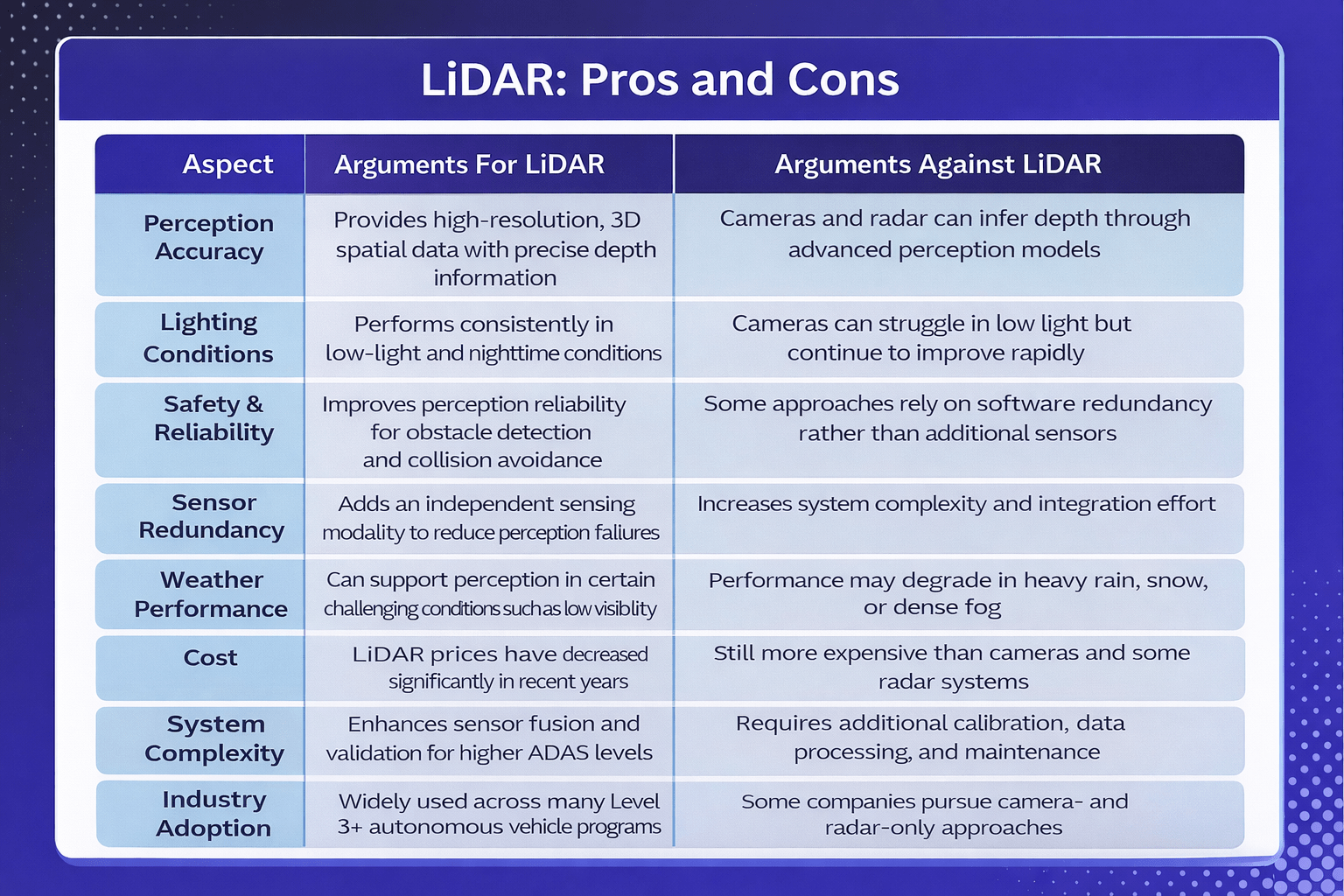
While LiDAR offers significant benefits, whether it is absolutely necessary for autonomous vehicles remains a subject of debate. Some experts argue that other technologies, such as cameras and radar, can provide sufficient data for autonomous navigation. Others maintain that Lidar's precision and reliability make it indispensable for ensuring the safety and efficiency of autonomous vehicles.
Arguments For LiDAR
- LiDAR provides high-resolution, three-dimensional data that other sensors cannot easily match.
- It is effective in various lighting conditions, making it reliable for 24/7 operation. Cameras struggle to provide details in low-light conditions, whereas LiDAR performs consistently in both daytime and nighttime conditions.
- LiDAR is also effective in certain adverse weather conditions, such as fog and low-light scenarios.
- LiDAR's ability to detect objects and their distance makes it crucial for obstacle avoidance.
Arguments Against Lidar
- LiDAR sensors are expensive, which can significantly increase the cost of autonomous vehicles. It should be noted that the prices of Lidars have come down significantly in the past few years and are expected to continue becoming cheaper. As a result, cost may become less of a limiting factor in the near future.
- Some experts believe that advanced camera and radar systems can provide sufficient data for autonomous navigation, making LiDAR unnecessary.
Understanding Tesla's stance on LiDAR
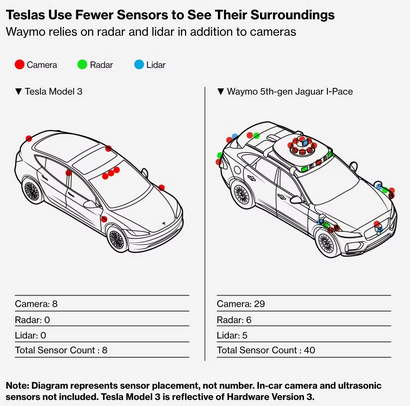
Tesla, one of the world’s leading electric vehicle manufacturers, has a unique stance on the use of Light Detection and Ranging (LiDAR) technology in the development of autonomous vehicles. Unlike many other car manufacturers and tech companies, Tesla has publicly dismissed the necessity of LiDAR in autonomous driving. This section examines Tesla’s viewpoint and the reasoning behind it.
Tesla's approach to autonomous driving
Tesla has always championed a different approach to autonomous driving. Instead of relying on LiDAR, Tesla's self-driving technology is primarily based on advanced sensors, artificial intelligence, and detailed mapping data. This combination is designed to interpret and react to real-world driving scenarios.
It should be noted that while Tesla does not use LiDAR on their cars, it uses data collected from LiDAR sensors on test vehicles to train better Machine Learning models. This data serves as an additional ground-truth signal for training the perception systems used to understand a car’s surroundings.
Why Tesla doesn't use LiDAR
There are several reasons why Tesla has chosen not to incorporate Lidar into its autonomous driving technology. These include:
- Cost: LiDAR sensors are expensive, and using them would significantly increase the cost of Tesla vehicles.
- Redundancy: Musk believes that the data obtained from LiDAR can also be gathered through other, less expensive means, such as cameras and radar.
- Reliability: Musk has expressed doubts over LiDAR's reliability in different driving conditions, such as heavy rain or fog.
Elon Musk's Statements on LiDAR
Elon Musk has been vocal about his skepticism towards Lidar. In Tesla's 2019 Autonomy Day, Musk famously referred to Lidar as a “fool’s errand”, reiterating his belief that the technology is unnecessary for achieving fully autonomous driving. He has remained consistent in this stance, stating that any company relying on Lidar is "doomed".
While Tesla’s camera-first approach has drawn significant attention, it remains an outlier in the broader autonomous vehicle ecosystem, where most manufacturers and AV developers continue to rely on LiDAR as part of a multi-sensor perception stack to improve robustness and safety.
Conclusion
While the debate continues, it is evident that LiDAR has a significant role to play in the development and operation of autonomous vehicles. Whether it is indispensable or not may depend on advancements in other sensor technologies and the specific requirements of different autonomous vehicle applications.
In safety-critical systems like autonomous vehicles, perception reliability is non-negotiable. LiDAR’s ability to provide accurate depth information across varying lighting conditions continues to make it a valuable component for building safer autonomous systems.