


You receive two quotes for the same annotation project. One is 30% cheaper than the other. On paper, this looks like an easy decision.
Most procurement teams choose the lower number. The service descriptions look identical. Both vendors claim high accuracy. Both promise fast turnaround. What exactly are you paying more for?
This is the question that defines how most annotation vendor evaluations begin — and where most of them go wrong. Because what makes annotation providers different is almost never visible in a quote. It lives inside their QA systems, their reviewer calibration processes, their escalation workflows, and how consistently they maintain output quality across thousands of labels and weeks of production work.
The cheapest annotation provider isn't always the lowest-cost choice. This article explains why, and gives you a practical framework for figuring out which one actually is.
Why pricing alone tells you very little about annotation value
Procurement teams gravitate toward cost-per-label comparisons for a reasonable reason: price is easy to compare. You can put two numbers next to each other in a spreadsheet and immediately see which one is smaller.
Quality is much harder to evaluate before a project starts. You cannot audit a vendor's reviewer calibration process from a sales deck. You cannot assess escalation logic or disagreement resolution workflows from a pricing proposal. And vendors rarely volunteer this information unprompted.
So buyers default to what they can see: the quote.
Annotation is not a commodity service
The problem with cost-per-label thinking is that it assumes all labels carry equal value. They don't.
A label produced by a calibrated reviewer operating inside a mature QA system has a meaningfully different operational value than a label produced without those safeguards — even if both labels look correct on initial review. One will hold up at scale. The other introduces variance that compounds quietly across your dataset.
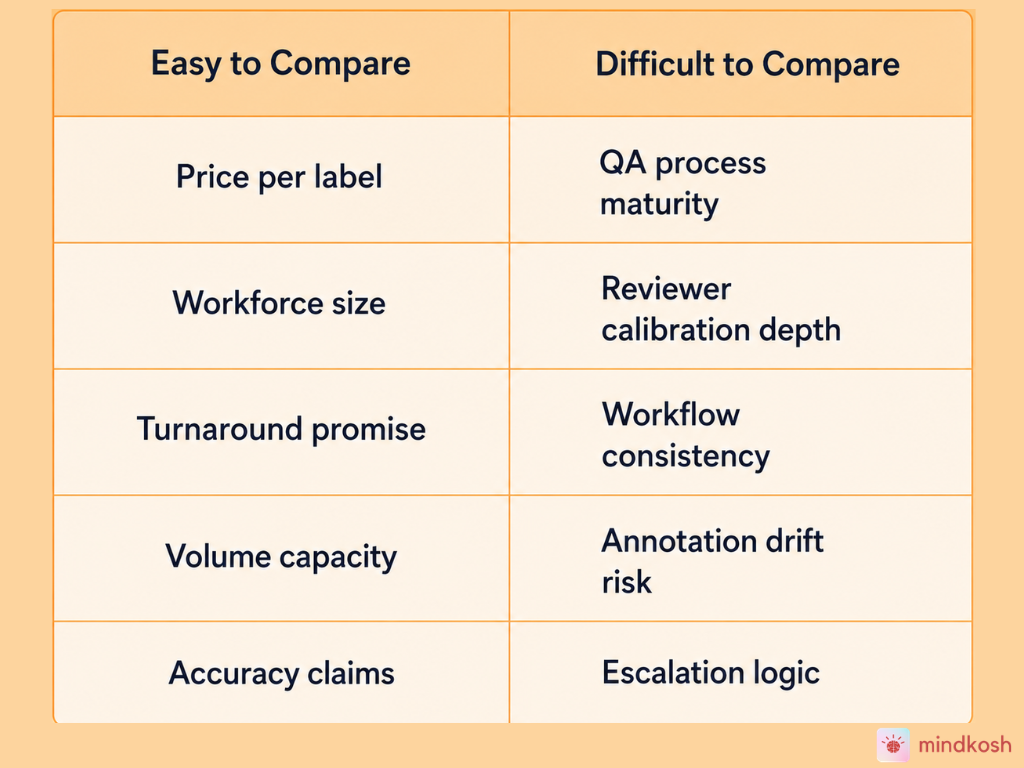
This table reflects a structural problem in how annotation vendors are evaluated. The columns on the left are what most buyers compare. The columns on the right are what actually determines output quality and downstream cost.
What data labeling quality actually means in practice
Most annotation vendors define quality as accuracy. Their proposals include inter-annotator agreement scores, sample QA pass rates, and accuracy percentages. These numbers matter, but they only capture part of what quality actually means in a production annotation environment.
Operational quality is not accuracy alone. It is repeatability.
A vendor can produce accurate labels in a controlled sample while still generating inconsistent outputs across a live dataset — because accuracy in isolation does not guarantee that the same decisions will be made the same way across all reviewers, all edge cases, and all working conditions.
The challenge is that repeatability is difficult to measure from a sales deck. Accuracy percentages are easy to publish. Consistency is harder to verify. One practical approach is to look beyond vendor claims and examine patterns in customer feedback. When reviewing case studies, G2 reviews, testimonials, or customer discussions, look for recurring mentions of consistent quality, reliable delivery, clear communication, and predictable outcomes over long-running projects. Those signals often reveal more about operational quality than headline accuracy numbers.
Similarly, ask vendors how they maintain consistency across reviewers and over time. Teams with mature annotation operations can usually explain their calibration processes, disagreement resolution workflows, and QA systems in specific operational detail. Teams without those systems often fall back on broad accuracy claims.
Consistency across reviewers and time
Real annotation quality means that two reviewers looking at the same object apply the same classification logic. It means that a reviewer working on frame 1,000 of a dataset applies the same decision criteria they applied on frame 10. It means that your labeling guidelines are interpreted consistently — not approximately.
This requires active calibration. Reviewers need alignment sessions. Guidelines need to be tested against real ambiguous cases. Disagreements need to be resolved through a documented process, not left to individual judgment.
The QA systems behind reliable data labeling
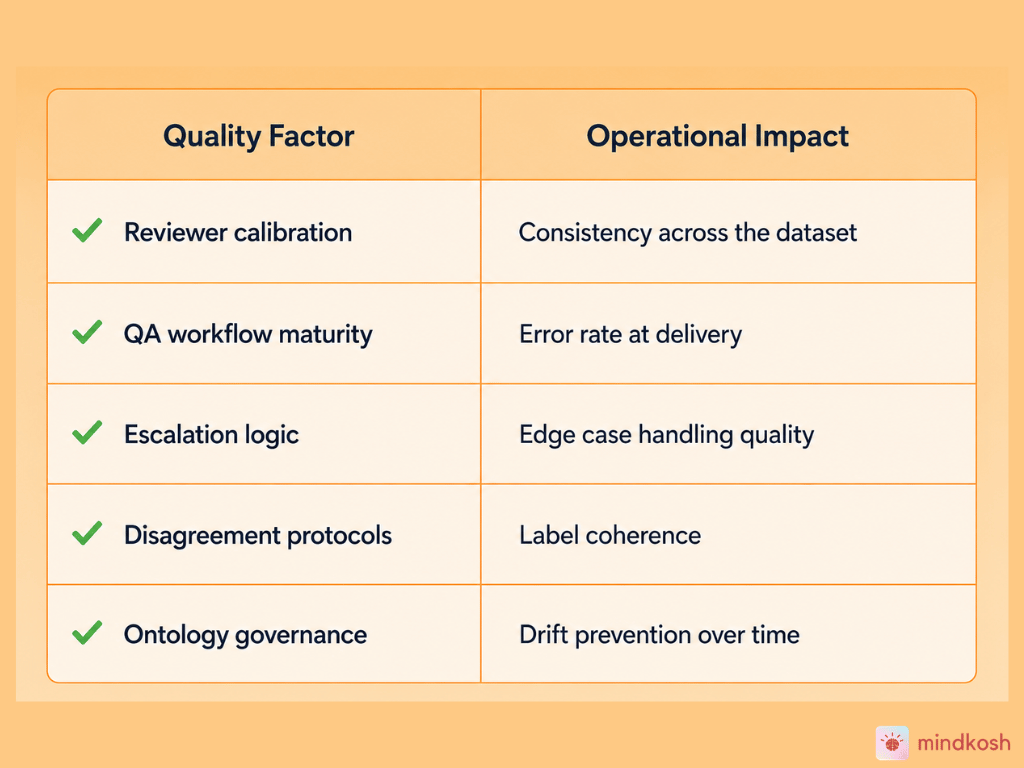
Quality at production scale depends less on individual reviewer skill than on the systems surrounding them. Those systems include:
- QA workflows that catch errors before data exits the annotation pipeline
- Escalation logic that handles edge cases without creating bottlenecks
- Disagreement management processes that resolve ambiguous annotations consistently
- Feedback loops that update reviewer behavior based on QA findings
- Ontology governance that maintains label consistency as guidelines evolve
Vendors who have built these systems produce more operationally reliable data. Vendors who haven't may still produce accurate-looking outputs in the short term — but the variance shows up eventually, and it shows up in your model.
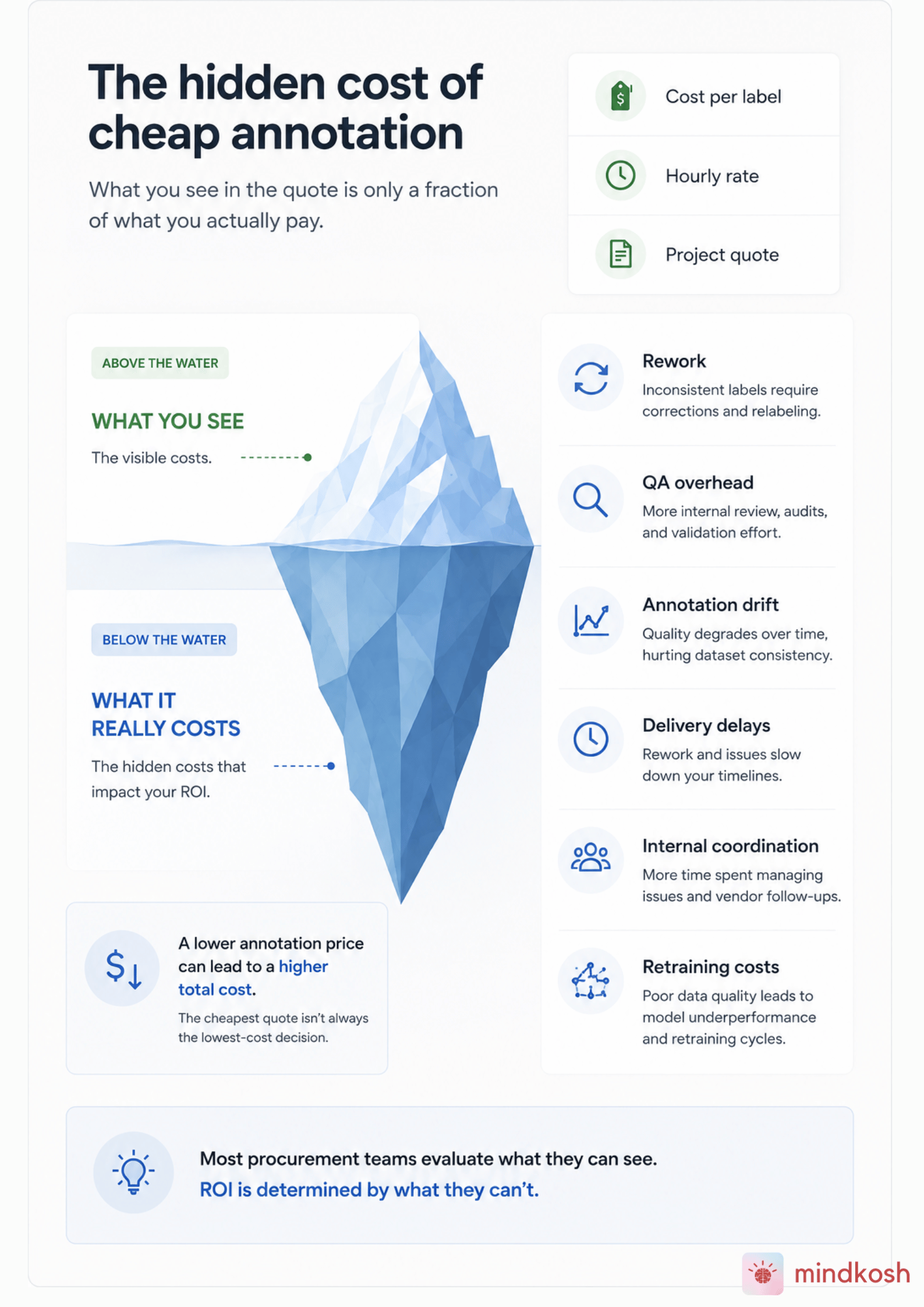
The hidden costs of cheap annotation
Lower pricing doesn't automatically mean lower quality. But it often reflects operational tradeoffs that move costs — rather than eliminating them. When a vendor compresses their price, something absorbs that compression. It is usually QA depth, reviewer calibration investment, or workflow infrastructure.
And when those elements are thin, the costs don't disappear. They transfer downstream to your team.
Rework and QA overhead are the most direct hidden costs
When annotation quality is inconsistent, the cost rarely disappears. It simply moves downstream.Labels that require correction, clarification, or additional review create rework and increase the QA burden on your internal team.
The savings gained from a lower annotation price can quickly be offset by the time spent auditing outputs, resolving inconsistencies, and managing additional review cycles. The question is not just how much annotation costs. It is how much work it creates after delivery
Annotation drift creates long-term model risk
Drift is what happens when annotation decisions gradually shift over the course of a project — reviewers start interpreting edge cases differently, boundary conditions get handled inconsistently, and the resulting dataset contains subtle contradictions.
Models trained on drifted datasets develop unstable behavior. They perform well on some subsets and poorly on others, in ways that can be difficult to trace back to the data rather than the model architecture. Identifying drift as the root cause often happens late — after retraining cycles have already consumed significant time and compute.
Small quality failures compound across the ML lifecycle
The most damaging aspect of annotation quality issues is how they scale. A 3% inconsistency rate in a dataset of 10,000 labels produces 300 problematic samples. At 100,000 labels, that's 3,000. Each problematic sample touches model training, QA, and potentially production performance.
How data labeling quality affects ROI long before deployment
Here is the strategic reality that most annotation conversations miss: ROI impact from annotation quality begins at the labeling stage, not at deployment.
By the time a model underperforms in production and the data quality is identified as a contributing factor, your team has already absorbed the cost of training, evaluation, debugging, and potentially retraining. The annotation invoice was paid months ago. But the cost of that annotation — the real cost — is still accumulating.
The relationship between quality and operational efficiency
High-quality annotation reduces the total amount of operational work required to get training data into production. Fewer QA cycles. Less rework. More predictable delivery. Fewer surprises during model evaluation.
Low-quality annotation creates operational drag at every stage — increasing the coordination burden on your team and slowing down the overall ML pipeline.
ROI starts at annotation, not at deployment
This is the reframe that changes how annotation procurement should work. The question is not just: How much does this annotation cost? The question is: How much total operational work does this annotation create or prevent?
A quality-aware annotation partner reduces downstream friction. A low-price, low-QA partner often shifts that friction onto your internal team — where it is harder to see, harder to budget for, and harder to recover from.
When cheaper annotation actually makes sense
This is worth saying clearly: not every annotation project requires the same level of quality infrastructure.
For pilot projects, proofs of concept, internal experimentation, and low-stakes research datasets, the cost-to-quality tradeoff shifts. If you are testing a model concept, not preparing production training data, the operational consequences of annotation variability are lower. A faster, lower-cost vendor may be entirely appropriate.
The mistake is not choosing a lower-cost vendor. The mistake is choosing a lower-cost vendor for production-grade work while assuming the quality difference is negligible.
How to evaluate data labeling services beyond pricing
Evaluating annotation vendors effectively means expanding your criteria beyond what is easy to compare. The following framework gives procurement teams a more complete picture.
Pricing carries weight in this framework — but it doesn't dominate the decision. A vendor scoring highly on QA maturity, reviewer calibration, and delivery consistency may represent better ROI at a higher price point than a low-cost vendor who underperforms on all three.
Questions to ask annotation vendors before committing
- How do you calibrate reviewers before a project begins?
- What is your process for resolving annotation disagreements?
- How do you detect and correct annotation drift over long projects?
- What QA steps happen before data is delivered?
- How do you handle edge cases that fall outside the original guidelines?
- What happens to delivery timelines when volume spikes?
Vendors with mature QA systems will answer these questions specifically. Vendors without them will give general answers about accuracy rates.
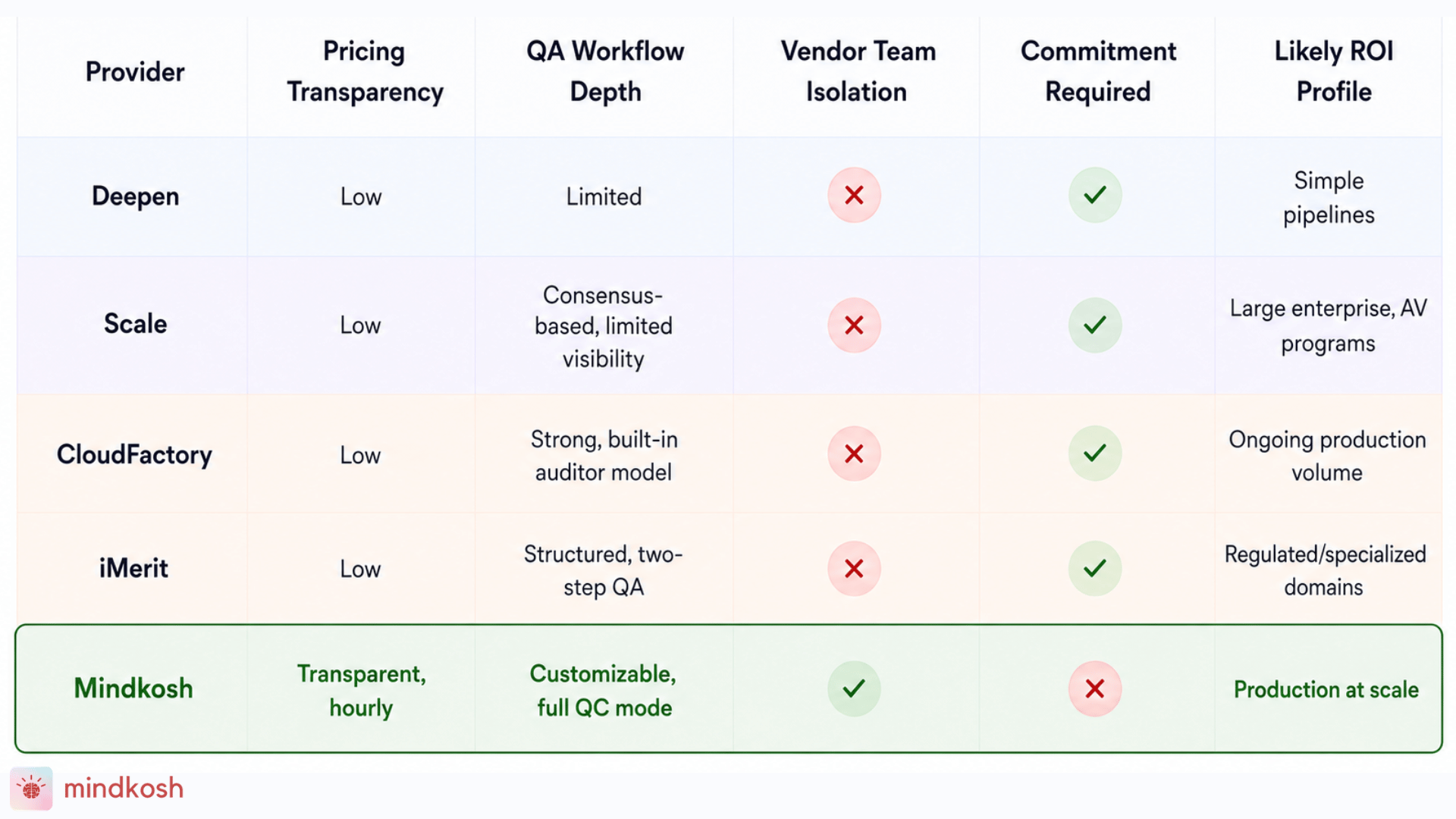
Comparing four annotation providers when quality and ROI are included
Applying this framework to real annotation providers reveals how different the picture looks when you move beyond per-label pricing.
The four platforms reviewed here — Deepen, Encord, Kognic, and Segments.ai — are well-known in the annotation space. Each has meaningful strengths. Each also carries operational tradeoffs that matter at production scale.
Deepen
Pricing position: Not publicly revealed; requires long-term commitments.
Quality focus: Deepen offers annotation workflow support, but its workflow is limited to three fixed stages with no customization. There is no central issue management system — issue tracking lacks in-app chat and a unified browsing interface, which creates communication gaps during QA.
QA sophistication: Moderate. The workflow structure exists but is rigid. Buyers who need customizable QA stages or complex review logic will find Deepen's tooling limiting.
Likely ROI profile: Suited to teams with simpler annotation pipelines and lower QA complexity. Not well-suited for high-volume, multi-reviewer projects that require workflow customization or robust issue management.
Scale
Pricing position: Not publicly listed for managed annotation; self-serve tier offers a free allocation before per-unit rates apply, but enterprise engagements require sales negotiation and typically involve annual volume commitments.
Quality focus: Broad multi-modal coverage including image, video, LiDAR, and sensor fusion, with strong tooling built for autonomous vehicle and robotics use cases. Historically relies on a large distributed contractor workforce rather than a fully in-house team, which has drawn recurring criticism around quality consistency.
QA sophistication: Uses consensus scoring and quality multipliers to manage output reliability, but published detail on client-facing issue tracking or dispute-resolution workflows is limited — pricing and process opacity is a consistent theme across independent reviews.
Likely ROI profile: Strong fit for large enterprises with big budgets and complex, multi-sensor annotation needs, especially in autonomous vehicle programs. Less suited to teams that need predictable, transparent pricing or a fast, low-friction path from evaluation to production.
CloudFactory
Pricing position: Consumption-based, hourly pricing negotiated through direct sales; no published rate card, but a free pilot/analysis is offered before commitment.
Quality focus: Uses a dedicated, managed workforce rather than a crowdsourced model, with a defined "auditor model" — every item gets a second set of eyes — supported by gold-standard datasets and double-blind review checks. Particularly positioned for regulated industries like healthcare and financial services.
QA sophistication: Built-in QA at each workflow stage, plus a dedicated Client Success Manager and Delivery Team Lead assigned per project. Some independent reviews note limited workflow customization and occasional delivery timeline inconsistency as tradeoffs of the managed-team model.
Likely ROI profile: Strong fit for teams running large, ongoing production volumes that need consistency and compliance documentation over time. Less suited to short, one-off projects or teams that want fast self-serve setup, since onboarding runs through a sales and pilot process rather than instant access.
iMerit
Pricing position: Not publicly listed; pricing is typically structured as either an hourly full-time-equivalent rate or a transactional rate tied to throughput, negotiated per client with no published long-term-commitment terms.
Quality focus: Domain-specialized in-house workforce covering medical, autonomous vehicle, and geospatial annotation, with genuine LiDAR and sensor-fusion capability delivered through its proprietary Ango Hub platform.
QA sophistication: Structured two-step production-and-QA workflow, with solution architects performing sample-based audits and real-time analytics tracking edge cases and delivery quality. Some reviews note that QA can become manual and time-intensive at very large project scale.
Likely ROI profile: Strong fit for regulated or safety-critical domains — autonomous vehicles, medical imaging, geospatial — where credentialed expertise and audit trails matter more than speed. Less suited to teams needing rapid pilot-to-production turnaround, since onboarding is more structured and slower than lighter-weight vendors.
Mindkosh approaches annotation ROI differently
Most annotation providers focus on helping teams create labels faster. Mindkosh approaches the problem from a different angle: reducing the operational costs that poor-quality annotation creates downstream.
The platform is built around the idea that annotation quality is not simply an annotator problem —it is a workflow problem. When quality issues are caught late, teams spend more time reviewing data, resolving disagreements, managing rework, and retraining models. Mindkosh's QA-first workflow is designed to prevent those costs from accumulating in the first place.
Several platform capabilities support this approach:
- Multi-annotator validation helps identify disagreements before annotations reach production, reducing the risk of inconsistent labels entering the dataset.
- Honeypot testing continuously measures annotator performance using pre-labeled tasks, helping teams identify quality issues early.
- Targeted reviewer workflows allow reviewers to focus on low-agreement samples and edge cases instead of manually reviewing every annotation.
- Issue tracking and escalation workflows ensure ambiguous samples are surfaced and resolved consistently rather than being handled differently by individual annotators.
- Reviewer scoring and performance tracking create a feedback loop that helps maintain consistency across teams and long-running projects.
The result is not simply higher annotation accuracy. It is lower operational overhead.
Fewer disagreements need to be revisited. Less internal QA effort is required after delivery. Edge cases are handled more consistently. And teams spend less time debugging problems that originate in the training data months later.
For organizations building production-grade AI systems, these operational savings often have a greater impact on ROI than the difference between two annotation quotes.

Conclusion
The invoice you pay for annotation is not the real cost of annotation. The real cost includes every hour your team spends auditing data that should have arrived clean, every rework cycle that delays a model training run, every retraining pass triggered by inconsistent labels, and every deployment delay caused by data your model couldn't learn from reliably.
Annotation providers look similar on a quote. They are not similar in operation. The differences live in QA maturity, reviewer calibration depth, workflow infrastructure, and how they handle the parts of annotation work that don't appear in a sales presentation.
A quality-adjusted ROI framework doesn't make the cheapest option wrong. It makes the evaluation more honest. And for most production-grade annotation programs, honest evaluation points toward providers who invest in the systems that prevent downstream costs — not just the ones who minimize the invoice.
If your annotation program is scaling and quality consistency is becoming a real operational concern, Mindkosh is worth a closer look.
Mindkosh offers annotation tooling built around the QA and workflow infrastructure that production-grade labeling actually requires — without the pricing opacity or long-term commitment structures that make vendor evaluation harder than it needs to be.
FAQ
What is data labeling quality, and why does it matter?
Data labeling quality refers to how consistently and accurately annotations are applied across a dataset — including reviewer calibration, QA workflow maturity, and how disagreements are handled. Poor quality directly increases rework, QA overhead, and model training costs, making it a central driver of annotation ROI.
How does poor annotation quality affect AI model performance?
Low-quality annotation introduces inconsistencies and contradictions into training data. Models trained on this data develop unpredictable behavior — performing well on some subsets while failing on others. These issues are difficult to diagnose without tracing them back to the annotation stage.
How should I evaluate data labeling services beyond price?
Evaluate vendors on QA process maturity, reviewer calibration methodology, workflow customizability, issue management capability, delivery consistency, and scalability under volume pressure. Weigh these criteria alongside pricing rather than allowing price to dominate the comparison.