
Get your data collection pipeline for Physical AI up and running
Lightning fast
Ambitious robots require data at a scale that matches their ambitions. Mindkosh is the infrastructure layer that lets you run large data collection programs efficiently, and get the datasets you need to train your models, quickly.
One pipeline, from raw footage to dataset
All you need is an app
The mobile app is the lower-friction path to egocentric data — iPhone or Android, no dedicated hardware required. For many teams, the app alone is enough to get started with physical AI data collection.

head-mounted camera preview
Set recording requirements once per collection project, and every collector gets the same in-app instructions and guardrails automatically.
Low light, a static scene, low battery, a recording running long — the app flags failure modes the moment they happen, so the collector team can address the problems immediately.
Captures synced video and IMU, and derives head-tracking straight from phone sensors — no extra hardware required.
From raw uploads to training-ready dataset, automatically
Privacy handled before anyone sees the footage
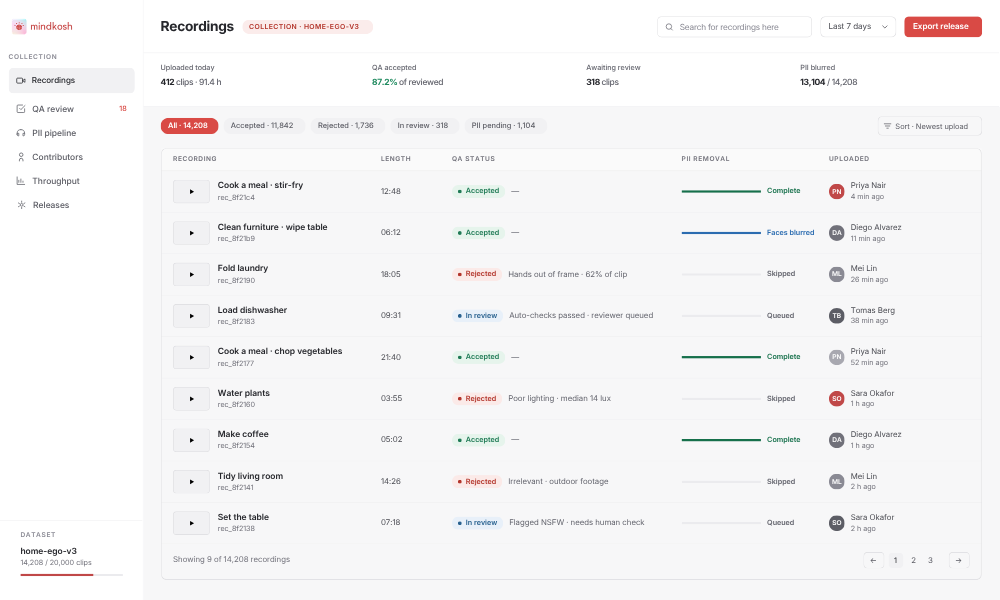
Faces, plates, and other personally identifiable details are automatically detected and redacted on ingest — so your dataset is compliant by default.
Ingest and QA, without the manual review queue
Videos stream in from phones and custom hardware straight into the pipeline. Automated QA checks run against your project's own criteria, so unusable footage gets flagged before it ever reaches a human reviewer.
Data curation built in
Every clip is indexed as it's ingested. Semantic search lets you query your entire dataset in plain language — "person picking up a mug in low light" — instead of scrolling through timestamps and episode descriptions.
Powerful search coupled with rich metadata help you find edge cases quickly. The rare failure mode buried in ten thousand hours of footage stops being a needle in a haystack.
High quality labels for every frame, at scale
Training needs highly accurate labeled datasets, not just raw videos. We label all the signals physical-AI policies train on — hands, contact, target objects, language and more.
Hand & body keypoints
Per-frame 2D and 3D keypoints for hands, fingers and full-body pose — the contact and articulation detail manipulation policies depend on.
Video segmentation
Pixel-accurate masks tracked across the whole clip — hands, objects and scene elements held consistent frame to frame.
Target-object labels
Which object the actor is reaching for, grasping or acting on at each moment — grounded to its mask and track.
Vision-Language-Action
Natural-language task and sub-step descriptions aligned to the video timeline and paired with the action segments they refer to — ready for VLA training.
Temporal action segments
Start and end boundaries for every action and sub-action, so long recordings break down into labelled, retrievable units.
2D & 3D bounding boxes
Object and region boxes when a full mask isn't needed — with rig pose providing 3D extent where the hardware supports it.
Model-assisted, human-verified
ML models pre-label the first pass on almost everything — keypoints, masks, boxes, action boundaries, allowing annotation at scale.
Trained annotators review every frame, correct what the model got wrong, and sign off — so the labels you train on meet a manual-review quality bar at automated-labelling speed.
Wearable hardware custom built for physical AI
Mono or stereo, your choice
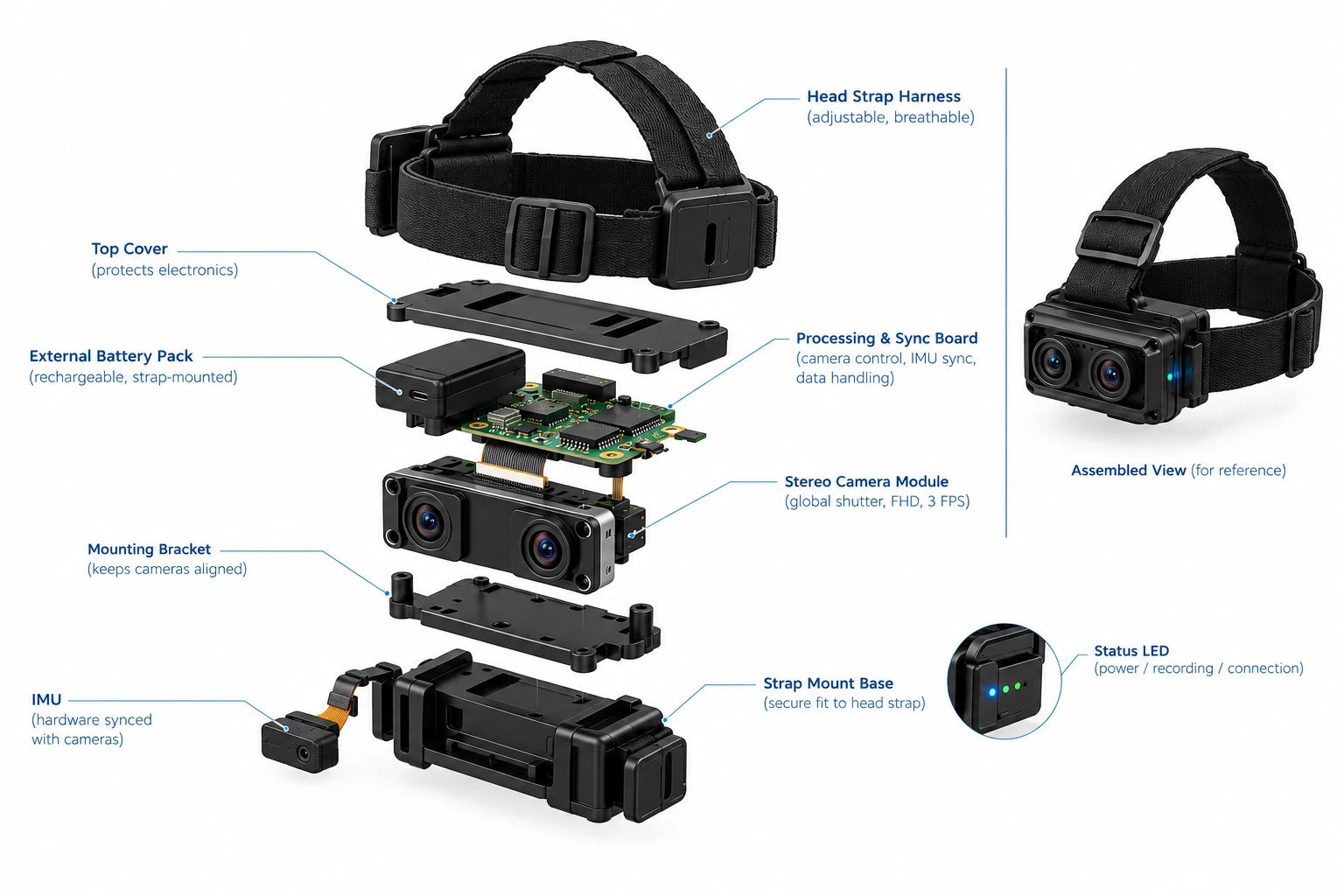
The same headmounted rig ships in mono and stereo configurations, so you can match the sensor setup to the policy you're training — without switching hardware between projects.
Every device is hardware-synced and ready to use when it reaches collectors, so they can get started immediately.
Global shutter and hardware-synced IMU
Rolling shutter turns fast head motion into wobble and skew — exactly the artifact that corrupts physical AI training data. All cameras on the rig use a global shutter instead, so motion stays sharp in every frame.
IMU and camera are synced at the hardware level, not stitched together after the fact, so pose and video timestamps line up to the frame with remarkable accuracy.