


iPhone or custom hardware, which one should capture your IMU and head pose data?
Both can, but not equally well. Most data collection vendors supply the capture hardware to their collectors rather than relying on whatever device a collector happens to own, since a personal device might not meet a project's specifications or might behave differently from one collector's phone to the next. The real decision, if you're evaluating a vendor, is which hardware that vendor has standardized on: an iPhone, which can run the software needed for egocentric capture, or a custom rig, built specifically for the task.
Every modern phone already has an IMU and a capable camera. So why do some vendors still build their own hardware instead of just handing collectors an iPhone? In this blog, we dive deeper into the differences and uncover the best approach for you.
What is IMU hardware?
IMU stands for inertial measurement unit. It's a small sensor package, usually an accelerometer paired with a gyroscope, that tracks motion and orientation. Paired with a camera, an IMU is what lets a system work out head pose, meaning which way the wearer's head was pointing and how it moved, frame by frame.
For a fuller grounding in egocentric data itself, our Egocentric Data Collection: A Beginner's Guide covers that in depth.
Can a smartphone be used for egocentric data collection?
Yes. Most modern iPhones already carry everything needed: a camera, an accelerometer, and a gyroscope. The iPhone 11 is a reasonable example to use as a reference point, since it was the first iPhone with an ultra-wide camera, which helps keep both hands in frame during a task. iPhones have had an accelerometer since the very first model, and a gyroscope since the iPhone 4, so this hardware isn't new.
What does custom hardware add that a phone doesn't?
Two things stand out: a global shutter instead of a rolling one, and an IMU synced to the camera in hardware instead of software. Both are covered in more depth just below. Neither can be bolted onto a phone after the fact, since they come from how the sensor itself is built.
Phone vs custom rig, side by side
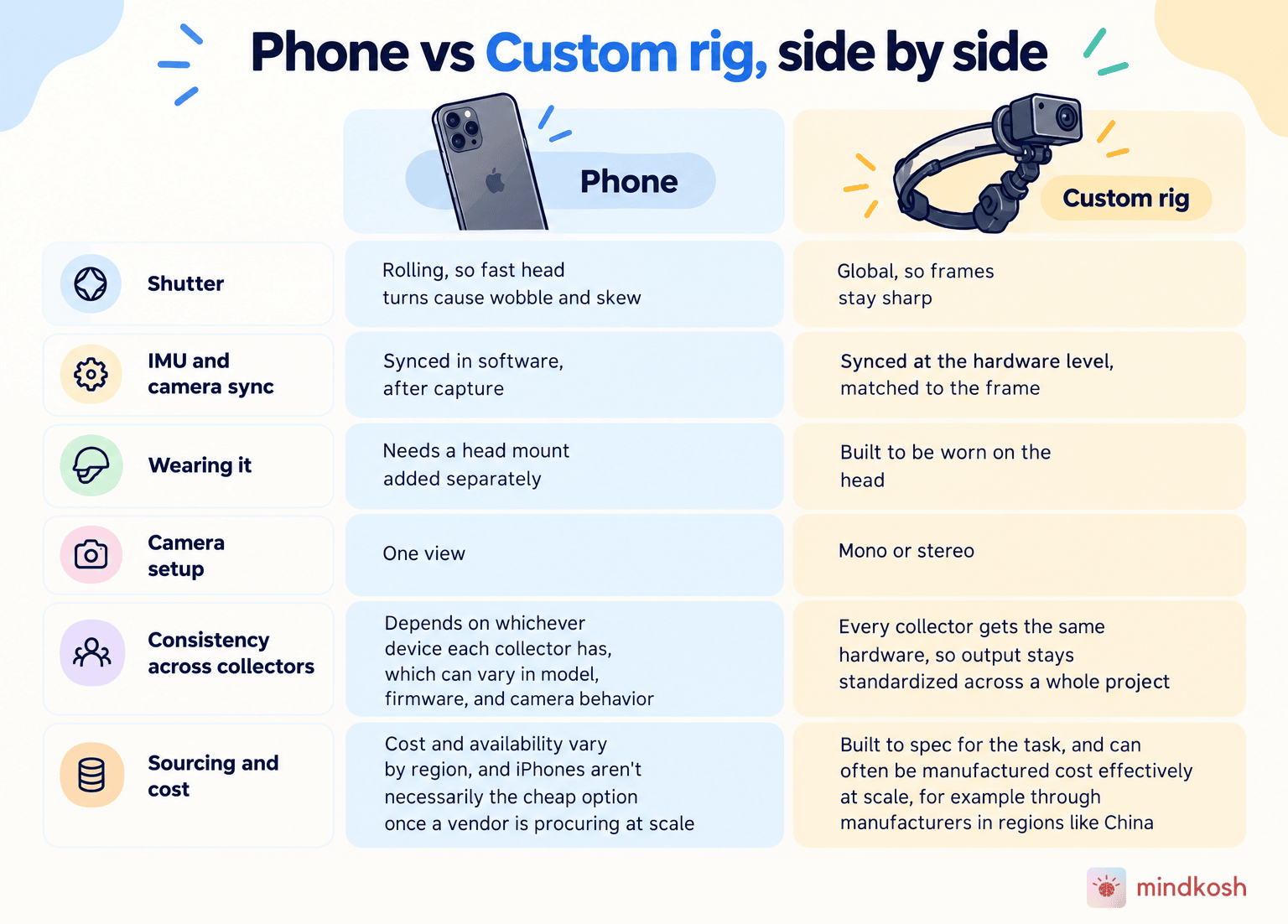
Mindkosh builds its own [purpose-built egocentric capture hardware], head-mounted, available in mono or stereo, with the IMU synced to the cameras in hardware rather than software.
Rolling shutter vs. global shutter
A global shutter reads every pixel on the sensor at the same instant, so the whole frame represents one single moment. A rolling shutter reads the sensor row by row in a sweep, so the top and bottom of one frame are actually captured a fraction of a second apart.
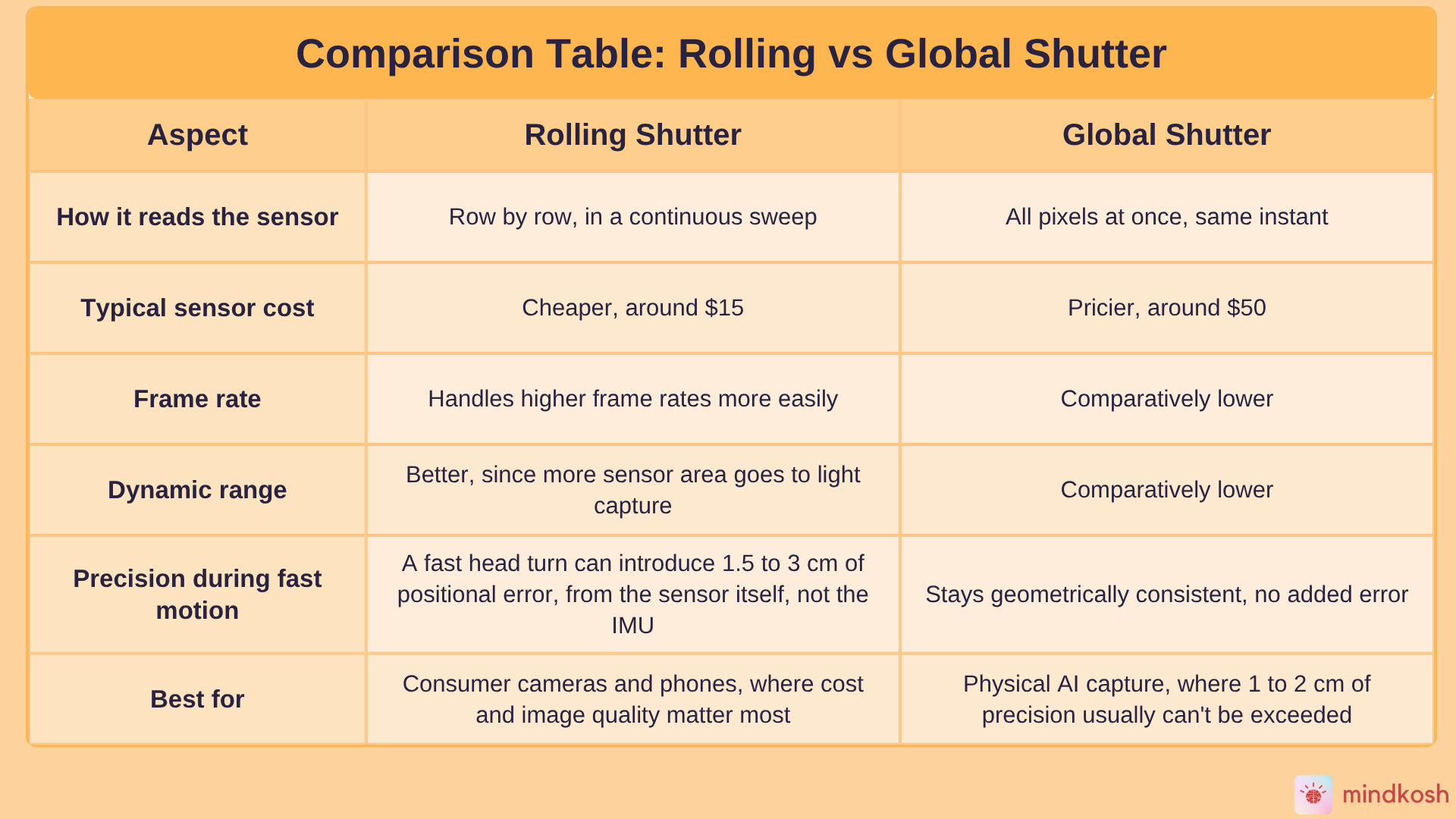
A rolling shutter is the one you'll find in almost every consumer camera, phones included, mostly because it's cheaper to build. It needs far less hardware per pixel, one shared row of capacitors swept across the sensor, instead of a dedicated capacitor sitting behind every single pixel. That difference shows up directly in price: a rolling shutter sensor can run around 15 dollars, where an equivalent global shutter sensor runs closer to 50. At the scale a data collection vendor is buying hardware, that gap adds up fast.
That cheaper design happens to perform well on two things that matter a lot for ordinary photography and video. Rolling shutter sensors handle higher frame rates more easily, which matters for egocentric capture, since 30 frames per second or more is usually the target. They also tend to have better dynamic range, meaning they hold detail in both a bright window and a dark cabinet in the same shot, since more of the sensor's physical space goes toward capturing light rather than storing charge.
So why bother with the more expensive option at all? The problem shows up specifically during fast motion. A head turn moving at around 120 degrees per second, while a rolling shutter sensor spends 15 to 30 milliseconds reading out a single frame, can shift the top and bottom of that frame by roughly 2 to 3.6 degrees relative to each other. At arm's length, that turns into something like 1.5 to 3 centimeters of apparent positional error. Not from the IMU, and not from tracking drift, but from the sensor itself reporting a frame that was never geometrically consistent to begin with. For physical AI work, where an end effector's position usually can't be off by more than 1 to 2 centimeters, that single-frame error can be enough on its own to make a take unusable. Put simply, the trade-off is this: a global shutter costs more per device, so the real question is whether the better tracking quality it gives you saves enough in rejected footage, and in how well the trained model performs, to be worth paying for.
Mono or stereo
Mono uses a single camera and has to infer depth. Stereo uses two cameras spaced apart, the way your own two eyes are, so the difference between what each camera sees, called disparity, converts directly into a real depth measurement.
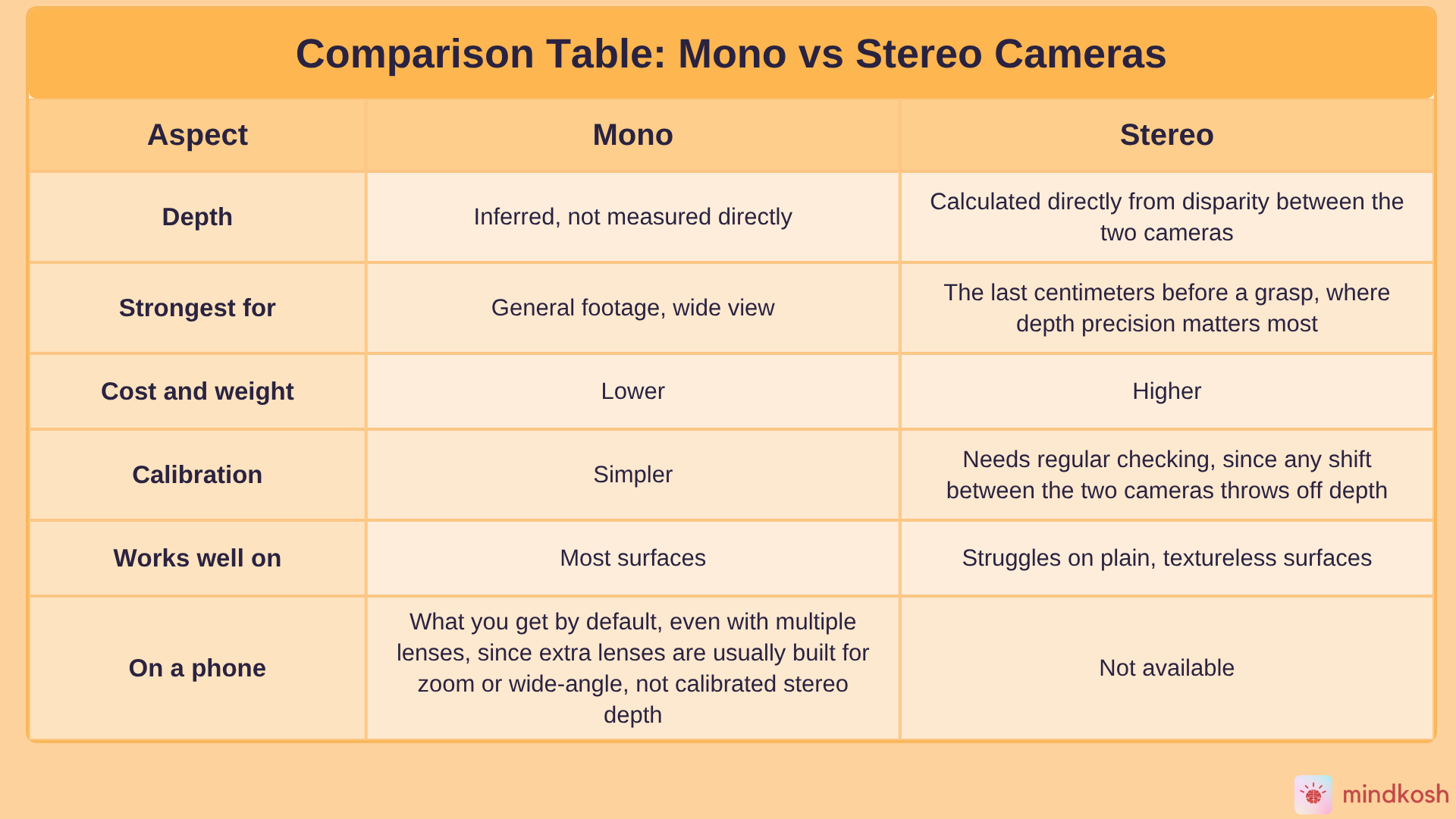
The distinction matters most in exactly the moments that are hardest to get right: the last centimeters before a hand closes around an object, or any frame where the hand partly blocks the object it's reaching for. A calibrated stereo pair removes most of the depth ambiguity in those moments, within its working range. A mono setup is left guessing.
Stereo isn't free of tradeoffs. Stereo rigs cost more and weigh more, and their calibration needs checking regularly, since even a small physical shift between the two cameras throws off the depth measurements. Stereo also performs worse on plain, textureless surfaces, and only works well within a specific depth range.
Most phones, even ones with multiple lenses, aren't giving you a calibrated stereo pair for this purpose. The extra lenses on a phone are usually built for zoom or wide-angle shots, not for the fixed, calibrated geometry stereo depth needs. Mindkosh's own rig, as covered above, ships in both mono and stereo configurations, so the choice comes down to whether the task you're training for genuinely needs that depth precision, not whether the hardware can technically support it. Mindkosh's own rig ships in both mono and stereo, so the choice comes down to whether the task you're training for genuinely needs that depth precision, not whether the hardware can technically support it.
Do you need LiDAR too, or is IMU enough?
For most egocentric collection, IMU plus camera is enough. LiDAR adds direct depth measurement, but head pose mainly depends on motion and orientation, which is exactly what an IMU is built to track.
Worth knowing if you're using an iPhone 11 specifically: it has no LiDAR at all. Apple only added LiDAR starting with the iPhone 12 Pro, and only on Pro models. That's rarely a dealbreaker for head pose tracking, but it's worth knowing before you assume a specific phone can do more than it actually can.
The Mindkosh capture device
Mindkosh offers two ways to collect this data. An app that works on a phone, or practically any device a collector already has, and a purpose-built custom rig for teams that need training-grade precision at scale.
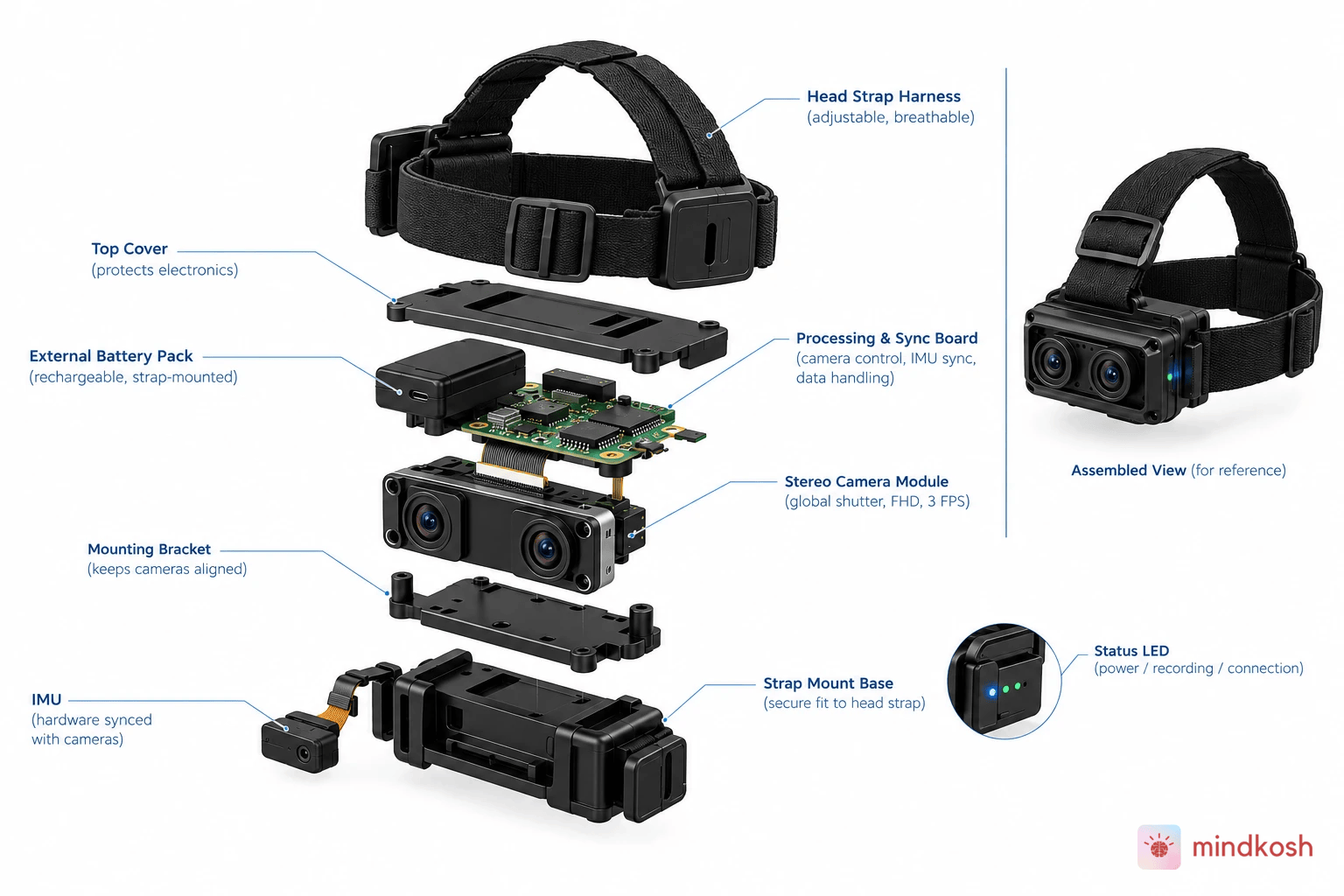
The custom rig breaks down into a small number of purpose-built parts:
- An adjustable, breathable head strap that holds the unit in place
- A stereo camera module, built with global shutter sensors, mounted so both cameras stay aligned
- An IMU wired to sync with the cameras at the hardware level
- A processing and sync board, handling camera control, IMU syncing, and data handling in one place
- A rechargeable external battery pack
- A status LED showing power, recording, and connection state at a glance
It ships in mono and stereo configurations, so a team can match the hardware to what a specific policy needs, without switching devices between projects.
Conclusion
Neither hardware choice is automatically the wrong one for a vendor to have built around. Phones get a project started quickly, since collectors can be onboarded fast and the gear is familiar to everyone. Custom rigs earn their cost once a project needs training-grade precision at scale, through a global shutter that avoids rolling shutter's positional error, an IMU synced to the camera in hardware rather than software, and, where the task calls for it, true stereo depth.
If you're evaluating a vendor, the device they've standardized on tells you a lot about what stage of project they're actually built for. Mindkosh's own app covers phones and other devices for teams just getting started, and its custom rig covers the rest once precision at scale becomes the goal.
FAQ
Do all phones have IMU?
Most modern smartphones do. An accelerometer has been standard for well over a decade, and a gyroscope has been standard on flagship phones, including iPhones, since around 2010.
How much does an IMU device cost?
Standalone IMU modules for hobbyist or robotics use can cost anywhere from a few dollars to a few hundred, depending on precision. For egocentric data collection specifically, cost usually isn't about the IMU chip itself. It's about the camera, shutter type, and mounting hardware built around it, and those are usually supplied by the data collection provider rather than bought separately.
What is an IMU vs an accelerometer?
An accelerometer measures acceleration and motion along an axis. An IMU is the broader sensor package, typically an accelerometer combined with a gyroscope (and sometimes a magnetometer), that together track both motion and orientation.
Can a smartphone be used for egocentric data collection?
Yes. Most iPhones already have the camera, accelerometer, and gyroscope needed. The tradeoff is a rolling shutter and software-level IMU sync, both of which custom rigs are built to avoid.
What is the difference between global and rolling shutter?
A rolling shutter scans a frame line by line, which can cause wobble during fast motion. A global shutter captures the whole frame at once, keeping motion sharp. A fuller breakdown of this, including the frame rate, cost, and precision tradeoffs, is covered above and gets its own dedicated post later.
Want the basics on egocentric capture before comparing hardware? Start with Egocentric Data Collection: A Beginner's Guide →