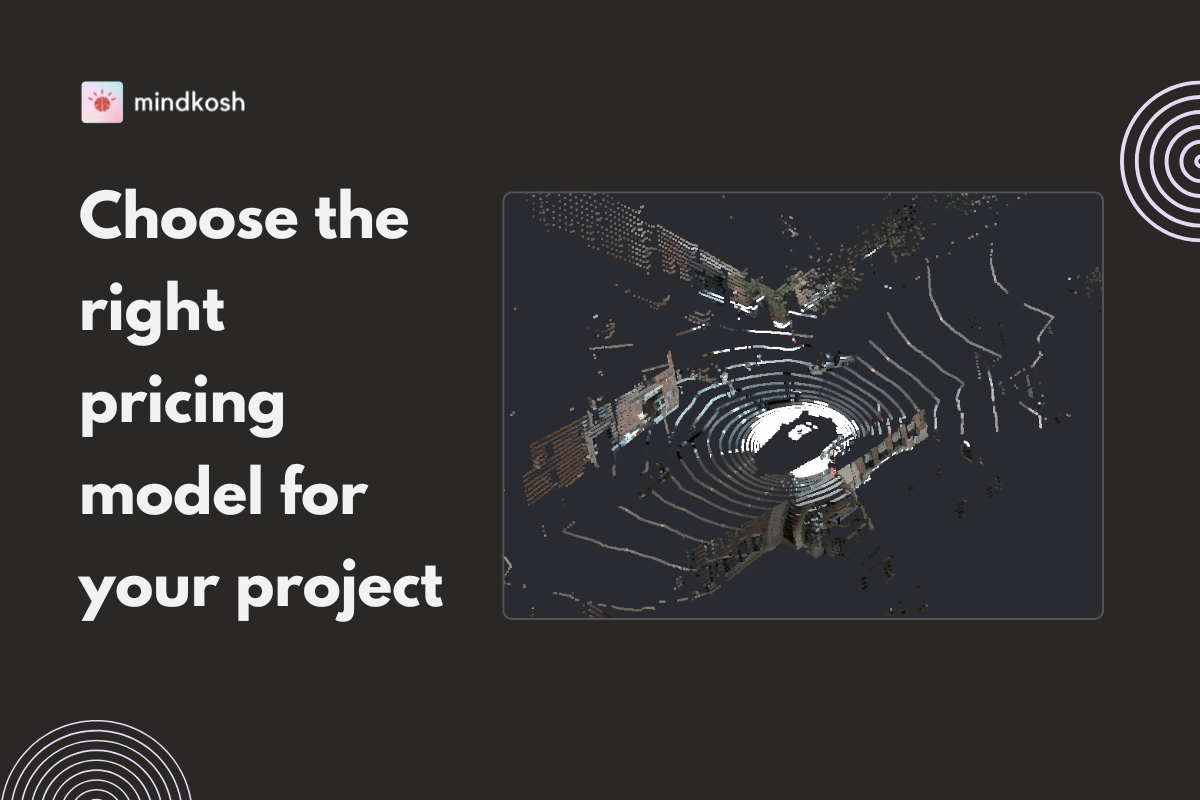



What is egocentric data collection?
Egocentric data collection is the process of capturing video, audio, and sensor data from a first-person point of view, usually through a wearable device like a head-mounted camera, a wrist-mounted sensor, smart glasses, or even an iPhone on a head strap, to train AI and robotics systems on how tasks look and feel from the perspective of the person or robot doing them.
Unlike text or image datasets that can be scraped from the internet, egocentric data has no such shortcut. It has to be captured in the physical world, from real objects, real surfaces, and real operating conditions, which is part of why collecting it takes far more deliberate planning than most other AI training data.
Where is egocentric data collection used?
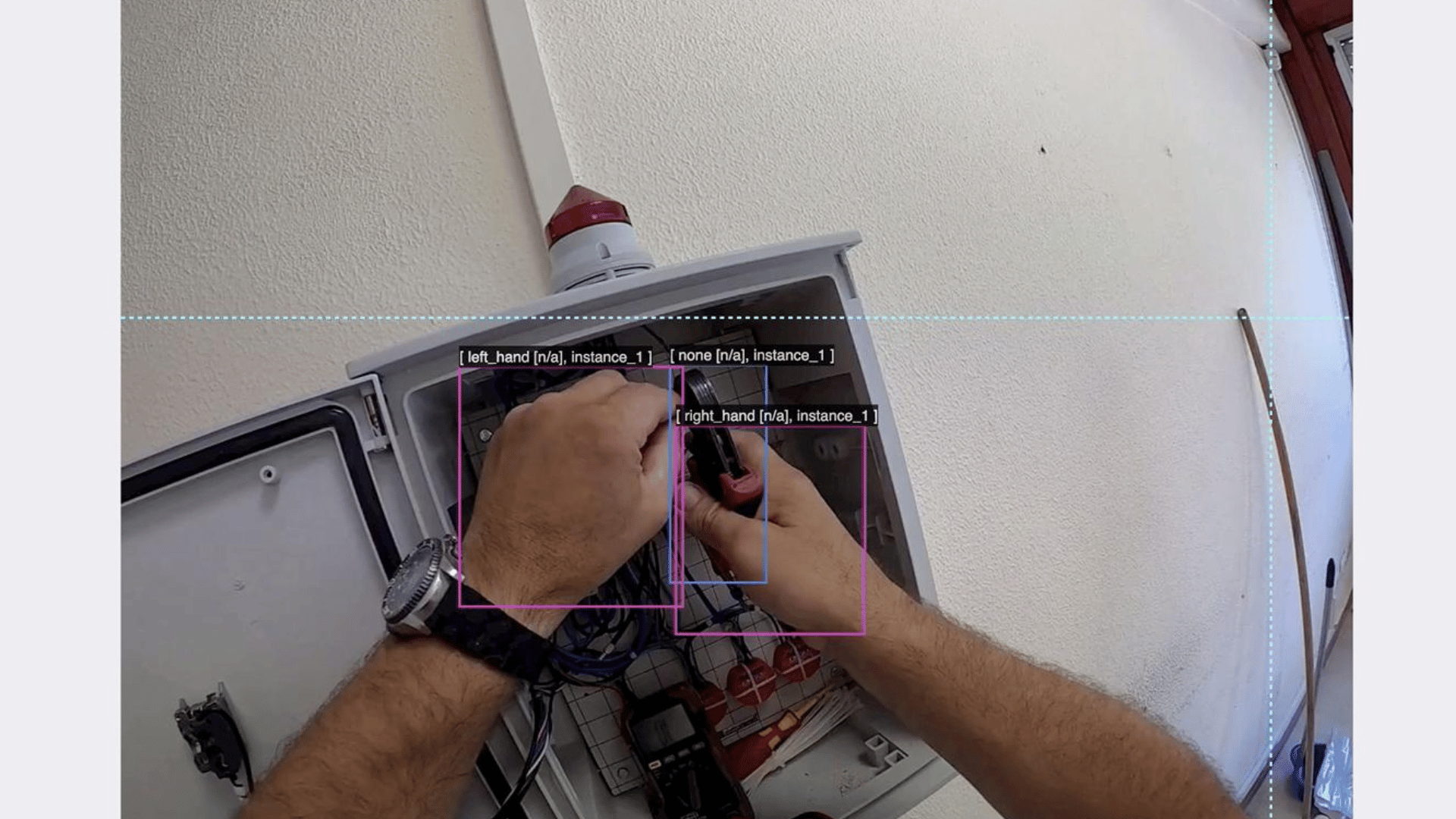
Egocentric data collection is most common in robotics and physical AI training, where a robot learns a task by watching it unfold from a first-person viewpoint.
It also supports human activity recognition, augmented and virtual reality, and some healthcare and sports performance monitoring. Still, robotics and physical AI are use cases driving most of the current interest, since these systems need to learn how to act in the world through something called imitation learning.
How does egocentric data collection differ from traditional (third-person) data collection?
Egocentric collection captures the world from inside the action, such as a hand reaching for a tool or a head turning toward a doorway, while traditional (exocentric, or third-person) collection captures it from an outside observer's viewpoint, like a fixed security camera watching a room.
Who performs the task matters too. Egocentric data can be recorded by a person doing the task, or by a robot, usually controlled remotely by a person. Robot recordings are slow and expensive to collect. Human recordings are faster and cheaper to scale, and they show how people actually use objects and move through a task.
Recent research shows human recordings are a core training input, not just a cheaper backup:
- EgoMimic (2024) found that adding 1 hour of human data helped a robot more than adding 1 hour of robot data. The human data was recorded with Meta's Project Aria glasses.
- EgoDex (Apple, 2025) recorded 829 hours of egocentric video across 194 tabletop tasks, from tying shoelaces to folding laundry. It used Apple Vision Pro to track hands and fingers.
- EgoScale (NVIDIA, 2026) trained a robot model on over 20,000 hours of human egocentric video. The more human video it used, the better the robot got. The average success rate of a highly dexterous robot hand went up 54% compared to a robot trained without it.
- Ego2Robot (2026) turned about 1,940 hours of human egocentric video into 18,561 hours of robot training data by swapping the human arm in each clip for a robot arm across 15 different robot types.
The question is no longer whether human egocentric data helps robots learn, but how much you need and how good it has to be.
4 categories of data collection methods
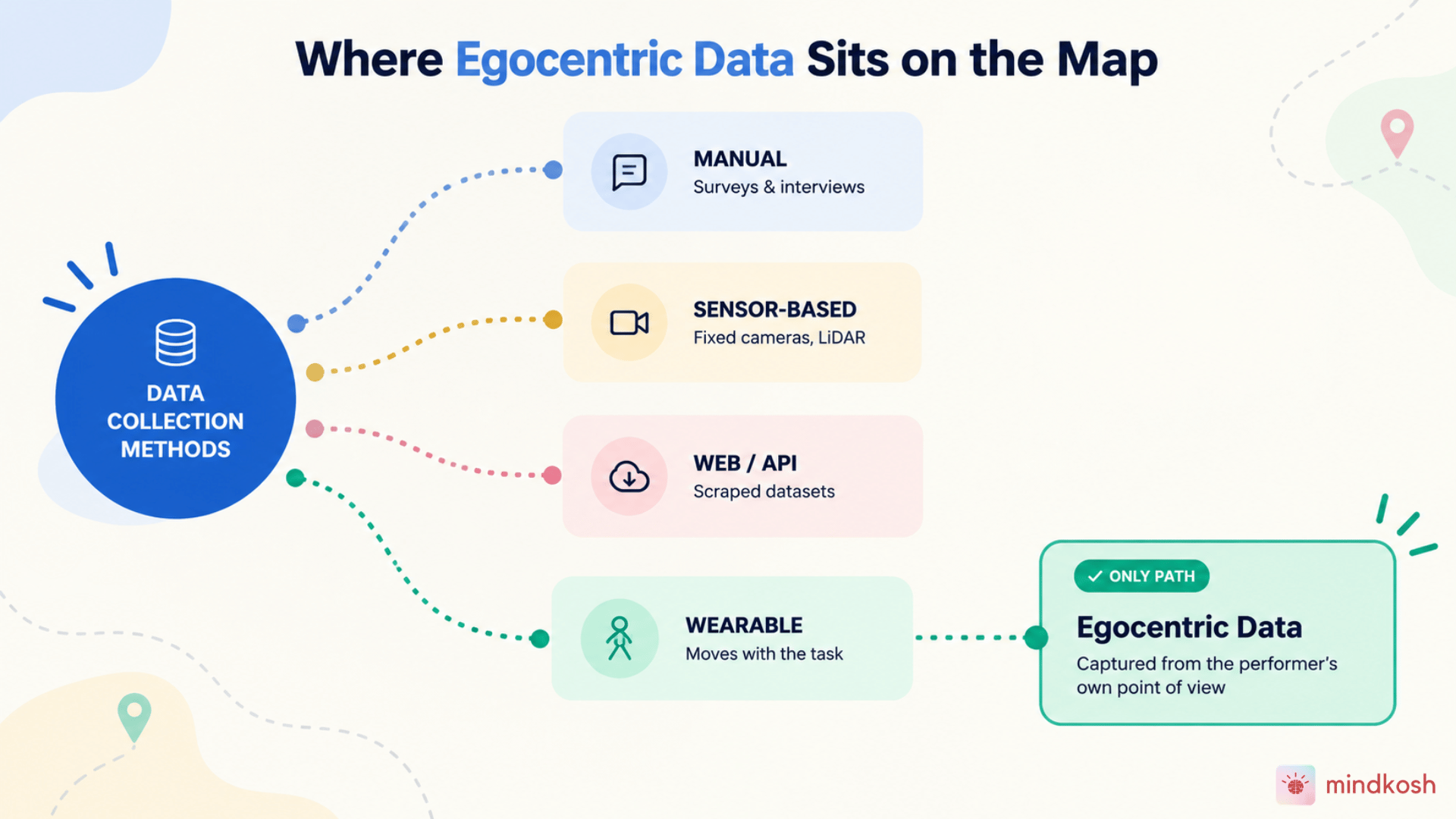
Data collection methods generally fall into four broad categories, and egocentric data sits inside just one of them:
- Manual collection: Data gathered directly from people through surveys, interviews, or direct observation. This is the slowest method and depends on a person recording or reporting what happened.
- Sensor-based collection: Data captured by cameras, LiDAR, or IMUs that stay fixed to an environment or a device, such as a security camera mounted on a wall or a sensor built into a factory line. The sensor observes the action, but it does not move with it.
- Web or API-based collection: Data scraped or pulled from existing digital sources, like websites, public datasets, or third-party APIs. This is how most large text and image datasets are built, and it is also why this method cannot produce egocentric data. There is no physical task happening for a scraper to capture.
- Wearable or first-person collection: Data captured by a sensor that moves with the person or robot doing the task, rather than staying fixed to a location. This is where egocentric data lives, and it is the only category of the four built specifically to capture a task from the perspective of whoever, or whatever, is performing it.
The practical difference is that exocentric footage shows what an action looks like from outside, and egocentric footage shows what an action looks like to the one performing it, including hand-eye coordination, viewpoint changes, and occlusion as objects come close to the camera.
For any system meant to act in the world rather than just recognize it from a distance, that first-person perspective is often the harder-to-get and more valuable data.
What hardware and methods are used to collect egocentric data?
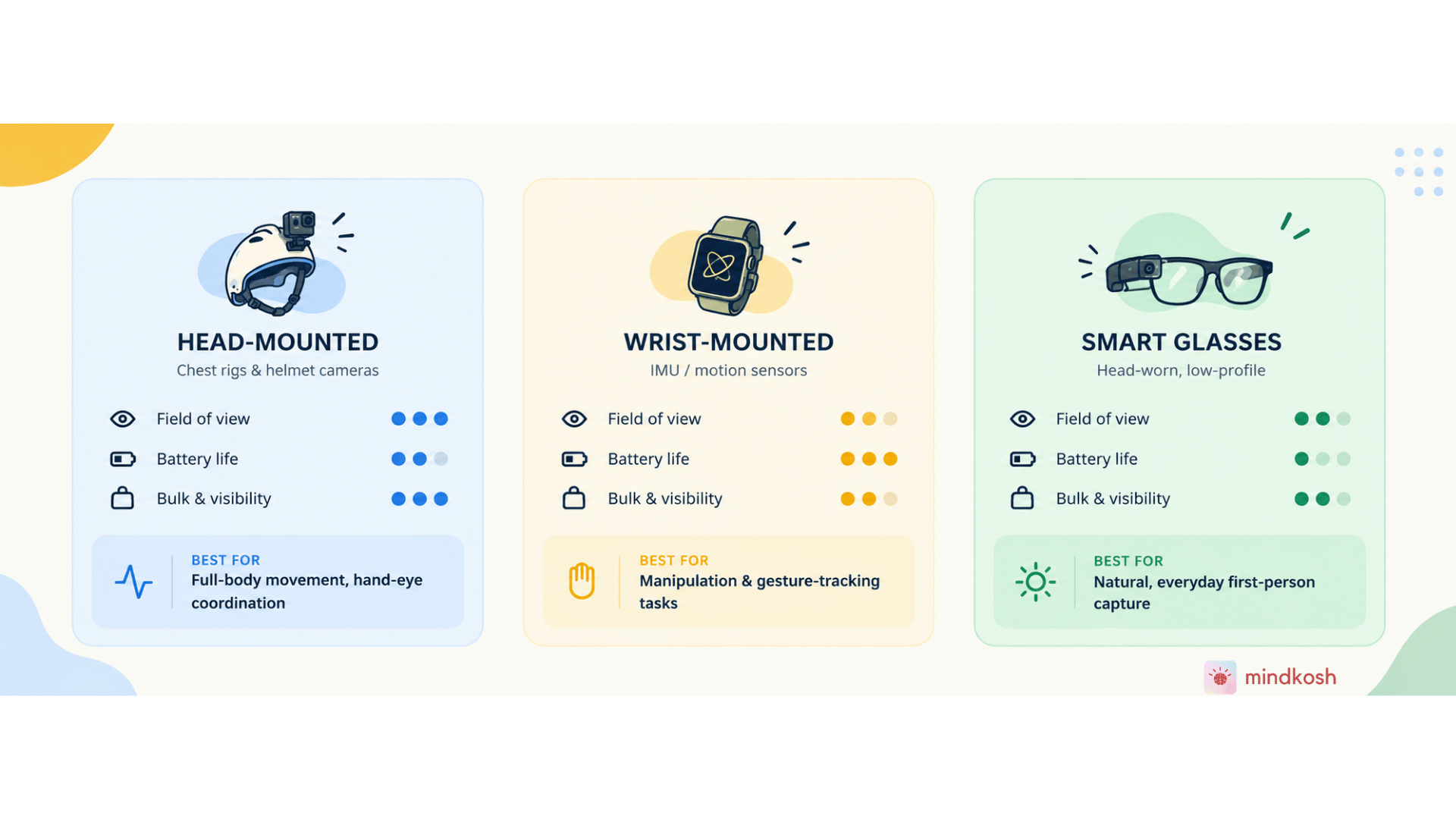
Egocentric data is usually collected with a device worn on the head, chest, or wrist. The most common options are head-mounted cameras, wrist-mounted sensors, and smart glasses, and each suits different tasks and different levels of intrusiveness.
- Head-mounted cameras, including chest rigs and helmet-mounted cameras, capture the widest and most natural approximation of human gaze. They are the standard choice for tasks involving full-body movement or hand-eye coordination, like assembly work or navigation. They also tend to be bulkier and more visible to the wearer and to people nearby.
- Wrist-mounted sensors, often paired with IMUs (inertial measurement units) rather than cameras alone, are lighter and less intrusive. They are a common choice when the goal is capturing motion and force rather than a full visual scene, such as in manipulation or gesture-tracking tasks.
- Smart glasses sit between the two. They sit closer to natural head position than a chest rig and are less visually awkward for the wearer, but they are generally limited in field of view and battery life compared to dedicated head rigs.
The right choice depends on what the downstream model needs to learn. Visual scene understanding calls for a camera-based rig, and motion or force data can often be captured more cheaply with wrist sensors alone.
iPhones vs. purpose-built capture devices
Most teams record with one of two options: an iPhone on a head strap, or a device built just for egocentric capture.
iPhones are easy to find and easy to mount, and the iPhone 11 is a common choice. It records video and uses Apple's ARKit to track where the head is and which way it faces. But iPhones have real downsides:
- Cost: iPhones are expensive, especially in markets like India, where even an iPhone 11 costs around ₹40,000. That adds up fast across a large recording team.
- Timing: The camera and motion sensor (IMU) don't run on the same clock, so sensor readings don't line up exactly with video frames. Phones have shown gaps of up to 30 milliseconds between the two.
- No depth: The iPhone 11 has no LiDAR, so it can't measure distance.
- Narrow view: The camera sees less than a wide-angle rig, so hands can slip out of frame.
Purpose-built devices solve most of this. They can be manufactured for less than an iPhone, which makes them cheaper to roll out at scale. They come with one camera (mono) or two (stereo), and every camera and sensor runs on one shared clock. Every frame and reading gets an exact timestamp, accurate to a millisecond or less. This matters most with two cameras: depth comes from comparing both images, so even a tiny timing gap gives wrong depth. These devices also use wider lenses to keep hands in view.
For most robot training work, that makes a purpose-built device the better choice on both cost and data quality.
From hardware to a finished dataset
Choosing a device is only the first decision. What gets recorded and how a session is run matters just as much.
Egocentric is a viewpoint, not a single type of data. Within that first-person view, a session can capture several kinds of data, each measuring something different:
- Vision: RGB video (standard color footage) shows objects, tools, and how the task progresses. Stereo video from two side-by-side cameras and depth maps (RGB-D), add distance and 3D shape.
- Point clouds and LiDAR: Sets of 3D points that capture the shape of the space, useful for mapping and spotting obstacles.
- IMU (inertial measurement unit): A small sensor package, usually an accelerometer and a gyroscope, sometimes with a magnetometer, that measures movement, rotation, and gravity. It works a bit like the inner ear, telling the model how the head or wrist is moving even when the camera view is blurred or blocked.
- Proprioceptive data: The robot's sense of its own body, such as joint positions, gripper opening, and where its hand is. This comes from robot-performed recordings. For human recordings, hand and body pose tracking plays a similar role.
- Touch and force data: Grip pressure, contact, and force-torque readings. These confirm what video can only suggest, like whether an object was actually grasped or slipped.
- Annotations and context: Task labels, language instructions, whether the task succeeded, and details like object weight or location, added during collection or later during annotation.
It also helps to record where each signal came from: measured by a sensor, calculated by an algorithm, labeled by a person, or generated in simulation. Only measured data is ground truth.
There is no default shopping list. The right mix depends on what the model needs to learn and the robot it will run on. Some projects only need video, and others need depth or point clouds on top. More sensors are not automatically better, since each one adds hardware, calibration, sync, storage, and privacy review work.
Whatever the mix, every stream has to line up on one shared timeline. Sensors record at different rates, so video might run at 30 frames per second while the IMU logs hundreds of readings per second. A model trying to learn "when the hand applies force" is only as good as how precisely each reading's timestamp matches the right video frame. That is exactly where phones fall short and hardware-synced devices earn their cost.
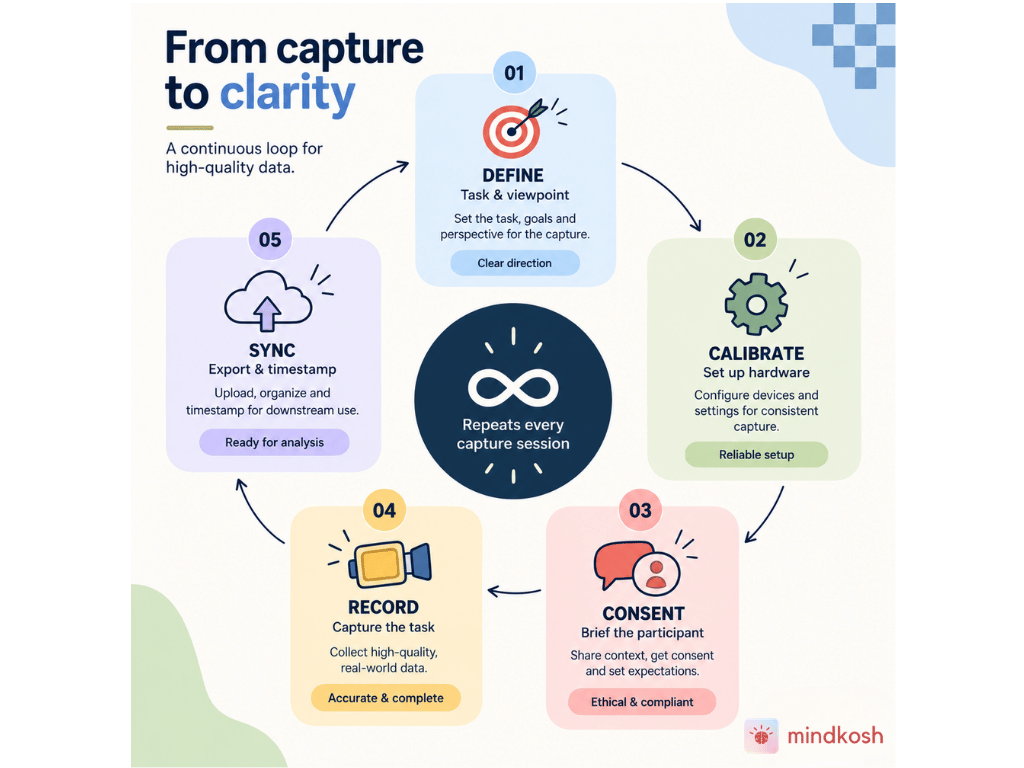
A typical egocentric collection workflow runs in five stages:
- Define the task, viewpoint, and data streams. Decide what the model needs to learn, which perspective shows it clearly, and which signals (video, depth, IMU, force) are actually needed.
- Select, calibrate, and sync hardware. Choose the device, calibrate it (lens settings, where each sensor sits, and timing offsets), and confirm every stream runs on one shared clock.
- Brief and consent the participant. Explain what is being recorded and get informed consent before the session begins.
- Record the task performance. Capture the task across multiple participants and conditions, not just one clean run.
- Export and timestamp-sync the footage. Prepare the raw files so every stream lines up correctly before the data moves to review and annotation.
Calibration has to happen before every session, not just once when the hardware is set up, since head-mounted rigs shift position between wearers and even between sessions with the same wearer.
What goes wrong in egocentric data collection?
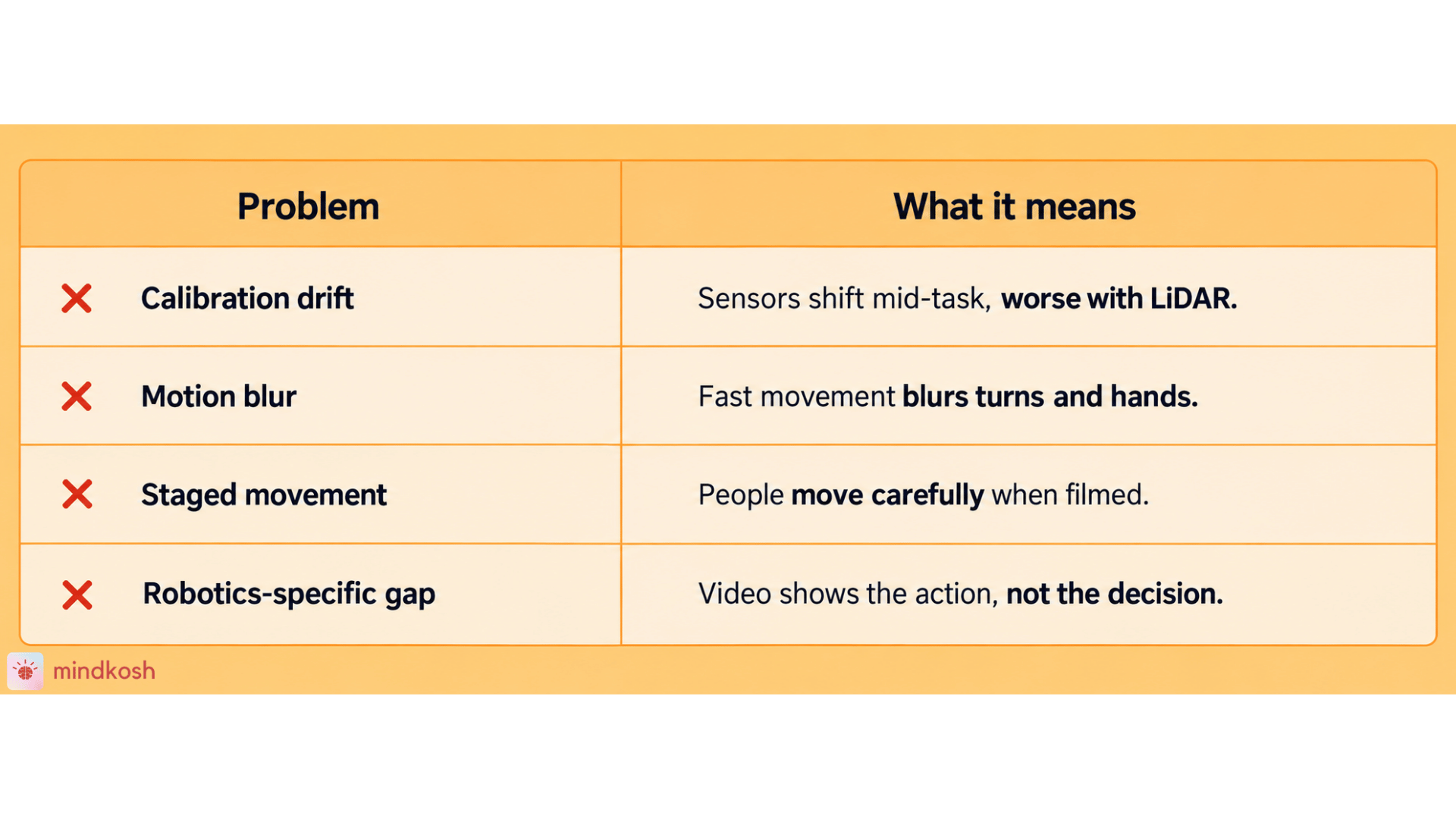
Not every recording makes it into a training dataset. Here is what actually gets clips rejected, based on a real breakdown of about 2,700 rejected egocentric clips (77 hours of footage):
- Hands not in frame (45%): The biggest reason by far. If the model can't see the hands, it can't learn the task.
- Task not useful (34%): The clip doesn't show a meaningful task, shows the wrong task, or shows a task that isn't allowed.
- Inappropriate content (9%): NSFW, violent, or illegal activity in the shot.
- People or details that shouldn't be recorded (6.5%): Children in frame, or personal details like faces and documents.
- Recording problems (5%): Clips that are too short, dropped frames, bad lighting, or a blurry lens.
- Device use (under 1%): The wearer using a device during the task.
A clip can be rejected for more than one reason. The surprising part is that camera quality is rarely the problem. Blur and bad lighting barely show up. Most clips are rejected because of what was recorded, not how. That is why clear instructions for the people recording, plus an automated QA check that catches these issues early, save more footage than better hardware alone.
Some teams try to sidestep these problems with synthetic or simulated data instead of real capture. That brings a different cost, known as the sim-to-real gap. A robot trained mostly on simulated footage often performs worse once deployed in a real facility, since simulated physics and lighting only approximate the real world.
One industry estimate, from Encord and reported by TechCrunch, put dense, hand-annotated task data at roughly twenty times the cost of lower-quality egocentric video, but worth closer to a hundred times as much for the tasks it targets. That is a company estimate, not a peer-reviewed study, but it matches a pattern seen often in physical AI: a smaller amount of carefully collected, well-annotated real data usually beats a much larger pile of noisy or simulated data.
Despite all of this, egocentric collection is still worth the effort. It remains one of the few practical ways to capture how a task genuinely unfolds in physical space, and no synthetic shortcut fully replaces it yet. These issues often mirror common production failures in multimodal annotation, and they are a big part of why higher-quality annotation is worth the added cost.
What are the legal requirements for collecting egocentric data?
Egocentric footage almost always contains personal data. Under laws like the EU's GDPR and India's DPDP Act, that means you need consent from the people being recorded, and it has to be given the right way.
What that looks like in practice:
- Tell people upfront. Before recording starts, the person must know what is being recorded, why, and how it will be used. GDPR also requires telling them who will receive the data and how long it will be kept.
- Include the buyer. If the footage will be sold or licensed, the person needs to know that, and what the buyer will do with it. Consent only covers the purposes they agreed to.
- Make consent real. Under the DPDP Act, consent has to be free, specific, informed, and given through a clear action. Both laws let people withdraw consent at any time, and withdrawing has to be as easy as giving it.
- Take extra care with children. The DPDP Act treats anyone under 18 as a child and requires verifiable consent from a parent. Children require particular care under GDPR too. An identifiable child's image can constitute personal data. Simply blurring a child's face may also not be sufficient if the child remains identifiable through other information. For this reason, data-collection projects may adopt stricter policies, which is why "children in frame" is a common rejection reason.
- Remember bystanders. A head-mounted camera records everyone nearby, not just the wearer, and those people often can't tell they are being filmed. Under GDPR, any image that can identify someone counts as personal data.
That last point is where PII (personally identifiable information) removal comes in. Consent decides what is allowed to be recorded. PII removal is the work of finding and blurring faces, documents, screens, and other identifying details once the footage exists. Once no one in the footage can be identified, it generally falls outside GDPR's scope.
India's DPDP Act is being rolled out in phases, with most obligations, including consent, taking full effect in May 2027. Teams collecting data now are better off building these steps in from the start than fixing them later.
Doing this by hand across thousands of hours of footage doesn't scale. That is why Mindkosh builds automatic PII removal into its workflow, so identifying details are handled as part of the pipeline instead of ad hoc. This kind of careful handling is also the foundation of human-aware physical AI. Before choosing a partner, it helps to look at the operational metrics that show whether a vendor can scale.
This is a general overview, not legal advice. Check the rules that apply where you collect data.

If you are just starting to collect egocentric data
If you are an ops leader or AI team about to scope your first egocentric data collection project, the highest-leverage first move is not buying capture hardware. It is deciding your consent language and your annotation pipeline, including how PII will be handled, before you record a single session.
Teams that treat these as afterthoughts end up re-shooting sessions or re-processing footage once they realize their calibration, consent, or privacy handling will not hold up at scale. Deciding this upfront costs a day of planning. Fixing it after the fact costs the whole dataset. It also helps to walk through the right questions to ask before you commit to a vendor.
Conclusion
Egocentric data collection is a specific, first-person approach to capturing how tasks actually unfold, and it is the approach driving most current progress in robotics and physical AI. It differs from traditional third-person collection in what it can show a model, from hand-eye coordination to occlusion, and it depends on getting hardware, calibration, and consent right before recording starts.
Research like EgoMimic, EgoScale, and Ego2Robot shows that human egocentric footage is now a core input for training robots. The common reasons footage gets rejected, from hands out of frame to missing consent, are avoidable with the right planning rather than inevitable. None of this replaces annotation. It sets annotation up to succeed, which is the connection worth understanding before you scope your first project.
FAQ
What is egocentric data, and what does egocentric data mean?
Egocentric data is data captured from a first-person point of view, typically through a device worn by a person, such as a head-mounted camera, smart glasses, or a head-strapped iPhone, or a camera mounted on a robot. It often includes more than video, such as depth, IMU motion readings, and hand or head pose. It records what the wearer sees and does, rather than observing them from an external viewpoint.
What is an egocentric video?
An egocentric video is footage recorded from a first-person perspective, usually through a head-mounted or body-worn camera, showing the scene as the wearer experiences it rather than as an outside observer would see it. For robot training, the wearer's hands need to stay in frame for as much of the recording as possible, since hand and object contact is what the model is trying to learn.
What is egocentric video data?
Egocentric video data is the full package that comes out of a recording session: the first-person footage, plus the data recorded alongside it, like IMU readings, head pose, depth, and timestamps, and any labels added later. It is what gets used to train or evaluate AI models, and it is only usable if every stream lines up on the same timeline.
What are the four main types of data collection?
Data collection methods generally fall into four categories: manual collection through surveys, interviews, or observation; sensor-based collection using fixed cameras, LiDAR, or IMUs; web or API-based collection that scrapes or pulls existing digital data; and wearable or first-person collection, which includes egocentric data.
Can AI collect your data?
Yes, but AI supports the process rather than replacing the people being recorded. Some capture devices now run AI during recording, for example checking whether the wearer's hands are in frame so problems can be fixed in seconds instead of being found later in review. After recording, AI tools help with quality checks and with detecting faces or other identifiable details for removal. The recording itself still needs human participants and informed consent.
How do you collect data from video?
Video-based data collection involves recording footage with the appropriate hardware, syncing and timestamping it, then extracting the relevant frames, objects, or events, either manually or with AI-assisted tools, before the footage moves into annotation and model training.