

Egocentric data collection has become the backbone of training physical AI and robotics models, and most teams running it are focused on getting hours of footage in the door. But hours alone don’t make a usable dataset. What determines whether a collection project actually succeeds is what you track along the way, from the moment footage is captured to the moment a collector gets paid.
What should you actually track during egocentric data collection?
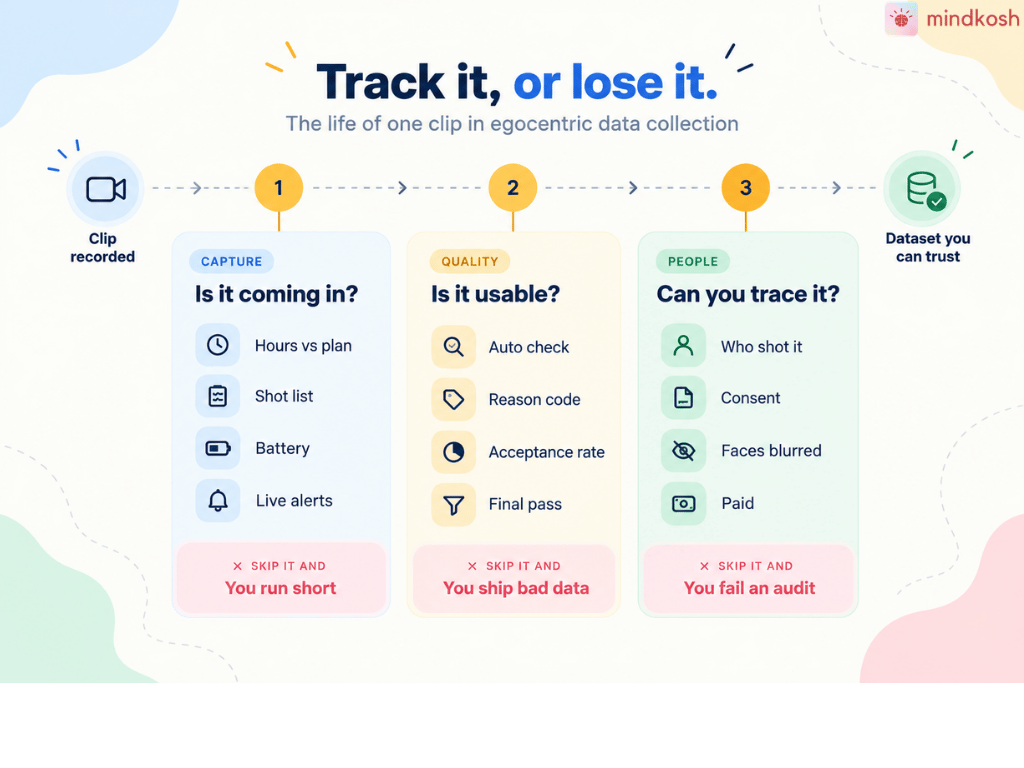
Three things: how much usable footage you're actually getting, whether it meets your quality bar, and whether every collector involved is accounted for, consented, and paid. Miss any one of these and a collection project either runs over budget, ships unusable data, or creates a compliance problem you discover too late to fix cheaply.
Egocentric data collection is rarely a single afternoon of recording. Most projects run for weeks, involve a dozen or more collectors, and touch multiple locations. Without a tracking system, nobody notices that one collector's footage is consistently unusable, or that a recording batch was never re-consented after a scope change, until the dataset is already late.
Where this actually matters: training physical AI and robotics models
The reason tracking discipline matters so much here is what the data is for. Egocentric footage is the primary training signal for physical AI and robotics systems that need to learn how a human hand approaches an object, how a body moves through a cluttered space, or how a task unfolds step by step from a first-person view. A robot arm learning to pack a box, or a home robot learning to load a dishwasher, is only as good as the demonstrations it was trained on. If a third of those demonstrations are unusable because nobody caught a calibration drift or a missing consent form, the model trains on a smaller, possibly biased slice of the data you thought you had. Tracking isn't paperwork. It's the thing that tells you, before training starts, whether your dataset is actually what you think it is.
1. Tracking capture progress
The first layer of tracking is the most basic: are collectors actually capturing what the project needs, and how much is coming in.
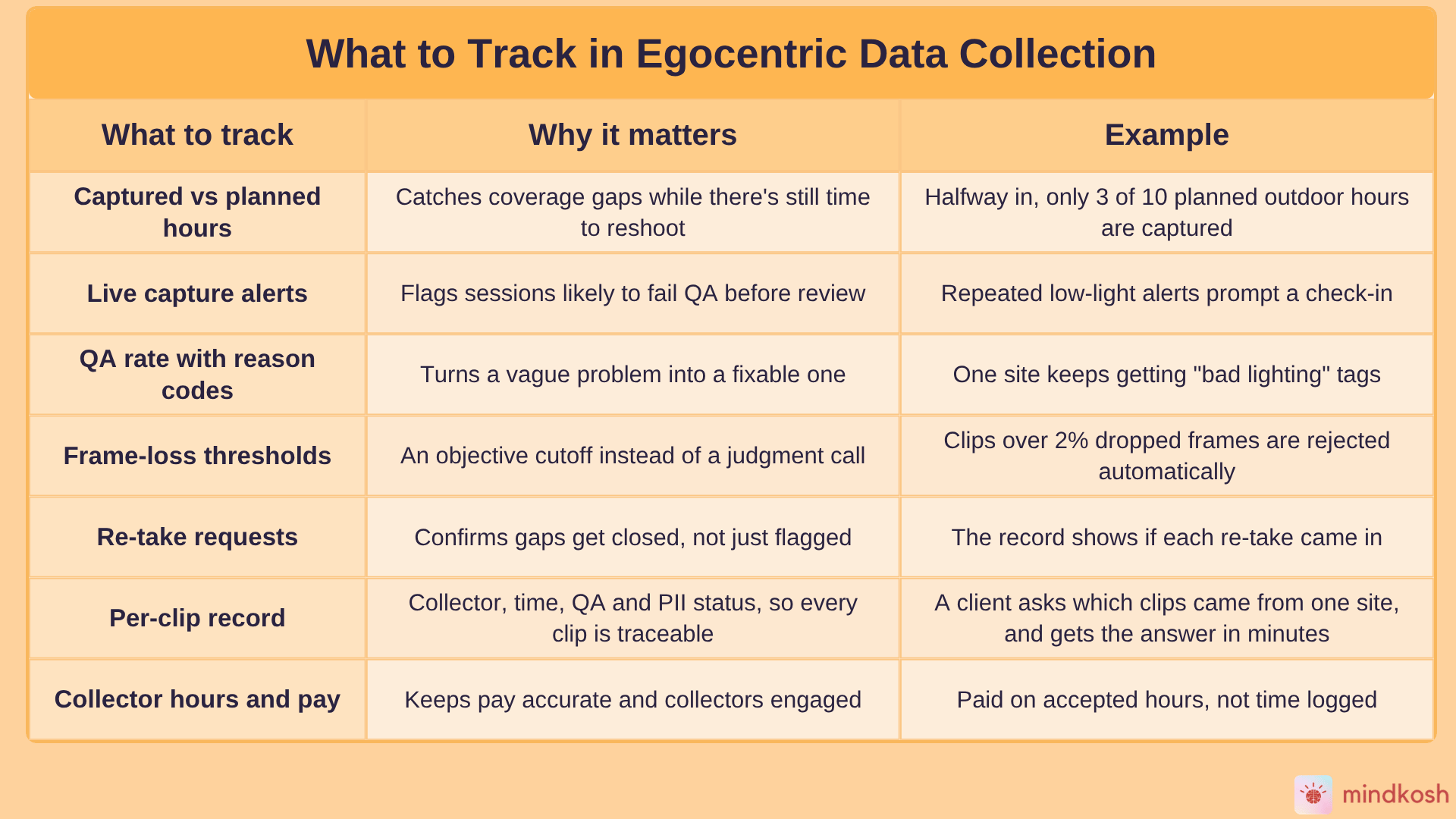
For most projects this means tracking, per collector and per session: hours or clips recorded, scenes or tasks covered against the project's shot list, device battery and storage status during the session, and any real-time capture alerts (low light, a static scene with no motion, long recording warnings) that fired during the session. Projects that skip this layer usually find out they're short on a specific scenario, say, left-handed grasps, or outdoor lighting, only after the collection window has closed and it's too late to send anyone back out.
A simple progress dashboard, even a shared spreadsheet, that shows planned hours versus captured hours per scenario catches this early enough to actually fix it.
2. Tracking quality and cleanup
Capturing footage is necessary but not sufficient. The second layer is whether what came in is actually usable, and this is where most collection budgets quietly leak.
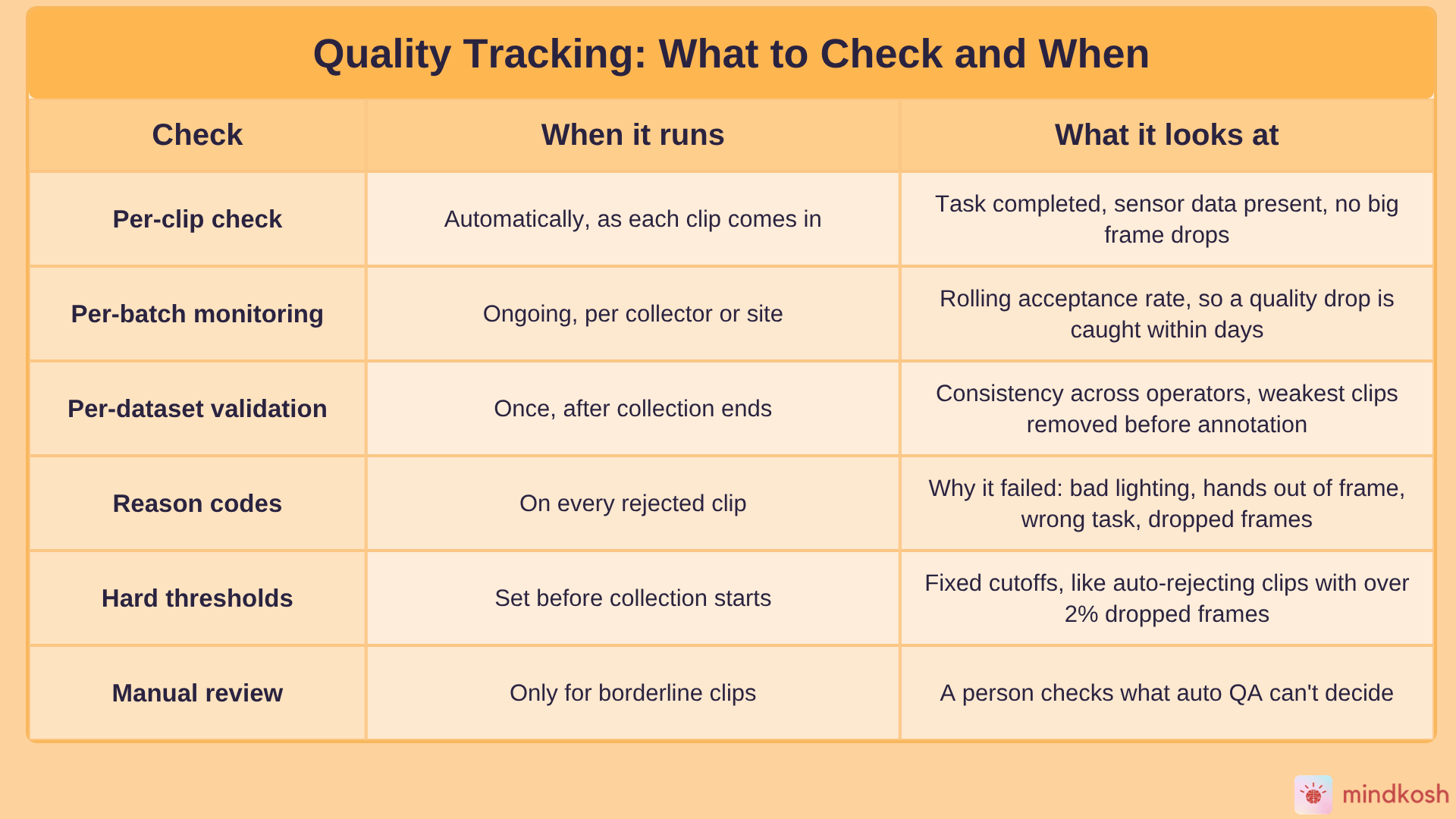
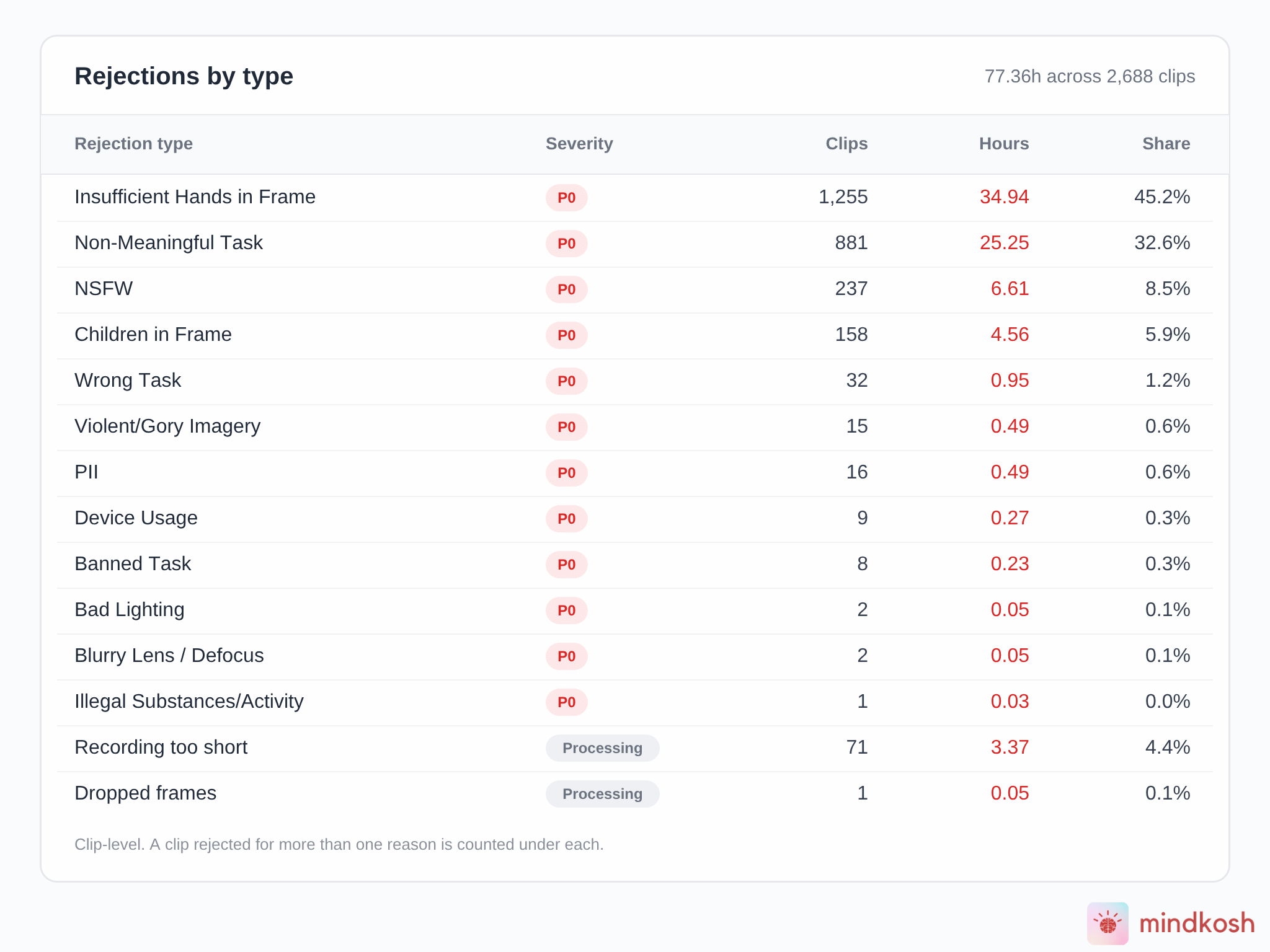
Track, at minimum: the pass or fail rate of auto-QA or manual review against the project's acceptance criteria, the reason code for every rejected clip (blur, occlusion, wrong task, calibration drift, missing audio if relevant), and whether a re-take was requested and whether it was completed. Without reason codes specifically, a team can see that 20 percent of footage failed QA without ever learning why, which means the same mistake keeps getting made by the same collectors or in the same conditions.
The Aria Everyday Activities dataset from Meta's Project Aria research team is a useful real-world reference here. According to the project's own documentation, every recording went through manual inspection of its motion trajectories and point clouds, and face and license-plate blurring was verified across multiple separate rounds of quality analysis before any recording was accepted into the dataset. Recordings that failed those checks were excluded outright, not patched or kept with a caveat. That's the standard worth aiming for: a clip either meets the bar after documented review, or it's dropped before it ever reaches annotation.
3. Tracking collectors, consent, and rewards
The third layer is about the people doing the collecting, and it's the one that's easiest to let slide because it doesn't show up in the footage itself.
Data provenance
Every clip needs a record of who captured it, when, where, and under what consent terms. This matters for two reasons. First, if a quality issue turns up later, provenance is how you trace it back to a specific collector, device, or site instead of guessing. Second, if a participant later asks what happened to their data, or a client asks for an audit trail, provenance is the only honest answer you can give.
Ego4D, the large-scale egocentric video dataset built across university and industry partners, is a good illustration of scale here. The project's own paper reports 3,670 hours of footage from 931 unique camera wearers across 74 locations in 9 countries, all collected under consent with de-identification procedures applied where needed. A project at that scale is unrecoverable without a provenance record tying every clip back to a consenting, identifiable (internally, not publicly) collector and session.
Collector payment
Collectors are typically contracted by the data collection provider rather than self-sourced, and tracking what's owed to each one is its own small operation: hours or clips completed, any quality bonus or penalty tied to acceptance rate, and payment status. This doesn't need to be complicated, but it does need to exist as a system rather than a memory. A collector who isn't paid accurately and on time is a collector who stops showing up, or stops caring about quality, on the next project.
The honest tradeoff: this is overhead, and it's worth it
None of this tracking is free. It adds coordination work, usually a dedicated person or tool, and it can feel like friction on a project where the instinct is to just get people capturing footage as fast as possible. Smaller teams in particular sometimes skip formal tracking because it looks like it's slowing things down.
But the cost of not tracking shows up later, and it's larger. A dataset with no reason codes for rejected clips means the same quality problem repeats across the whole collection window instead of getting caught after session one. A dataset with no provenance record can't survive an audit, a compliance question, or a participant's data request. A dataset with no payment tracking loses collectors mid-project, which is far more expensive than the tracking overhead ever was. The teams that track well aren't moving slower. They're the ones who don't have to redo a collection run three months later because nobody can explain where a third of the footage came from.
How to apply this if you're scoping your first collection project
If you're setting up tracking for the first time, don't try to build all three layers at once. Start with reason codes on QA rejections. That single habit, tagging every rejected clip with why it failed rather than just pass or fail, gives you the fastest, cheapest signal into whether your collection process is actually working, and it's the one piece of tracking that pays for itself within the first week of a project.
How Mindkosh tracks an egocentric data collection project
This is the one place Mindkosh is relevant to this piece, because tracking is a large part of what the Mindkosh pipeline is actually built to do.
On the capture side, Mindkosh's guided mobile app runs on a collector's own iPhone or Android phone, so no dedicated hardware has to be issued or tracked separately. Each project gets its own configured recording checklist, so collectors know exactly what scenarios and durations are expected, and the app surfaces real-time alerts during recording for low light, a static scene, low battery, and overly long recordings, catching problems while a collector can still fix them instead of after the footage is already in.
On the quality side, every clip goes through automatic QA against the project's own acceptance criteria as it's ingested, with any flagged clip tagged with a reason for review and, where needed, routed back for a re-take. PII such as faces is automatically redacted on ingest, and the dataset stays searchable through semantic cataloging, so a specific scenario or location can be found across a large collection run instead of scrolled through manually.
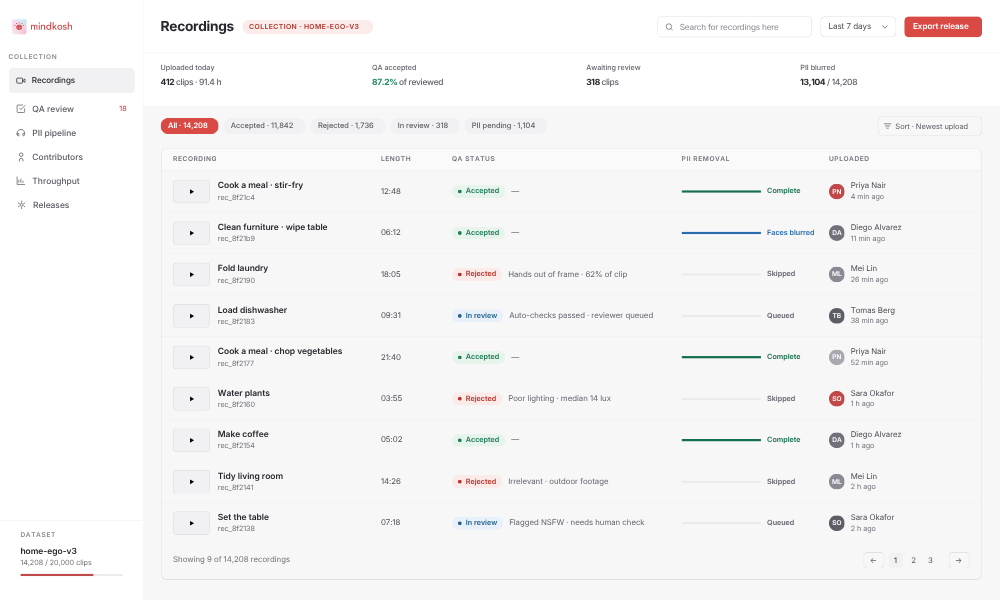
Mindkosh doesn't run on-ground collection teams itself, but this layer of tracking makes it straightforward for the team that does to calculate exactly what each collector has delivered and what they're owed, since acceptance status and hours are already recorded per clip rather than reconstructed after the fact. For teams that need hardware instead of a phone, Mindkosh also offers custom-built egocentric capture rigs, in mono or stereo configurations with global shutter sensors and hardware-synced IMU.
Conclusion
Egocentric data collection succeeds or fails on tracking discipline more than on any single piece of hardware. A project that tracks capture progress knows where its gaps are before the window closes. A project that tracks quality with reason codes fixes the same mistake once instead of twenty times. And a project that tracks provenance and collector payment can actually answer for its own dataset months later, when someone asks where a clip came from or whether a collector was paid fairly. None of this replaces good equipment or well-briefed collectors. It's what makes sure their work actually turns into a dataset worth training on.
FAQ
What's the difference between tracking capture progress and tracking quality?
Capture progress tells you whether footage is coming in at all, measured against a shot list or hours target. Quality tracking tells you whether that footage is actually usable, measured against acceptance criteria. A project can be fully on schedule for capture and still fail badly on quality if the two aren't tracked separately.
Why do rejected clips need a reason code instead of just a pass or fail mark?
A plain fail rate tells you that something is wrong. A reason code tells you what, whether it's blur, occlusion, calibration drift, or a wrong task, which is the only way to actually fix the root cause instead of just re-shooting and hoping.
Do collectors usually provide their own recording devices?
Not typically. In most managed collection setups, the data collection provider supplies or configures the capture method, whether that's a guided app on a phone or dedicated hardware, rather than relying on each collector's personal device.
Does tracking collector data mean the platform handles payouts directly?
Not necessarily. Good tracking records what each collector delivered, their acceptance rate, and their hours, which makes calculating payouts far easier and more accurate. Who actually issues the payment is usually a separate function handled by the collection team or provider.
How much footage from a typical collection project ends up unusable?
It varies widely by project and quality bar, but it's rarely zero. The Aria Everyday Activities dataset documentation notes that recordings failing quality checks, including trajectory and de-identification review, were excluded outright rather than kept with caveats, which is a useful reminder that some loss is normal and tracking is what keeps it from being silent.
See how Mindkosh tracks an egocentric data collection project →